When you click on links to various merchants on this site and make a purchase, this can result in this site earning a commission. Affiliate programs and affiliations include, but are not limited to, the eBay Partner Network.
I find it interesting, and annoying, that my 2026 (delivered Feb 20th ) C8 HTC (non-Z51) SR has such a high temp. thermostat. Yes, I read that keeping it near 200 is better for efficiency, understood.
What I am very interested in, is adding the capability to run cooler as I approach home or any other destination (like a fan switch). AND, the capability to cool it off when I stop. I'm awaiting having a garage built, and don't want to wait an hour to install the car-cover for fear that it will melt.
Sidenotes: I did buy some heat shielding to put under the trunk's carpeting. Also, I plan to buy a set of air scoops that force air up from the bottom.
Last edited by brucewhittakerduck; Apr 14, 2026 at 01:56 PM.
The only thing on your car that could cause heat damage to a quality car cover would be the exhaust tips touching it, and that is simple to work around.
And, if the car is hot enough when you turn it off the fan will continue to run for a few minutes.
Having a switch on the fan to activate before you get to your house would not cool it off any more than the thermostat would allow.
Plus, I'm sure having such a switch would throw a code or cause some other computer issue.
The only thing on your car that could cause heat damage to a quality car cover would be the exhaust tips touching it, and that is simple to work around.
And, if the car is hot enough when you turn it off the fan will continue to run for a few minutes.
Having a switch on the fan to activate before you get to your house would not cool it off any more than the thermostat would allow.
Plus, I'm sure having such a switch would throw a code or cause some other computer issue.
The only thing on your car that could cause heat damage to a quality car cover would be the exhaust tips touching it, and that is simple to work around.
And, if the car is hot enough when you turn it off the fan will continue to run for a few minutes.
Having a switch on the fan to activate before you get to your house would not cool it off any more than the thermostat would allow.
Plus, I'm sure having such a switch would throw a code or cause some other computer issue.
This. Don't overthink it. Unless you're tracking it hard, don't worry about it.
I can see your concern with heat rising up thru the engine bay vents, but I don't think you are close, temperature wise, to melting a cover. Maybe contacting the Cover Mfgr. and inquiring about the Temp. rating of the cover will put you at ease. Did you ever place a thermometer on the hood(?) where the engine is and check temperature? I would start there.
Oh they can get damn hot...hot enough to cause plenty of issues. However that's typically only if driven hard for a long time. C8s struggle dissipating heat then. For daily use, it's fine.
I find it interesting, and annoying, that my 2026 (delivered Feb 20th ) C8 HTC SR has such a high temp. thermostat. Yes, I read that keeping it near 200 is better for efficiency, understood.
What I am very interested in, is adding the capability to run cooler as I approach home or any other destination (like a fan switch). AND, the capability to cool it off when I stop. I'm awaiting having a garage built, and don't want to wait an hour to install the car-cover for fear that it will melt.
Sidenotes: I did buy some heat shielding to put under the trunk's carpeting. Also, I plan to buy a set of air scoops that force air up from the bottom.
Do you have a Z51 C8? Those have an extra radiator to cool the e-LSD and DCT.
I have a non-Z51 and have seen temps up to 210 and don't consider it a concern. The temp gauge range goes far higher than that. The engine cooling fan will come on sometimes after I've shut off the engine, as it is supposed to.
I find it interesting, and annoying, that my 2026 (delivered Feb 20th ) C8 HTC SR has such a high temp. thermostat. Yes, I read that keeping it near 200 is better for efficiency, understood.
What I am very interested in, is adding the capability to run cooler as I approach home or any other destination (like a fan switch). AND, the capability to cool it off when I stop. I'm awaiting having a garage built, and don't want to wait an hour to install the car-cover for fear that it will melt.
Sidenotes: I did buy some heat shielding to put under the trunk's carpeting. Also, I plan to buy a set of air scoops that force air up from the bottom.
Hmm, first I have seen a comment about the 2026 having a higher Thermostat. I have had a 2020 C8 Z51 for 4 years and now 2 years with my E-Ray and if asked would say they run cool! Typically 175 to 180 in my rural area driving. Even on 95 degrees days in NE SC. That includes some agressie accelerating BUT not exceeding triple digits. Don't know the Thermostat temp but would guess it's about 175F.
Now in town IF stuck for two red light cycles (very unusual in my area and NO bumper to bumper traffic) it might get to 190 F. But as soon as I start moving it quickly gets back to ~180F.
So I asked Google AI if the 2026 uses a different thremostat than my 2024:
I'll paraphrase the answer: Based on reports and discussions surrounding the 2026 C8 Corvette, the vehicle is designed to operate in a similar temperature range as previous C8 models, with operating temperatures often sitting between 180°F and higher when Tracking or in heavy traffic.
There is no information indicating that the 2026 model has a higher-temperature thermostat than the 2024 model as a stock feature.
So if an individual car is operating significantly different it should be checked! Or if driving in heavy or bumper to bumper traffic can understand higher temps. But on a 60 to 70 mph on a highway at 90F would expect all should be ~180F.
Now Installing a Car Cover is a Whole Other Kettle of Fish!
as little to do with the Thermostat! If I pull in the garage and shut the engine off, lots of 200+ engine blockheads to dissipate that temp!
For example some of my aggressive driving is near my home where there is a 3/4 mile long road with mostly farm fields both side, no home, people and often no other cars. Yep I may accelerate to triple digits for fun. And apply the brakes aggressively to stop at a 4 lane divided highway at the end, getting 4 large rotors very hot. When I pull into the garage the large fan on the driver's side turns on and my stay on for 5 minutes to supply cooling air to the engine compartment.
On all Stingrays and my E-Ray there is a large fan on the driver side behind the fender air scoop. . My C8 Z51 and E-Ray on the passenger side have a rad and fan that preferentially cools the DIC fluid but also blows some air into the engine compartment. Putting on a Car Cover will block that cooling air and should not be done until those fans are off. And frankly there is convection cooling thru the vents even when the fans are NOT operating. I would not put a car cover on for some time after parking.
Heck I like looking at my Vette AND my now 26 year old Street Rod parked next to it and would not think of putting a cover on either!
From: Early 2020 Z51 Coupe, Original Owner, Ahwatukee Foothills, AZ
I'm understanding that typically your running at 200 radiator temps, for that to happen in my car it would need to see slow to stop and go traffic in 95 to 115° temps. My thermostat runs between 183-187° and is usually 6 to 7° above oil temp. To burn off condensation, oil temps on the low side should be a minimum of 175 to 180°.
Regularly seeing your radiator at 200° while 50+ cruising above average for the LT2. Is it a deal breaker, probably not, but it would be for me living in the SW AZ desert.
This makes me wonder cool down time of the HTC vs coupe. And, I know the top is supposed to be put up when parked but I’m guessing the engine compartment stays hotter longer if left down or in traffic. I don’t cover my car often after driving due to dirt and possible scratches but if I do, I’ll wait for it to cool.
OP, you didn't state whether or not you have a Z51 but Z51s run cooler than non-Z51s in normal daily driving. That is why you are seeing some people report that they run cooler than 200F. 200F won't hurt anything, they are designed to run at that temperature and higher without damage. Running a fan longer wouldn't help much because your thermostat is controlling the water flow through the cooling system. If you were to change thermostats to make it run cooler you would actually cause problems because the engine is designed to operate at the higher temperature.
Do you have a Z51 C8? Those have an extra radiator to cool the e-LSD and DCT.
I have a non-Z51 and have seen temps up to 210 and don't consider it a concern. The temp gauge range goes far higher than that. The engine cooling fan will come on sometimes after I've shut off the engine, as it is supposed to.
Thanks for the reply. No, I did not order the Z51. What caught my attention was seeing heat-waves distorting my rear camera while idling for ~6 minutes in a driveway (about 70-degrees outside). No hard driving beforehand.
OP, you didn't state whether or not you have a Z51 but Z51s run cooler than non-Z51s in normal daily driving. That is why you are seeing some people report that they run cooler than 200F. 200F won't hurt anything, they are designed to run at that temperature and higher without damage. Running a fan longer wouldn't help much because your thermostat is controlling the water flow through the cooling system. If you were to change thermostats to make it run cooler you would actually cause problems because the engine is designed to operate at the higher temperature.
Thanks for the input. Non-Z51. On the freeway, I thought it would run cooler, after idling in a friend's driveway and going up to 201. When it only cooled down to ~191, I sought out the wisdom of you and others here... My first vette, I love and respect the advice so many have provided thus far.
Thanks for the input. Non-Z51. On the freeway, I thought it would run cooler, after idling in a friend's driveway and going up to 201. When it only cooled down to ~191, I sought out the wisdom of you and others here... My first vette, I love and respect the advice so many have provided thus far.
Consider in a Front engine car like my C7 Vettes. At idle with no air coming into the front rad the electric fan will come on to pull air thru the radiator to reduce coolant temp. That air will also enter the engine compartment and help move air and the heat from engine.
NO such help with a rear engine car as the front rad fans will come on to remove coolant heat BUT they provide zero air movement over the hot engine! That is what the large fan behind the driver side rear fender scoop will help do. BUT ONLY IF the engine compartment gets too hot. It's controlled by a thermostat in the engine compartment. As I said mine ONLY comes on IF I have been driving aggressively BEFORE pulling into the garage. Normally it will not come on. It typically stays on about 5 minutes with engine off if it does turn on. The C8 will actually shut off the engine (I think in 10 minutes) if you let it sit idling!
SIDEBAR
I had a similar issue with my Street Rod. The radiator is a custom deep aluminum but is limited in width/height do to the room in a '34 Ford designed for a 100 hp flathead! My street rod has an 8.2 Liter 525 hp Chevy Big Block. The engine has a 6 blade fan that pulls air thru the radiator when engine is running. i added two electric pusher fans in front. If traveling even 25 mph plenty of air flowing to keep the coolant at ~190 F without the electric fans turning on. They are activated by a temp sensor at the bottom of the rad. But when stopped idling, temp quickly raises. I even added a switch in parallel with the temp sensor to turn the electric fans on sooner if say in a line going into a Car Show. But on a hot summer day ~95F the coolant temp was approaching 220F. To restate, on that same 95F day if traveling at 25 mph where the front movement brings air into the radiator and coolant temps stayed at ~190 F.
I had to use something that was used in cars prior to emissions controls started. Found the solution in an old book re cooling hot rods. Turns out some cars had a switch that switched from Ported Vacuum to Manifold Vacuum if at idle the temperature was increasing excessively! The GM Crate motor I assembled specified to use Ported Vacuum, which is none when at idle as the port is above the Carburetor butterflies. Manifold Vacuum is high at idle. It required adjusting the idle fuel needle valves to reduce the furl going into the engine at idle to decrease idle rpm by ~300 rpm to ~900! Less fuel, less heat, cooler temp. Dropped the max temp at idle by ~10 deg F.
This is what Google Search stated when I asked the question re timing Ported versus Manifold Vacuum: Ported vacuum was used as early as the 1930s-1950s for specific carburetor tuning (e.g., Ford Flatheads, 1957 Fords), though manifold vacuum was common for performance and idle quality in the 1950s-60s. The industry-wide shift to strict ported vacuum for emissions control occurred around 1968–1970 to reduce NOX emissions.
Hard to see but there is a 6 blade coolant fan attached to the engine. There is also a tight fitting aluminum coolant shroud to help pull as much air as possible thru the rad. Those are original louvers Henry provided to help get engine heat out of the engine compartment. But much more heat come from the 8.2 Liter 525 hp Big Block than the OEM 100 hp flathead.
Note I added two Pusher Electric Fans in front of Rad to help when idling. They do not turn on if traving even 25 mph. Not needed.
I can see your concern with heat rising up thru the engine bay vents, but I don't think you are close, temperature wise, to melting a cover. Maybe contacting the Cover Mfgr. and inquiring about the Temp. rating of the cover will put you at ease. Did you ever place a thermometer on the hood(?) where the engine is and check temperature? I would start there.
Originally Posted by JerryU
.......... Putting on a Car Cover will block that cooling air and should not be done until those fans are off. And frankly there is convection cooling thru the vents even when the fans are NOT operating. I would not put a car cover on for some time after parking.......
Right! I doubt it will harm the cover, but the cover could potentially cause harm by preventing engine compartment cooling during the heat-soak phase, and a cover blocking the vents might even cause the engine compartment cooling fans to activate.
The engine needs to be at operating temperature, and it would not be a good idea to try to lower that by changing out the thermostats (there's more than one). So its going to be at operating temperature when it is shut off. And the exhaust system components will also be very hot - not much way around that regardless of attempts to lower engine coolant temperature. When the car is shut off, if the ambient temperature is high enough, the engine compartment temperature will rise enough to trigger the engine compartment cooling fans - the goal being to keep the engine compartment cool because excessive heat will damage non-metal components over time. Often the fans do not come on after shutdown, and that is because the natural flow of air from convection is sufficient to cool it down. In fact, putting the cover on and preventing the convection flow might cause excessive engine compartment temperature and activate the fans, when it otherwise would not have.
200 degree coolant operating temperature seems a bit high by the way. Most don't report seeing that in street driving conditions.
Interesting. My non-Z runs so much cooler than any temps reported in this thread. In cooler weather mine seldom gets above 167°. When it gets hot out (Western Washington highs in 90s) it goes clear up to 173°. I can run it down the freeway in 4th gear for the better part of an hour and it won't hit 175°. The only way I can get the temp up hot enough to check the oil is to sit and idle for a few minutes.
Do you have a Z51 C8? Those have an extra radiator to cool the e-LSD and DCT.
I have a non-Z51 and have seen temps up to 210 and don't consider it a concern. The temp gauge range goes far higher than that. The engine cooling fan will come on sometimes after I've shut off the engine, as it is supposed to.
OP, you didn't state whether or not you have a Z51 but Z51s run cooler than non-Z51s in normal daily driving. That is why you are seeing some people report that they run cooler than 200F. 200F won't hurt anything, they are designed to run at that temperature and higher without damage. Running a fan longer wouldn't help much because your thermostat is controlling the water flow through the cooling system. If you were to change thermostats to make it run cooler you would actually cause problems because the engine is designed to operate at the higher temperature.
Interesting. My non-Z runs so much cooler than any temps reported in this thread. In cooler weather mine seldom gets above 167°. When it gets hot out (Western Washington highs in 90s) it goes clear up to 173°. I can run it down the freeway in 4th gear for the better part of an hour and it won't hit 175°. The only way I can get the temp up hot enough to check the oil is to sit and idle for a few minutes.
hmmm.
IMO, the issue is idling in an ME engine is not like a Front Engine car. In a C7 when idling the radiator electric fan will come on to reduce coolant temperature. That same air being pulled thru the radiator sends air to the engine compartment help reduce the external engine temp. No such help from the front rads in the C8. There is a large fan behind the left side rear fender scoop that if the engine compartment gets above a design temp comes on when the car stops to reduce compartment temp. I find it only comes on IF I drive aggressively prior to parking. (In my case with an E-Ray and prior C8 Z51, the passenger side small fan and rad furter cools coolant coming from the front rads and directs most to the DCT via a liquid/liquid heat exchanger. That smaller fan also blows air into the engine compartmnt. )
There is another issue after shutting the engine off when parked, called Hot Soak. Paraphrasing Google AI: An aluminum engine block can reach a "hot soak" temperature of 250F shortly after shutdown. The lack of cooling airflow and water pump circulation causes engine components to rise, as heat dissipates from internal parts. (My Note: Parts like the cylinder head combustion chamber and upper cylinder walls exposed to 2500+F combustion temps for example are hotter than coolant temp.) Cooling Time: An engine can stay warm for several hours after being turned off, but if it is still excessively hot after two hours, it may indicate a pre-existing issue.
Designer Imagines A Corvette That Looks More Like a Corvette Than the Corvette
Slideshow: A Jaguar designer's personal project imagines what a modern front-engined Corvette might look like if Chevrolet revisited the golden age of the Stingray.




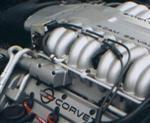


 Engine Cooling
 ) C8 HTC (non-Z51) SR has such a high temp. thermostat. Yes, I read that keeping it near 200 is better for efficiency, understood.