When you click on links to various merchants on this site and make a purchase, this can result in this site earning a commission. Affiliate programs and affiliations include, but are not limited to, the eBay Partner Network.
Added your info to table I have in my C7 Aero PDF. Fits. That data came from comments Tadge made in several forum posts and video.
Read somewhere that the C8 high wing added about the same high downforce as the low standard Z51 Wing. I have the Stage 2 Aero on my C7 Grand Sport and ordered the Ground Effects for my C8 so interested in that data . Will keep and eye out for other and reinforcing data.
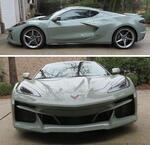
Do you have pics of the high and low wing just to be clear? Aero is my thing.
^^^
Unlike my 260Z where I added a large front air dam and rear spoiler for performance, I'm getting the high wing on my C8 strictly for looks. I just won't be traveling fast enough to make the wing effective! But the C8 rear view is it's worst appearence. IMO the high wing helps with the boxy look dictated by the large truck.
My 260Z was interesting. It was shown that the base car had 140 lbs of front lift and 35 lbs in the rear. At 100 mph that 2700 lb car felt very light. The parts I added were shown to add 100 lbs of front and 35 lbs of rear downforce, partly offsetting the lift. From 100 to 120 mph (about max) could feel a significant difference. Cars of the day were designed for looks and that airfoil shape was effective in causing lift! Full 240Z race cars had even more aggressive aero stuff and were lowered.
^^^
Unlike my 260Z where I added a large front air dam and rear spoiler for performance, I'm getting the high wing on my C8 strictly for looks. I just won't be traveling fast enough to make the wing effective! But the C8 rear view is it's worst appearence. IMO the high wing helps with the boxy look dictated by the large truck.
My 260Z was interesting. It was shown that the base car had 140 lbs of front lift and 35 lbs in the rear. At 100 mph that 2700 lb car felt very light. The parts I added were shown to add 100 lbs of front and 35 lbs of rear downforce, partly offsetting the lift. From 100 to 120 mph (about max) could feel a significant difference. Cars of the day were designed for looks and that airfoil shape was effective in causing lift! Full 240Z race cars had even more aggressive aero stuff and were lowered.
I love auto aero even though I'm air force ret. and an advanced aerobatic instructor and flying is my first love. Exploiting an airfoil is the greatest thing in life. I'm not an aerodynamicist but I do have a CFD add on on my Solid Edge program and I stayed in a Holiday Inn once. If both those wings produce 400 pds downforce, which I very much doubt, how do the two designs differ in delivery? You think chassis and suspension design is complicated, do you know the physics of the placement of a wing and what would be different from a fe and a me application? I don't feel like typing now.
If that wing makes real downforce - and I’m sure it does - doesn’t it flex the deck lid? Do you have it mounted to the frame, through the floor?
Also, when I ran with NASA at Roebling this spring I spent a lot of time talking with a C6Z guy that ran the apr wing. He said that the published cfd on their website was total bs. The wing, as well as the supports had far more drag than apr claims. Said a lot of the real race guys were going to an aluminum, chassis mount wing. https://9livesracing.com/products/co...-c5-97-05-wing
I love auto aero even though I'm air force ret. and an advanced aerobatic instructor and flying is my first love. Exploiting an airfoil is the greatest thing in life. I'm not an aerodynamicist but I do have a CFD add on on my Solid Edge program and I stayed in a Holiday Inn once. If both those wings produce 400 pds downforce, which I very much doubt, how do the two designs differ in delivery? You think chassis and suspension design is complicated, do you know the physics of the placement of a wing and what would be different from a fe and a me application? I don't feel like typing now.
I'm not an aero expert by any means but watching how F1 spends a fortune continually making refinements throughout the year and the key teams have their own wind tunnels and use advanced computational Aero software, it is very interesting. When I added a carbon fiber diffuser to my Grand Sport (strictly for looks) after searching the Net I bought book that was referenced by Kratz entitled Race Car Aerodynamics. Kratz consults for F1 teams. Found it very interesting. I put some of the info in an Appendix on my How To Install PDF of the Diffuser. It is 7 pages in my PDF. If interested you can just bypass the How To stuff...http://netwelding.com/Rear_Diffuser.pdf
Of interest, the top F1 teams were running their wind tunnels 24/7 and with the aero software getting so good similar extensive use. The smaller teams couldn't keep up with the cost! F1 now limits wind tunnel time and so folks like Mercedes just don't buy a Cray computer they limit not time BUT teraflops of resolver time that can be used!
If that wing makes real downforce - and I’m sure it does - doesn’t it flex the deck lid? Do you have it mounted to the frame, through the floor?
Also, when I ran with NASA at Roebling this spring I spent a lot of time talking with a C6Z guy that ran the apr wing. He said that the published cfd on their website was total bs. The wing, as well as the supports had far more drag than apr claims. Said a lot of the real race guys were going to an aluminum, chassis mount wing. https://9livesracing.com/products/co...-c5-97-05-wing
The load is in compression only and the incidence is set for 400lbs downforce including the moment force plus the diffusers 200lb. I measure load by deflection with cameras at the spring and not load sensors. I designed the support for a torque and compression load to the chassis below. It is not bolted or welded to the chassis, the downforce becomes a structural component.. It moves around a little but I dare not increase incidence. It's way beyond my driving capabilities anyway.
It is a copy of the factory airfoil which is a published 4 digit number. It has a uniform chord and camber aligned to the relative air flow along it's span, there fore the twist. It is placed in a sweet spot that attaches the flow to the glass with a uniform angle of attack along it's span. See pressure CFD below. The spoiler and a Gurney is the last part of the tune which completely attaches the flow under the wing which reduces drag immensely. This in turn augments diffuser flow, which is my design with a 15' ramp angle.
The wing on the C6 in your link is placed way back and high so there is a high understeer moment and high drag. There is only effective downforce at the endplates. The air flow over the roof is very turbulent because of wing placement that doesn't make use of the leading edge wash.This placement does not help the diffuser either. They haven't a clue which is typical of the after market. Although the wing has a uniform chord along it's span, the straight wing is very inefficient in the center with lots of drag. Clean air is high drag. The closer the wing to the body, the less drag it will have.
I hope he has a lot of power for that huge front splitter for that high total drag on that very poor set up. The C5 pictured is a dangerous disaster waiting to happen.
The factory race cars only have 550 or so HP but they can reach 170mph easy..
The load is in compression only and the incidence is set for 400lbs downforce including the moment force plus the diffusers 200lb. I measure load by deflection with cameras at the spring and not load sensors.
You measured the load with a camera? That's awesome. Real numbers.
I've flow tested industrial gas turbine parts for 20 years - no analysis comes close without real supporting data. I would tease the guys running Ansys - Fluent, knowing my data would carry far more weight than their hours of hard work modeling.
Great job!
Did you test and tune the diffuser separately? 200lb is a great result - I had no idea that much could be generated.
Last edited by fatsport; Dec 13, 2019 at 12:08 PM.
You measured the load with a camera? That's awesome. Real numbers.
I've flow tested industrial gas turbine parts for 20 years - no analysis comes close without real supporting data. I would tease the guys running Ansys - Fluent, knowing my data would carry far more weight than their hours of hard work modeling.
Great job!
Did you test and tune the diffuser separately? 200lb is a great result - I had no idea that much could be generated.
Sometimes I have an abrasive attitude. I'm in big trouble over on the other side.
Anyway. There are huge learning curves curves when ever you do things for the first time and designing and making a diffuser is no different. Anything related to ground effect is pitch and roll sensitive. You can calculate how much downforce you can expect, but in reality, you never quite get there because of a multitude of factors that arise. The diffuser actually didn't work at all by itself. The ride height had to be 2.5" and I couldn't get it that low. Also a bumpy surface and curbs either stalled it or chocked it. I copied the side feeder system of the Enzo with a second aluminum floor. The exhaust and engine an gearbox hot air had to be separated with fences which were sensitive to yaw. Yaw and roll arrive at the same time. When I put the wing on, I didn't know what the angle of attack was because you can't possible know the relative wind. I was at Homestead and Palm Beach. I installed my front splitter and dialed in some incidence using photos of the C6R and an 1/8th scale model of the C5R( The Daytona winning Earnhardt car.) I attached cameras at each wheel after I calibrated each spring by measuring defection under a press and made marks with a load value in compression. I found a nice center of pressure balance just by playing with rear ride height and wing incidence. I never knew exactly what the angle of attack was but all of a sudden it came alive. I played with pitch with 1'2 " increments at the rear and the wing is adjusted by grooves in the end plates one at a time. I had done a lot of suspension work before the aero package was installed. The muffler was installed for car shows. Haven't driven the car for years.
Separating hot and cold air is not easy. I closed the center but it gets very hot. The ramp area is as large I could get it. The diffuser is carbon.
Your whole outlook on life changes with downforce.
I'm pretty sure I heard the wing is mounted to the frame on the C8. You can lift the rear deck lid and the wing does not move.
You're right the wing does not move when you raise the deck lid!. The rear wing (Z51 or high) is mounted to the rear bumper. There is no frame that far back.. May be some crash protection foam..
The C5 platform is CD is .29 and 200 lbs lighter. No wings or splitter. Lingenfelter took it over 220 mph with the 650 hp version. Think what it could do with a C8 lt 2 in it.




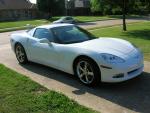


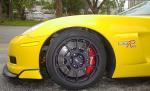


 Added your info to table I have in my C7 Aero PDF. Fits. That data came from comments Tadge made in several forum posts and video.