












Task Force Orbital

Drifting


Joined: Oct 2003
Posts: 1,945
Likes: 10
From: Salinas Ca.

I have not been able to permanently get rid of swirl marks using a PC. I can cover them up for a time, but they do come back. My experience has been that only a wet sanding followed by polishing with a rotary buffer will do the job. If you have had real success with the PC please tell me what you did. Thanks.
Last edited by benspruce; Jan 22, 2007 at 12:10 AM. Reason: used wrong terminology

Safety Car

Joined: Sep 2001
Posts: 4,596
Likes: 2
From: Atlanta GA
I have not been able to permanently get rid of swirl marks using a PC. I can cover them up for a time, but they do come back. My experience has been that only a wet sanding followed by polishing with a rotary buffer will do the job. If you have had real success with the PC please tell me what you did. Thanks.
I have removed some pretty heavy defects with a rotary on a C5, it still will take some time.
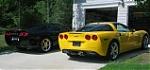
The TR coupe started out like this:

As you can see the fwd part of the tape line was rotary polished with Menzerna PG, IP and FPII

The is the area to the right in the above pic after it was complete:

Pro

Joined: Jul 2005
Posts: 556
Likes: 1
From: Atlanta GA
Even though motor power is not directly related to current on a single phase brush type motor, it is a pretty good indicator, and the PC 7424 and 7336 both have 3.7 amp draw motors which point to a motor that has at least 5X more power than the one you mentioned. It also oscillates with variable speeds up to 6000 OPM, producing almost twice as much "work" as the one you mention.
You will need something with the power (and pad availability) of the PC to get much work done on Corvette clear coat. I am assuming of course that you have a later model Vette with clear coat paint.
Shine on!

Corvette Stories
The Best of Corvette for Corvette Enthusiasts

10 Reasons the C6 Z06 is Still A Performance Benchmark After 20 Years
Joe Kucinski
How Much Horsepower Every Corvette Engine "LOST" in 1972
Joe Kucinski
Top 10 DOs and DON'Ts for Protecting Your Convertible Top!
Michael S. Palmer
Top 10 Most Explosive Corvettes Ever Made: Power-to-Weight Ratio Ranked!
Joe Kucinski
150 hp to 1,250 hp: Every Corvette Generation Compared by the Specs That Matter
Joe Kucinski
8 Coolest Corvette Pace Cars (and Replicas) of All Time
Verdad Gallardo
Top 10 Corvette Engines RANKED by Peak Torque (70+ Years of Muscle!)
Joe Kucinski
Corvette ZR1X Will Be Pacing the Indy 500, And Could Probably Race, Too!
Verdad Gallardo
Top 10 Corvettes Coming to Mecum Indy 2026!
Brett Foote
Melting Slicks

Joined: Feb 2004
Posts: 3,195
Likes: 2
From: ATL
St. Jude Donor '05-'06-'07-'08-'09-'10
I have not been able to permanently get rid of swirl marks using a PC. I can cover them up for a time, but they do come back. My experience has been that only a wet sanding followed by polishing with a rotary buffer will do the job. If you have had real success with the PC please tell me what you did. Thanks.
This was my first big-time turn-around.
1998 Grand Prix "Pace Car" with over 200k miles.
The picture below shows the roof panel. I ran a piece of tape from side to side on the roof panel.
The left side is polished with PB SSR 2.5 (x2) with the Orange Propel pad on my PC at 6. I removed the tape and took the picture below.
You can check out the whole detail HERE.
Click for the bigger pic.


Former Vendor
Joined: Feb 2006
Posts: 1,943
Likes: 2
From: Orlando/Oviedo FL
This can't hurt anything, and it may make applying wax or sealant a little easier than doing it by hand. But if you have any serious polishing to do, scratches, swirls, etc... you will probably need something like the Porter Cable.
Even though motor power is not directly related to current on a single phase brush type motor, it is a pretty good indicator, and the PC 7424 and 7336 both have 3.7 amp draw motors which point to a motor that has at least 5X more power than the one you mentioned. It also oscillates with variable speeds up to 6000 OPM, producing almost twice as much "work" as the one you mention.
You will need something with the power (and pad availability) of the PC to get much work done on Corvette clear coat. I am assuming of course that you have a later model Vette with clear coat paint.
Shine on!
Even though motor power is not directly related to current on a single phase brush type motor, it is a pretty good indicator, and the PC 7424 and 7336 both have 3.7 amp draw motors which point to a motor that has at least 5X more power than the one you mentioned. It also oscillates with variable speeds up to 6000 OPM, producing almost twice as much "work" as the one you mention.
You will need something with the power (and pad availability) of the PC to get much work done on Corvette clear coat. I am assuming of course that you have a later model Vette with clear coat paint.
Shine on!
Pro
Joined: Jul 2005
Posts: 556
Likes: 1
From: Atlanta GA
Not only are you getting 5 times the power and up to twice the OPM, which as mentioned gives you 10x the power (well closer to 7 times) but you can also focus that power on a smaller pad such as a 6.5" or a 4". A ten inch pad has a surface area of 78.53981633974483 inches squared where as a 4" pad has a surface area of 12.5563 inches squared. As you can see, the 4 inch pad produces 4x's the working power of a 10 inch pad in terms of pressure applied, and can produce that pressure with out loading the motor as much.
Or as my friend Tim the Tool Man would say.....uggghhh, uggghhh, uggghhh.....

