



First or Worst Rule???

Thread Starter
Drifting


Joined: Sep 2003
Posts: 1,325
Likes: 6
From: FRANKLIN GA
 First or Worst Rule???
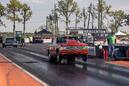
Was at out local track Sunday. We had Pro Mods there. Let me tell you, it was pretty impressive watching these guys go down our back woods track. They must have ***** of steel.
Anyway a late model firebird was racing a fiberglass 57. The 57 redlighted bad, don't know what went wrong but he left on like the first light. The firebird could have just taken the pass, but he ran it for all it was worth. From where I was standing I couldn't see it, but he just barley grazed the gaurd rail enough to leave a 1 foot stripe of paint on it. We have a very narrow track. So even though the out guy redlighted bad he won because crossing the line or hitting the rail is worse than redlighting. First or worst. Even though I thought it was kinda unfair because when the 57 redlighted he is immediatly disqualified I could still see why it was ruled that way.
So I'm still watching and the footbrakers come out. Fast camaro against a slower vega wagon (not stock) and both redlighted. The camaro redlighted worst low 400's to the vega's high 400's. They gave the win to the camaro. Why is this? Why wouldn't the first or worst rule come into play here also? I didn't think that one was fair.
By the way, the firebird set a track record the pass before he was disqualified 4.51 at 170.39
Anyway a late model firebird was racing a fiberglass 57. The 57 redlighted bad, don't know what went wrong but he left on like the first light. The firebird could have just taken the pass, but he ran it for all it was worth. From where I was standing I couldn't see it, but he just barley grazed the gaurd rail enough to leave a 1 foot stripe of paint on it. We have a very narrow track. So even though the out guy redlighted bad he won because crossing the line or hitting the rail is worse than redlighting. First or worst. Even though I thought it was kinda unfair because when the 57 redlighted he is immediatly disqualified I could still see why it was ruled that way.
So I'm still watching and the footbrakers come out. Fast camaro against a slower vega wagon (not stock) and both redlighted. The camaro redlighted worst low 400's to the vega's high 400's. They gave the win to the camaro. Why is this? Why wouldn't the first or worst rule come into play here also? I didn't think that one was fair.
By the way, the firebird set a track record the pass before he was disqualified 4.51 at 170.39
Elite Torch Red Member


Joined: Sep 1999
Posts: 57,805
Likes: 23
From: Exit 89 GSP,Lakewood,NJ The Land Of Mojo
Cental/South NJ Events Coordinator
CI 1-2-3-4-5-6-7-8-9-10-11-12 Vet
CI-II Burnout & Drag Champ
St. Jude Donor '03-'04-'05-'06-'07
I once won a race on a double red light and double breakout.
My opponent redlit first so I got the automatic win. When I saw my win light on, I just hit it for a free timeshot and broke out, she had broke out as well.
My opponent redlit first so I got the automatic win. When I saw my win light on, I just hit it for a free timeshot and broke out, she had broke out as well.

Team Owner

Joined: Nov 1999
Posts: 32,782
Likes: 11
From: Former NCM Drag Racing coordinator, National director Corvette Challenge Spring Hill, Tennessee: Whiting, New Jersey
Cruise-In VI Veteran
Cruise-In VII Veteran
Only one car can loose by red light, once the first car red lights the other lane automatically gets the win reguardless of when they leave even if it's before the green.

Le Mans Master

Joined: Feb 1999
Posts: 6,172
Likes: 11
From: somers, ny
Eddie, there's a bunch of people who agree with you and are trying to promote changing the rules.......however it's not likely to happen and in bracket racing, it's more complex than you might think.

Race Director


Joined: Sep 2000
Posts: 17,298
Likes: 33
From: The Top of Utah
If it's a heads up race, the bigger red light, the Camaro, goes red first. The Vega wins. If it's a bracket race. The slower car (the Vega) gets the tree first, by the difference in their dials. His smaller red light occurred before (first) the Camaro's. The Camaro wins. The Vega's red light is first. In "First or Worse", worse, refers to the severity of the rule broken, not by the amount it was broken. Leaving the track boundaries is "worse" than a red light, even though the red light came first. One red light is no "worse" than another red light. So in that case, first applies. Clear as mud?
RACE ON!!!
RACE ON!!!
Race Director


Joined: Jan 2003
Posts: 15,176
Likes: 88
From: State of Confusion
EJ82:
mackeyred96 and CFI-EFI are correct;
during a race, once one side of the tree 'fouls', the tree automatically can't deliver a red-light to the other competitor.
If a 13-second car goes red by even .001-second, his opponent (for example a 9-second car) can leave upon seeing the red-light on the 'other' side of the tree. His amber bulbs will still 'count-down', and delievr a 'green' light on the tree.
Of course, the 9-second car would receive a rediculously-early RT on his ET-slip, but unless the 9-second car violates the rules even worse (usually a SAFETY violation), he will win that round.
This is one of the scenarios where-by the slower car IS at a disadvantage, by virtue of him having to 'leave' first...
The 13-second car had the FIRST violation, and he loses, unless the 9-second car has a WORSE violation.
Hence, it is the "First OR Worst" rule
mackeyred96 and CFI-EFI are correct;
during a race, once one side of the tree 'fouls', the tree automatically can't deliver a red-light to the other competitor.
If a 13-second car goes red by even .001-second, his opponent (for example a 9-second car) can leave upon seeing the red-light on the 'other' side of the tree. His amber bulbs will still 'count-down', and delievr a 'green' light on the tree.
Of course, the 9-second car would receive a rediculously-early RT on his ET-slip, but unless the 9-second car violates the rules even worse (usually a SAFETY violation), he will win that round.
This is one of the scenarios where-by the slower car IS at a disadvantage, by virtue of him having to 'leave' first...
The 13-second car had the FIRST violation, and he loses, unless the 9-second car has a WORSE violation.
Hence, it is the "First OR Worst" rule
Team Owner
Joined: Nov 1999
Posts: 32,782
Likes: 11
From: Former NCM Drag Racing coordinator, National director Corvette Challenge Spring Hill, Tennessee: Whiting, New Jersey
Cruise-In VI Veteran
Cruise-In VII Veteran
Originally Posted by Glensgages
EJ82:
If a 13-second car goes red by even .001-second, his opponent (for example a 9-second car) can leave upon seeing the red-light on the 'other' side of the tree. His amber bulbs will still 'count-down', and delievr a 'green' light on the tree.
Of course, the 9-second car would receive a rediculously-early RT on his ET-slip, but unless the 9-second car violates the rules even worse (usually a SAFETY violation), he will win that round.
If a 13-second car goes red by even .001-second, his opponent (for example a 9-second car) can leave upon seeing the red-light on the 'other' side of the tree. His amber bulbs will still 'count-down', and delievr a 'green' light on the tree.
Of course, the 9-second car would receive a rediculously-early RT on his ET-slip, but unless the 9-second car violates the rules even worse (usually a SAFETY violation), he will win that round.
This is also where you can have some fun if your on the win side of that red light. In eliminations if I see red in the other lane and it late in the competition I'll leave right away, my green comes on my win light is on, now you ride the brake at the 1/8 mile mark to 1000' and then let off killing afew .10's, by doing this you hope your next opponent is now staging behind you seeing all this. He'll check out your ET but will be wondering what you've got left for the next round.
That every advantage you can, believe me it works.
Corvette Stories
The Best of Corvette for Corvette Enthusiasts

Top 10 Most Expensive Corvettes Ever Sold on Bring A Trailer
Brett Foote
10 Things Every Corvette Owner Needs (2026 Edition)
Michael S. Palmer
8 Most "Only Corvette Owners Understand" Quirks and Problems
Pouria Savadkouei
10 Reasons the C6 Z06 is Still A Performance Benchmark After 20 Years
Joe Kucinski
How Much Horsepower Every Corvette Engine "LOST" in 1972
Joe Kucinski
Top 10 DOs and DON'Ts for Protecting Your Convertible Top!
Michael S. Palmer
Top 10 Most Explosive Corvettes Ever Made: Power-to-Weight Ratio Ranked!
Joe Kucinski
150 hp to 1,250 hp: Every Corvette Generation Compared by the Specs That Matter
Joe Kucinski
8 Coolest Corvette Pace Cars (and Replicas) of All Time
Verdad Gallardo
Race Director
Joined: Oct 1999
Posts: 13,298
Likes: 14
From: Somers NY
Some very good answers here... in a "sorta" related story, I'll tell ya how sometimes your the squirrel, and sometimes the nut  Mackey was at E Town when the following really happened to me...
I'm not sure of the correct order the following happened, but I'll do my best. It was a Gamblers race on a Fri night.
Round 1 I had a good light.. & won the round
Round 2 The other guy went RED.. I got the win
Round 3 Car in the other lane was leaking oil & was shut down.. I got the win
Round 4 I had a Bye into the finals another round win..
Round 5 (Final) I'm dialed 12.40 the other guy is dialed 10.5x I left first & went -.015 RED I "Knew I lost" ..Then the 10 sec Chevelle left the line, & lost his left rear wheel as he launched, & spun across the center line.. it happened before the 60' & he was "OK" just a broken axle.. but his crossing the center line was worse than my RED light, & I got the WIN in the final ...
Sometimes it Better to be LUCKY Than Good!
I always hear the "Pros" say "I'll take a win anyway I can get it" Well its true...
Mackey was at E Town when the following really happened to me...I'm not sure of the correct order the following happened, but I'll do my best. It was a Gamblers race on a Fri night.
Round 1 I had a good light.. & won the round
Round 2 The other guy went RED.. I got the win
Round 3 Car in the other lane was leaking oil & was shut down.. I got the win
Round 4 I had a Bye into the finals another round win..
Round 5 (Final) I'm dialed 12.40 the other guy is dialed 10.5x I left first & went -.015 RED I "Knew I lost" ..Then the 10 sec Chevelle left the line, & lost his left rear wheel as he launched, & spun across the center line.. it happened before the 60' & he was "OK" just a broken axle.. but his crossing the center line was worse than my RED light, & I got the WIN in the final ...
Sometimes it Better to be LUCKY Than Good!
I always hear the "Pros" say "I'll take a win anyway I can get it" Well its true...

Team Owner
Joined: Jul 1999
Posts: 26,545
Likes: 46
From: Huntersville NC
So if you are in the faster car, let's say you are dialed in at 11.00 and the guy next to you is dialed in at 14.00, and he goes red, and you leave as soon as you see his red light..... then you have left almost 3 seconds early. Does your race timer work? What kind of et will you get? 
Thread Starter
Drifting
Joined: Sep 2003
Posts: 1,325
Likes: 6
From: FRANKLIN GA
Originally Posted by PRND21
So if you are in the faster car, let's say you are dialed in at 11.00 and the guy next to you is dialed in at 14.00, and he goes red, and you leave as soon as you see his red light..... then you have left almost 3 seconds early. Does your race timer work? What kind of et will you get?
It has no effect on ET unless you are the one doing the effecting.
I'm new to racing, only a couple of years, and I'm a heads up index racer, so I'm probably perceiving things wrong here..... but I've tried my hand at brackets a few times. In head up everything is setup up to be fair for BOTH cars. On a double redlight the WORST one loses. I don't understand why it doesn't work the same way for brackets. I thought that was the whole purpose of bracket racing to begin with... to make 2 cars no, matter how fast they run to be EQUAL. It might be just my opinion but that puts the hadicap car at a disadvantage, therfore they are no longer equal. The faster car will always have an advantage rule wise and racing wise.
It doesn't make much since if there is a big gap in ET say a 13 to a 11, The guy running the 11 would be an idiot to redlight,but if the ET's are closer say 13 to 12.98 it still works the same way, though now it is more in line with driver error. If both are in error the faster car gets the win, even though he could have had the worst redlight.

Former Vendor
Joined: Jun 2001
Posts: 7,204
Likes: 6
From: St Marys PA
Originally Posted by EDDIEJ82
Yes!!! thats what gets me. The timer will still show the R/T's of each driver. The timers will show who was WORST.
It has no effect on ET unless you are the one doing the effecting.
I'm new to racing, only a couple of years, and I'm a heads up index racer, so I'm probably perceiving things wrong here..... but I've tried my hand at brackets a few times. In head up everything is setup up to be fair for BOTH cars. On a double redlight the WORST one loses. I don't understand why it doesn't work the same way for brackets. I thought that was the whole purpose of bracket racing to begin with... to make 2 cars no, matter how fast they run to be EQUAL. It might be just my opinion but that puts the hadicap car at a disadvantage, therfore they are no longer equal. The faster car will always have an advantage rule wise and racing wise.
It doesn't make much since if there is a big gap in ET say a 13 to a 11, The guy running the 11 would be an idiot to redlight,but if the ET's are closer say 13 to 12.98 it still works the same way, though now it is more in line with driver error. If both are in error the faster car gets the win, even though he could have had the worst redlight.
It has no effect on ET unless you are the one doing the effecting.
I'm new to racing, only a couple of years, and I'm a heads up index racer, so I'm probably perceiving things wrong here..... but I've tried my hand at brackets a few times. In head up everything is setup up to be fair for BOTH cars. On a double redlight the WORST one loses. I don't understand why it doesn't work the same way for brackets. I thought that was the whole purpose of bracket racing to begin with... to make 2 cars no, matter how fast they run to be EQUAL. It might be just my opinion but that puts the hadicap car at a disadvantage, therfore they are no longer equal. The faster car will always have an advantage rule wise and racing wise.
It doesn't make much since if there is a big gap in ET say a 13 to a 11, The guy running the 11 would be an idiot to redlight,but if the ET's are closer say 13 to 12.98 it still works the same way, though now it is more in line with driver error. If both are in error the faster car gets the win, even though he could have had the worst redlight.
Leaving second is about the advantage to having the faster car. Not only that but chasing your opponent gives you a better line of sight, and its easier to gage your charge if your going to catch him.
The downside of being faster is more power - more power = more chance of tire spin and harder to run the numbers.
Reminds me of a night down at Beaver Springs. A guy (looked to be in his 80-90s) in a ford taurus was UNBEATABLE. He ran 20sec 1/4 mile times, in his 4 banger, but his lights were near perfect. And the car ran EXACTLY on the dial every time. He just punched it and rode out the ride. His only challenge was to hit a good light.
He won the whole ball of wax that night. Pretty crazy seeing him take out on a 9sec car and the other car sitting there for what seemed forever. 

Race Director

Joined: Oct 2001
Posts: 19,653
Likes: 428
From: Melbourne Florida
Cruise-In IV Veteran
Hey Eddie...being the first car to leave in almost all of my Challenge races, I know what you mean....I must also tell you I have been the recipient of many a red light by the faster car because he got "antsy" to catch me....I just do it this way...once I set my dial, I concentrate on running my race...after they pull me up I could not tell you who is next to me, what kind of car, their dial or anything else...I do look over at about 1000' and adjust, if necessary, at that time...
Truthfully, I have never known that my opponent red lit after I left...always find out when I get the time slip....I believe if I cut a decent light going first it puts a lot of pressure on my opponent....
Truthfully, I have never known that my opponent red lit after I left...always find out when I get the time slip....I believe if I cut a decent light going first it puts a lot of pressure on my opponent....
Race Director
Joined: Jan 2003
Posts: 15,176
Likes: 88
From: State of Confusion
Originally Posted by Fuzzy Dice
....I believe if I cut a decent light going first it puts a lot of pressure on my opponent....
If you are a 2-seconds or more slower than your opponent, and when he sees you leaving clean-and-green, if he knows that you are killing the tree, unless he is mentally-capable of blocking-out that fact, in his mind, he is thinking:
"Damn, Funkmaster is killing the tree! He might've gone .50..."
...and in that fraction of a second, his concentration is broken, making him more-likely to foul-out himself.

It is only AFTER the run, he sees the ET-slip, sees that you 'only' had a decent .530-light, not a 5-oh, and he realizes that he didn't need to cut the tree so-thin.....
The moral of the story is to hit the tree as hard as you can, every run, whether you are the quicker or the slower car;
once you get a reputation is a tree-trimer, you become more-likely to have opponents foul against you.
Race Director
Joined: Sep 2000
Posts: 17,298
Likes: 33
From: The Top of Utah
Originally Posted by EDDIEJ82
On a double redlight the WORST one loses. I don't understand why it doesn't work the same way for brackets.
A red light in the right lane is no more serious than a red light in the left lane. Therefore, the condition of WORSE is eliminated, and FIRST kicks in. In a heads up race, the greater (worse) red light will occur first. Coincedentially, in that case, first just happens to be a greater red light (worse) , also. In a bracket race the slower car gets the FIRST opportunity to red light. Since red lights are of equal seriousness, the first one loses, regardless of how great a red light it is.
It is rare, but I have seen the faster car, in a bracket race, leave before the slower car. The faster car had the first red light, and lost.
It takes some thinking about. It CAN be a difficult concept to get your mind wrapped around. I struggled with the same thing, years ago. Keep mulling it over...you'll get. Even *I* did.
RACE ON!!!
Thread Starter
Drifting
Joined: Sep 2003
Posts: 1,325
Likes: 6
From: FRANKLIN GA
Originally Posted by CFI-EFI
In a heads up race, the greater (worse) red light will occur first. Coincedentially, in that case, first just happens to be a greater red light (worse) , also. In a bracket race the slower car gets the FIRST opportunity to red light. Since red lights are of equal seriousness, the first one loses, regardless of how great a red light it is.
In heads up the car that gets the first redlight will always have the worst redlight (time wise). He or she that had the first redlight lost period.
So now I see why the first redlight in brackets works that way. First redlight lost period.
Like CFI said it took a minute to wrap my mind around that one.
