


Safe quench limits, opinions?

Thread Starter
Large Impressive Member


Joined: Jul 2003
Posts: 65,811
Likes: 71
From: Good health is merely the slowest possible rate at which one can die
St. Jude Donor '04-'05-'06-'07
 Safe quench limits, opinions?
This will be dual purpose but mainly a street engine built with long life in mind. LT1 stroker w/ zero deck. 4.030" forged and coated pistons with .0025" clearance. Would you recommend .040", .045" or?

Melting Slicks


Joined: Jul 2000
Posts: 2,112
Likes: 2
From: Peoria IL
I think the only people who have actually have purposeful insite as to what the limits are would be experienced race engine builders who have taken it to the limit and back to learn what they know. And they aren't gonna be telling everyone else what they know.
.040 would be safe. IMO
.040 would be safe. IMO

Burning Brakes

Joined: Jan 2003
Posts: 755
Likes: 32
From: Roswell Georgia
John Lingenfelter recommends a piston-to-head quench area from 0.040-0.045" on page 48 of his book about modifying small block engines. For a dual purpose street engine, I think that 0.045" is a safe figure to work with.
I've had excellent results running as little is 0.039" on pure racing engines, but this leaves little room for any errors in measurement of any of the components, i.e., block, rods, pistons, and gaskets. If you go this route, be sure to measure the assembled components carefully to avoid accicently smacking the head with some portion of the piston if rocking in the bore occurs. (Been there, didn't do that, and paid the price in broken parts!! )
)
- Greg Smith, Perpetual Corvette Mechanic
I've had excellent results running as little is 0.039" on pure racing engines, but this leaves little room for any errors in measurement of any of the components, i.e., block, rods, pistons, and gaskets. If you go this route, be sure to measure the assembled components carefully to avoid accicently smacking the head with some portion of the piston if rocking in the bore occurs. (Been there, didn't do that, and paid the price in broken parts!!
)- Greg Smith, Perpetual Corvette Mechanic
Melting Slicks
Joined: Jul 2000
Posts: 2,112
Likes: 2
From: Peoria IL
Any recommended method for reliably measuring rocking?
Seems to me that there are just to many unquantifiable variables. Piston rock, rod stretching when the piston pulls on it, the rod lengthening due to heat etc..
Seems to me that there are just to many unquantifiable variables. Piston rock, rod stretching when the piston pulls on it, the rod lengthening due to heat etc..

Race Director


Joined: Sep 2000
Posts: 17,298
Likes: 33
From: The Top of Utah
My Chevrolet Power Book states, "Piston to Cylinder Head: .035" minimum." A few lines above that they spec a piston to cylinder wall clearance of ".005 +/-.0005" with forged pistons, which would rock more than yours with less than .003" clearance. Elsewhere I have seen Chevy spec, ".035" to .040", minimum". I have heard of people running .030" and less. With your intended mild usage and tight piston clearance, I would allow no more than .040". Again with your set up, you might get brave and shoot for something closer to .030".
RACE ON!!!
RACE ON!!!
Thread Starter
Large Impressive Member
Joined: Jul 2003
Posts: 65,811
Likes: 71
From: Good health is merely the slowest possible rate at which one can die
St. Jude Donor '04-'05-'06-'07
Originally Posted by mr.beachcomber
be sure to measure the assembled components carefully to avoid accicently smacking the head with some portion of the piston if rocking in the bore occurs. (Been there, didn't do that, and paid the price in broken parts!! )
)
Originally Posted by korvetkeith
Any recommended method for reliably measuring rocking?
Seems to me that there are just to many unquantifiable variables. Piston rock, rod stretching when the piston pulls on it, the rod lengthening due to heat etc..
Seems to me that there are just to many unquantifiable variables. Piston rock, rod stretching when the piston pulls on it, the rod lengthening due to heat etc..
Thread Starter
Large Impressive Member
Joined: Jul 2003
Posts: 65,811
Likes: 71
From: Good health is merely the slowest possible rate at which one can die
St. Jude Donor '04-'05-'06-'07
Originally Posted by CFI-EFI
I'd like to see you STILL use those Impala gaskets with your zero deck. *I* think that would be perfect.
RACE ON!!!
RACE ON!!!
 How would that get me the generally agreed upon safety margin though, boss? Do you know something I don't? Just sent you a PM on related matters, BTW.
Corvette Stories
The Best of Corvette for Corvette Enthusiasts

Every 2027 Corvette Engine Explained
Joe Kucinski
Designer Imagines A Corvette That Looks More Like a Corvette Than the Corvette
Verdad Gallardo
10 Ugly Corvettes That We Still Kinda Love
Joe Kucinski
Top 10 Most Expensive Corvettes Ever Sold on Bring A Trailer
Brett Foote
10 Things Every Corvette Owner Needs (2026 Edition)
Michael S. Palmer
8 Most "Only Corvette Owners Understand" Quirks and Problems
Pouria Savadkouei
10 Reasons the C6 Z06 is Still A Performance Benchmark After 20 Years
Joe Kucinski
How Much Horsepower Every Corvette Engine "LOST" in 1972
Joe Kucinski
Top 10 DOs and DON'Ts for Protecting Your Convertible Top!
Michael S. Palmer
Burning Brakes
Joined: Jan 2003
Posts: 755
Likes: 32
From: Roswell Georgia
Originally Posted by korvetkeith
Any recommended method for reliably measuring rocking?
Use a dial indicator gauge on the flat, outside edge of each piston in two positions each perpendicular to the wrist pin while applying slight pressure to the opposite side. Record the readings to make sure that all the pistons exhibit the same relative movement.
Now the fun part, you must refer back the piston maker's specs to see if you are within the acceptable range for all pistons. (Be careful with offset wristpins. Each side will have a different value.) Hypereutetic pistons have lower movement values than forged pistons since they expand less as the engine reaches operating temperature. Forged pistons typically have the highest "rock" values due to their higher rate of expansion. If you are running a tight quence (anything under 0.040"), any piston rock over 0.006" means take it easy with the engine until it reaches operating temperature as rule of thumb. (Specific range of values must be provided by the piston manufacturer.)
If you're interested, I've found that Keith Black-Silvolite Pistons to have an excellent web site with many excellent tech articles and engine building calculators availabe for free. Their tech reps will anwser your questions via e-mail or phone.

Hope this info helps!
- Greg Smith, Perpetual Corvette Mechanic
Race Director
Joined: Sep 2000
Posts: 17,298
Likes: 33
From: The Top of Utah
PM answered.
It definitely pushes the envelope. Consider, however, that the specs are for looser racing pistons, turning much higher rpms, and frequently if not devoted to racing. It takes some ***** to go there, but if there were a situation that begged for it, and is likely to get away with it, it's yours. Think of the money you'll save on head gaskets.
There was a fellow that I was explaining quench to, that related having a big block that ran a little harder that all his other, similar racing engines. He recalled that when they disassembled it they found the part number that was stamped into the top of the piston, embossed on the quench area of the cylinder head. That one had a TIGHT quench distance. At the time he wasn't aware of the benefits of a close quench, and they didn't check to see what the clearance was. After he knew about, and understood the benefits of quench, he knew why that engine ran so much better than the others.
RACE ON!!!
It definitely pushes the envelope. Consider, however, that the specs are for looser racing pistons, turning much higher rpms, and frequently if not devoted to racing. It takes some ***** to go there, but if there were a situation that begged for it, and is likely to get away with it, it's yours. Think of the money you'll save on head gaskets.
There was a fellow that I was explaining quench to, that related having a big block that ran a little harder that all his other, similar racing engines. He recalled that when they disassembled it they found the part number that was stamped into the top of the piston, embossed on the quench area of the cylinder head. That one had a TIGHT quench distance. At the time he wasn't aware of the benefits of a close quench, and they didn't check to see what the clearance was. After he knew about, and understood the benefits of quench, he knew why that engine ran so much better than the others.
RACE ON!!!
Melting Slicks
Joined: Jul 2000
Posts: 2,112
Likes: 2
From: Peoria IL
Originally Posted by CFI-EFI
PM answered.
It definitely pushes the envelope. Consider, however, that the specs are for looser racing pistons, turning much higher rpms, and frequently if not devoted to racing. It takes some ***** to go there, but if there were a situation that begged for it, and is likely to get away with it, it's yours. Think of the money you'll save on head gaskets.
There was a fellow that I was explaining quench to, that related having a big block that ran a little harder that all his other, similar racing engines. He recalled that when they disassembled it they found the part number that was stamped into the top of the piston, embossed on the quench area of the cylinder head. That one had a TIGHT quench distance. At the time he wasn't aware of the benefits of a close quench, and they didn't check to see what the clearance was. After he knew about, and understood the benefits of quench, he knew why that engine ran so much better than the others.
RACE ON!!!
It definitely pushes the envelope. Consider, however, that the specs are for looser racing pistons, turning much higher rpms, and frequently if not devoted to racing. It takes some ***** to go there, but if there were a situation that begged for it, and is likely to get away with it, it's yours. Think of the money you'll save on head gaskets.
There was a fellow that I was explaining quench to, that related having a big block that ran a little harder that all his other, similar racing engines. He recalled that when they disassembled it they found the part number that was stamped into the top of the piston, embossed on the quench area of the cylinder head. That one had a TIGHT quench distance. At the time he wasn't aware of the benefits of a close quench, and they didn't check to see what the clearance was. After he knew about, and understood the benefits of quench, he knew why that engine ran so much better than the others.
RACE ON!!!
Burning Brakes

Joined: Feb 2005
Posts: 894
Likes: 91
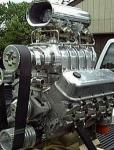
406" SB 580 HP/523 Ft.Lbs. on 93 -.070" "Quench"
Originally Posted by Corvette Kid NC
This will be dual purpose but mainly a street engine built with long life in mind. LT1 stroker w/ zero deck. 4.030" forged and coated pistons with .0025" clearance. Would you recommend .040", .045" or?
P.S. This one also has a $15.00 "nylon" timing chain setup (TC499S), which we figure was worth some additional "upstairs" H.P. We use these on a number of mechanical roller, street units, to keep the engine/driveline vibrations from getting up to the cam/lifter area, as opposed to a "Jesel" belt setup.
Last edited by GOSFAST; Dec 4, 2005 at 10:23 PM.
Race Director
Joined: Sep 2000
Posts: 17,298
Likes: 33
From: The Top of Utah
Originally Posted by GOSFAST
Unit has a .070" quench area, .032" P/D, and .038" Head Gasket. (Again, how important is this number?)
The tighter the quench, the more effective it is. The effectiveness gradually decreases as the distance increases. It is generally considered that the benefit of the quench area is all but gone, at about .060"
RACE ON!!!



Le Mans Master

Joined: Feb 1999
Posts: 6,172
Likes: 11
From: somers, ny
Kid....i'd shoot for .040 unless you're building a comp engine or something. 40 is safe and if there are some variances in the parts it shouldn't be a problem. As i understand it, combustion cannot be supported in such a tight space and it pushes the a/f mixture out into the combustion chamber with turbulence. Going to 30 or 35 isn't going to make that much of a difference so why push the envelope on a s/s application.
Race Director
Joined: Sep 2000
Posts: 17,298
Likes: 33
From: The Top of Utah
Originally Posted by ralph
Kid....i'd shoot for .040 unless you're building a comp engine or something.
Going to 30 or 35 isn't going to make that much of a difference so why push the envelope on a s/s application.
Going to 30 or 35 isn't going to make that much of a difference so why push the envelope on a s/s application.
On the other hand, with the streeter, the daily driver, where the demands will be less frequent and of a lesser magnitude, you want to be conservative.
Interesting.
RACE ON!!!
Le Mans Master
Joined: Feb 1999
Posts: 6,172
Likes: 11
From: somers, ny
Yes....on a street application I would be a more "conservative" than i would be on an all out race engine where squeezing every bit of performance is required to be competitive.
That doesn't sound logical to you Jim?
That doesn't sound logical to you Jim?
Melting Slicks
Joined: Jul 2000
Posts: 2,112
Likes: 2
From: Peoria IL
[QUOTE=ralph Going to 30 or 35 isn't going to make that much of a difference so why push the envelope on a s/s application.[/QUOTE]
I don't agree with that, and you have no way of knowing for sure. But IMO it will make a difference.
I don't agree with that, and you have no way of knowing for sure. But IMO it will make a difference.
Le Mans Master
Joined: Feb 1999
Posts: 6,172
Likes: 11
From: somers, ny
[QUOTE=I don't agree with that, and you have no way of knowing for sure. But IMO it will make a difference.[/QUOTE]
OK so what is your estimate? 2 hp, 5, 10, more? Is it worth pushing the envelope for a car that i assume will be more street than strip? Would the engine rev quicker with a big $ lightened rotating assembly? Of course it would, but i wouldn't recommend it for this application either. Would it make more HP down two qts of oil? yes.....I assume you see where i'm going.
OK so what is your estimate? 2 hp, 5, 10, more? Is it worth pushing the envelope for a car that i assume will be more street than strip? Would the engine rev quicker with a big $ lightened rotating assembly? Of course it would, but i wouldn't recommend it for this application either. Would it make more HP down two qts of oil? yes.....I assume you see where i'm going.
Race Director
Joined: Sep 2000
Posts: 17,298
Likes: 33
From: The Top of Utah
Originally Posted by ralph
Yes....on a street application I would be a more "conservative" than i would be on an all out race engine where squeezing every bit of performance is required to be competitive.
That doesn't sound logical to you Jim?
That doesn't sound logical to you Jim?
A daily driver that makes a little more power than it should, no pinging, better power and fuel mileage with less ignition lead, all sound like the DD I'd like to have. Because of of the difference in applications, .040" isn't necessarily more conservative than .030".
RACE ON!!!