






Tri Power Manifold Performance Potential
Thread Starter
Racer

Joined: Mar 2007
Posts: 278
Likes: 2
From: Wellington Florida

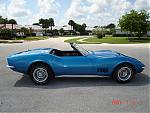
I ran it on an engine dyno, so the typical dyno air horn was used. Based on my calculations with the torker, the rpm is about 3/4" too tall. I use a drop base 427/390 air cleaner in the car with a 3" element and a 1/2" carb spacer. That leave 1/4" clearance to the BB hood.
Thread Starter
Racer
Joined: Mar 2007
Posts: 278
Likes: 2
From: Wellington Florida

Race Director


Joined: May 2005
Posts: 10,674
Likes: 122
From: Millington Illinois
St. Jude Donor '08-'09
Thread Starter
Racer
Joined: Mar 2007
Posts: 278
Likes: 2
From: Wellington Florida
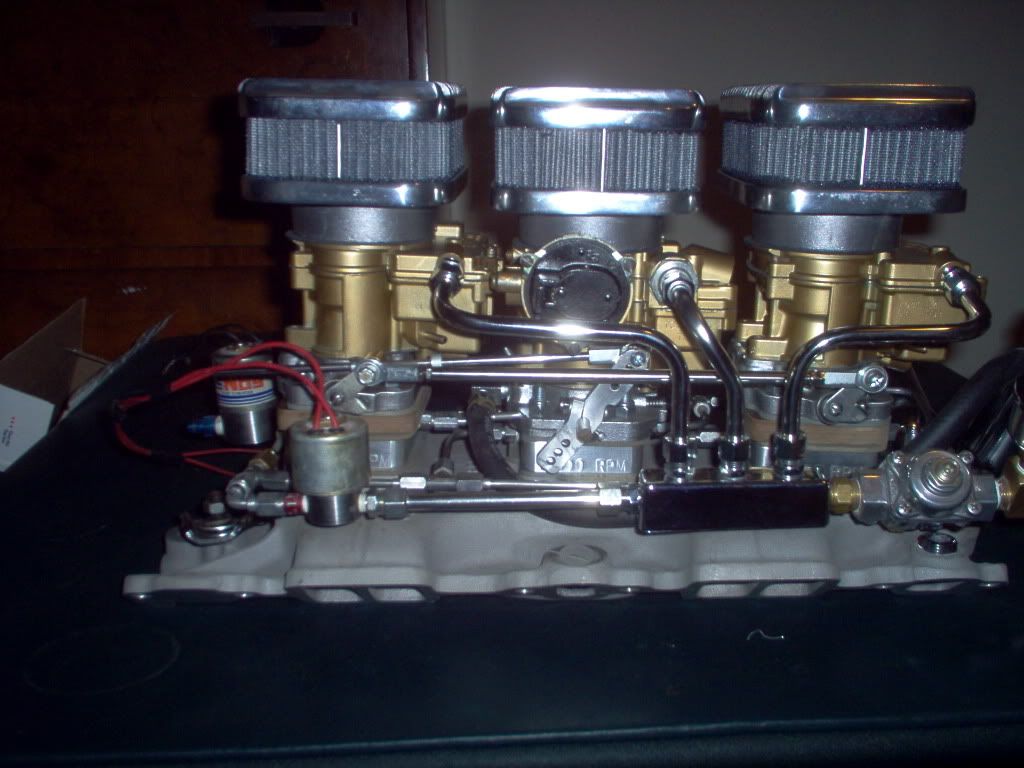
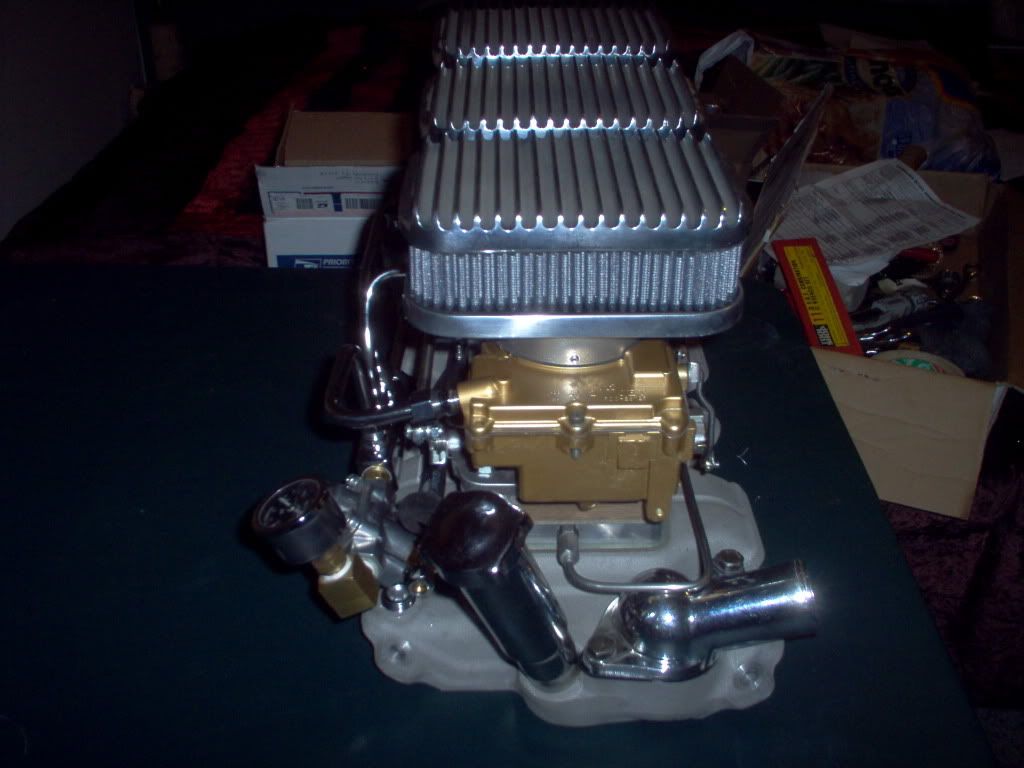
No The rating is different. My tripower for a small block uses 3-378 CFM carbs. this does no equate to 1134 CFM but to 816. The Barry Grant system is rated like a 4 bbl instead of a 2 bbl. Barry Grant 750 also runs like an 850 because of the design. Ther is more information about CFM ratings on tripowers on pontiactripower.com. I did a lot of sudying on this when I designed my system with a custom nitrous plate setup.
Race Director
Joined: May 2005
Posts: 10,674
Likes: 122
From: Millington Illinois
St. Jude Donor '08-'09
 This is for a forged full roller 383. Should run with the big blocks though.
Last edited by 63mako; Apr 11, 2007 at 08:12 PM.

Intermediate
Joined: Feb 2009
Posts: 28
Likes: 0
Last May, Corvette Enthusiast did an 11.5:1 489 buildup using AFR 315 CNC heads. They tested 3 induction systems: Holley Strip Dominator 4150; Edelbrock RPM Air Gap and a modified 67 Tripower. The 4-bbl intakes were tested with a Holley 950 HP carburetor. The results were impressive:
Although I don't have a Corvette (yet) I wanted to thank you all for the information on this site to help me with my build. I thought I would post some of the details for anyone who might benefit from it. I hope you enjoy.
Here's a Cliff Note version preface:
After a multi-year search, I found my car (70 Chevelle) tucked away in "cold storage", a converted commercial chicken coop (thus my Screen Name) in Freeport Maine where it had been sitting, protected from the elements, for almost 9 years. CA built, sold in TX, then found it's way to ME through FL where it was converted to be a hobby drag racer. Incredibly rust free, my goal was to do a full frame off restoration while reviving it into a "Retro-Mod" (my version of a combination of resto-mod/pro-touring/period correct upgrades).
My vision for the car has evolved as follows: restored as if GM had given the performance team the opportunity to create an "in house" COPO-like vehicle (with an aluminum headed 454 Tri-power that was being considered at one point http://hotrod.automotive.com/81383/h...ips/index.html). A mock-up, using a pre-production body, some goodies from the Corvette & Hi Perf parts bins, and with some modern updates. No Covan's or any of that other "LA Customs" c**p.
Fast forward through the tear down, chassis restoration & rebuild, to the engine. It had a beat-up 468 BBC in it. Planned for a 496. Fate opened up an opportunity to move to a 511 stroker with far better internals for the same cost as the less durable 496.
I called and got a copy of the above Corvette Enthusiast magazine, read it, called the engine builder, the carb guy, got all the details and began looking for a tri-power. I almost cancelled the idea of the tri-power after finding out that I would probably have to spend $5K to do it, when fate again smiled upon me. I found an old hot rodder in No. CA who had a 67 manifold in near perfect condition and 3 NIB carbs. A genuinely nice guy who adjusted his original asking price so I could get the bypass outlet fixed...$1700 shipped.
I sent the manifold out to Jerry McNeish in MD (http://www.z28camaro.com/index.html) for a full resto ($325 inc. shipping) and modded the carbs as explained by Jerry Luck. I arranged a dyno day with my engine builder.
Before


After


Engine specs as follows:
454 block .060 over torque plate honed, line bored, studded mains, clearanced for stroker
511 CI Eagle Rotating assm (balanced in shop) 4.375 stroke, 4340 crank, H-beam rods, lightweight forged pistons, floating pins, 18 cc dome
AFR 305's with CNC option (approx 10.3:1 CR)
UDHarold Custom ground billet solid roller cam 282-251-.725 \ 288-257-.725 \ 112sep
Isky Red-Line lifters
Comp Roller Rockers
Roller timing chain & gears
Melling oil pump
Moroso 20403 pan and pick-up
Curved (at dyno shop) Summit HEI dist.
67 Corvette tri-power manifold and modded carbs.

Dyno Day
Installed the intake at 9 AM and was informed that due to an emergency, we were limited to 1/2 of dyno time. Some "bug work outs" (dist. curving, warm-up, re-adjust valves, then 3 full pulls)
1st pull @ 30 total adv was the weakest, the 2nd (LH column in the chart) was best at 32 total adv, 3rd pull at 34 total netted 1 hp extra, but most numbers deteriorated.
550+ TQ from 3000-6000 Peak 617 @ 4200
Peak HP 631@ 6100
We also attempted to get a reading at estimated cruising speed, about 2200 RPM. HP was in the upper mid 200's and TQ was over 400.

Mech fuel pump could not keep up with demand. Nearing the 1/2 day limit, there was no time to replace, but it is estimated that there's another 30 HP with a more substantial fuel flow.
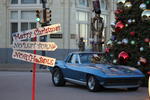
Here's one of the latest photos.

Again, thanks for the inspiration, information sources, and the opportunity to share.
If anyone would like more info, just let me know.
Thanks,
Fred
Intermediate
Joined: Feb 2009
Posts: 28
Likes: 0
Forgot to mention that I asked member to "Guess my Dyno Results". Anyone that was within 10%, I'd donate $100 to St. Jude's, dead on $300.
No one really guessed it but I gave a $300 donation to St. Jude's anyway.
No one really guessed it but I gave a $300 donation to St. Jude's anyway.
Corvette Stories
The Best of Corvette for Corvette Enthusiasts

Top 10 Most Expensive Corvettes Ever Sold on Bring A Trailer
Brett Foote
10 Things Every Corvette Owner Needs (2026 Edition)
Michael S. Palmer
8 Most "Only Corvette Owners Understand" Quirks and Problems
Pouria Savadkouei
10 Reasons the C6 Z06 is Still A Performance Benchmark After 20 Years
Joe Kucinski
How Much Horsepower Every Corvette Engine "LOST" in 1972
Joe Kucinski
Top 10 DOs and DON'Ts for Protecting Your Convertible Top!
Michael S. Palmer
Top 10 Most Explosive Corvettes Ever Made: Power-to-Weight Ratio Ranked!
Joe Kucinski
150 hp to 1,250 hp: Every Corvette Generation Compared by the Specs That Matter
Joe Kucinski
8 Coolest Corvette Pace Cars (and Replicas) of All Time
Verdad Gallardo
Intermediate
Joined: Feb 2009
Posts: 28
Likes: 0
Jerry starts out by machining the cast mating surfaces so the seal is be perfect (body, metering plate) and smoothing all of the casting seams inside the throats with a small hand grinder. He said he didn't think that made a single HP more, but it doesn't take much to do it. I did not do those parts as the carbs I had were all new.
The main mods were a combination of small things designed to compensate for the larger and more aggressive motor.
The carbs have adequate flow to accommodate the motor size based on a CFM calculator and a 2bbl flow rate conversion chart. At 90% efficiency a 511 needs between 865 and 961 CFM. The tri power flows 1350 but has to be adjusted based on the differences in how a 2bbl and 4bbl are rated less than 1350:
To make an accurate comparison of a 2v VS 4v carb take the total cfm of the 2v's and divide by 1.414.
Example: Total cfm rating of Corvette tri-power carbs is 1350 cfm. 350 cfm primary + 500 cfm each outboard = 1350 cfm divided by 1.414 = 954.74 cfm. (So technically, I was "choking" down the engine when over approximately 6100 RPM)
The shortfall of the carbs in stock form is how they were "tuned" for a 427; jets, metering plates, squirter, and accelerator pump cam.
Instructions were to change the stock primary jets to 65's and open up the metering plates from the stock .068 to .078 (a 5/64 drill size). He also said that I may need to go to an .080 for my engine (drill size 64).
Then change the squirter from the stock 21 to a 28, a #240 accelerator pump cam in the #1 position, keeping the WOT clearance of 15 thousandths, and change the stock vac springs to yellows. That would have the secondaries progressively opening in the 2800-5000 RPM range, about 1000-1500 RPM lower on the opening and full open than the stock springs.
My carb had the 240 cam (red) in position # 1 already
He used a 5.5 power valve, but suggest that with my combo to keep the stock 6.5 valve, as is is a stick, not an auto.
"Everyone said to use a 50 cc pump...bulls**t, 30's plenty. The secret's in the squirters and the accel pump cam." to quote him.
My AF ratio was perfect until I hit the mid 4's, which is when the high flow Carter pump began to show it's limitations. It is supposed to flow 120 GPH at 4-5 PSI up to 6500 RPM, but the pressure began to drop off as the RPM increased dipping down to 2 then zero (when all 3 carbs were working). The AF ratios were near perfect for "economy" at the upper range, but getting it richer (12's) in the 5000-6500 range would add more power. So before too much time elapses, I will upgrade the pump to the next level (street/strip 120 GPH 6-9 PSI which is still OK w/o a pressure regulator)
What I was really happy about was the TQ curve, 550+ and as flat and broad as Kansas. I have to figure that planting the right foot in any gear at or above 3500 RPM will result in a "Shuttle" launch experience...which I am really anxious to try out.
That's it for now.
The main mods were a combination of small things designed to compensate for the larger and more aggressive motor.
The carbs have adequate flow to accommodate the motor size based on a CFM calculator and a 2bbl flow rate conversion chart. At 90% efficiency a 511 needs between 865 and 961 CFM. The tri power flows 1350 but has to be adjusted based on the differences in how a 2bbl and 4bbl are rated less than 1350:
To make an accurate comparison of a 2v VS 4v carb take the total cfm of the 2v's and divide by 1.414.
Example: Total cfm rating of Corvette tri-power carbs is 1350 cfm. 350 cfm primary + 500 cfm each outboard = 1350 cfm divided by 1.414 = 954.74 cfm. (So technically, I was "choking" down the engine when over approximately 6100 RPM)
The shortfall of the carbs in stock form is how they were "tuned" for a 427; jets, metering plates, squirter, and accelerator pump cam.
Instructions were to change the stock primary jets to 65's and open up the metering plates from the stock .068 to .078 (a 5/64 drill size). He also said that I may need to go to an .080 for my engine (drill size 64).
Then change the squirter from the stock 21 to a 28, a #240 accelerator pump cam in the #1 position, keeping the WOT clearance of 15 thousandths, and change the stock vac springs to yellows. That would have the secondaries progressively opening in the 2800-5000 RPM range, about 1000-1500 RPM lower on the opening and full open than the stock springs.
My carb had the 240 cam (red) in position # 1 already
He used a 5.5 power valve, but suggest that with my combo to keep the stock 6.5 valve, as is is a stick, not an auto.
"Everyone said to use a 50 cc pump...bulls**t, 30's plenty. The secret's in the squirters and the accel pump cam." to quote him.
My AF ratio was perfect until I hit the mid 4's, which is when the high flow Carter pump began to show it's limitations. It is supposed to flow 120 GPH at 4-5 PSI up to 6500 RPM, but the pressure began to drop off as the RPM increased dipping down to 2 then zero (when all 3 carbs were working). The AF ratios were near perfect for "economy" at the upper range, but getting it richer (12's) in the 5000-6500 range would add more power. So before too much time elapses, I will upgrade the pump to the next level (street/strip 120 GPH 6-9 PSI which is still OK w/o a pressure regulator)
What I was really happy about was the TQ curve, 550+ and as flat and broad as Kansas. I have to figure that planting the right foot in any gear at or above 3500 RPM will result in a "Shuttle" launch experience...which I am really anxious to try out.
That's it for now.
Race Director


Joined: Jan 2000
Posts: 13,017
Likes: 2,261
From: Corsicana, Tx
2020 C2 of the Year - Modified Winner
2020 Corvette of the Year (performance mods)
C2 of Year Winner (performance mods) 2019
2017 C2 of Year Finalist
The tripowers are really cool and run great when right.
You might check into the ancient C-427 series of Edelbrocks.
There was a C-396 that was oval ports for a 4150 carb.
A C-400 was oval for a Dominator.
A C-427 was for rectangular ports and a 4150.
A C-454 was for rectangular ports and a Dominator.
It was a large runner dual plane that looks like a 427/425 intake...just bigger runners. It has the carb flange milled at an angle like a stock intake to lower front part of carb to clear hood. That's what Mark did to his Vic Jr. The Holley Strip Dominators are milled the same way, but I think it will take an L-88 hood to use one.
I just did some dyno work using a stock swap meet C-454 on a pump gas 555" motor in the mid/upper 700 HP range and it did very well!
JIM
You might check into the ancient C-427 series of Edelbrocks.
There was a C-396 that was oval ports for a 4150 carb.
A C-400 was oval for a Dominator.
A C-427 was for rectangular ports and a 4150.
A C-454 was for rectangular ports and a Dominator.
It was a large runner dual plane that looks like a 427/425 intake...just bigger runners. It has the carb flange milled at an angle like a stock intake to lower front part of carb to clear hood. That's what Mark did to his Vic Jr. The Holley Strip Dominators are milled the same way, but I think it will take an L-88 hood to use one.
I just did some dyno work using a stock swap meet C-454 on a pump gas 555" motor in the mid/upper 700 HP range and it did very well!
JIM

Racer
Joined: Aug 2005
Posts: 347
Likes: 0
From: Pace FL
Did you get a plot of your AF #'s? Your curves are very rough at the top end. If it did lean out there you could easily break something. I think you have lots more in it but you need to monitor the AF in real time before attempting too many timing adjustments. Did you port the intake any to match the heads? What headers? You should re-tune it on the chassis dyno before running it hard.
I used the 30cc pump as well as the 50cc pump. While I agree that there is not a power difference and that a 30 cc is sufficient on any double pumper or other 4bbl I used, the 50cc with adustments to the squirter flow and timing allowed me to use a lighter spring in the secondaries with a smoother transistion. This is only noticed in driving; you might see less dip on the dyno if it was recording at that rpm.
-Scott
I used the 30cc pump as well as the 50cc pump. While I agree that there is not a power difference and that a 30 cc is sufficient on any double pumper or other 4bbl I used, the 50cc with adustments to the squirter flow and timing allowed me to use a lighter spring in the secondaries with a smoother transistion. This is only noticed in driving; you might see less dip on the dyno if it was recording at that rpm.
-Scott
Intermediate
Joined: Feb 2009
Posts: 28
Likes: 0
Thanks for the input and ideas. 
We did monitor the AF's, but there was no hat for a tri-power. The builder, a very experienced old school guy, was very satisfied with them. My friend who had his motor built and dyno'd there had similar AF's (540 BBC 70 Chevelle running mid-10's to high 9's at the track and thousands of street miles had zero internal issues during a recent top end tear down and cam change). So I am reasonably confident all is OK.
I can't get too technical regarding all of the readings, testing procedures, etc. because I do not know enough about them to do that...which is why I wanted someone with street, race, and 30 years of motor experience building and testing it.
Items that could not be re-tested due to the time constraints were replacing the fuel pump with one better suited to the fuel flow and opening up the secondary metering plates to a full .080 (in the dyno runs they were opened from stock to .078).
I think that both would have added some power, but technically the carbs are a hair too small for the motor. My calcs are that over 6100 RPM, they are actually holding the motor back some.
These tuning points will be left to doing a chassis dyno test and tune when the car is all together.
My main purpose in testing the motor were:
To be sure that some of the "bugs" could be identified and/or eliminated. We found 3-distributor (shape of weights over advanced the timing), valves kissing the v-covers (clearanced) and the possibility that the fuel pump was weak or defective.
That the performance was in line with expectations (mostly mid-range) good wide, flat TQ, an honest 625 HP, power at 2K (cruise mode). I figured that if any of these were really bad, I would have left the motor there and made internal changes. All were good.
And third, that if there was a manufacturing defect in any of the parts, it would blow up on the dyno, not in my fully and newly assembled car.
We did monitor the AF's, but there was no hat for a tri-power. The builder, a very experienced old school guy, was very satisfied with them. My friend who had his motor built and dyno'd there had similar AF's (540 BBC 70 Chevelle running mid-10's to high 9's at the track and thousands of street miles had zero internal issues during a recent top end tear down and cam change). So I am reasonably confident all is OK.
I can't get too technical regarding all of the readings, testing procedures, etc. because I do not know enough about them to do that...which is why I wanted someone with street, race, and 30 years of motor experience building and testing it.
Items that could not be re-tested due to the time constraints were replacing the fuel pump with one better suited to the fuel flow and opening up the secondary metering plates to a full .080 (in the dyno runs they were opened from stock to .078).
I think that both would have added some power, but technically the carbs are a hair too small for the motor. My calcs are that over 6100 RPM, they are actually holding the motor back some.
These tuning points will be left to doing a chassis dyno test and tune when the car is all together.
My main purpose in testing the motor were:
To be sure that some of the "bugs" could be identified and/or eliminated. We found 3-distributor (shape of weights over advanced the timing), valves kissing the v-covers (clearanced) and the possibility that the fuel pump was weak or defective.
That the performance was in line with expectations (mostly mid-range) good wide, flat TQ, an honest 625 HP, power at 2K (cruise mode). I figured that if any of these were really bad, I would have left the motor there and made internal changes. All were good.
And third, that if there was a manufacturing defect in any of the parts, it would blow up on the dyno, not in my fully and newly assembled car.
