




Which Supercharger, Magnuson or ProCharger?
Thread Starter
Pro

Joined: Jun 2005
Posts: 730
Likes: 0
From: Winter Springs FL
 Which Supercharger, Magnuson or ProCharger?
I'm definitely not an expert in this category. Pros and Cons? Should I be looking at other methods? Your input would be greatly appreciated.
Thanks, Mike
Thanks, Mike

Drifting

Joined: Dec 2005
Posts: 1,777
Likes: 1
From: Port Neches Texas
St. Jude Donor '07-'08-'09
Depends on what your goals are and how much you want to spend. You might also consider APS twin turbo - but it is a little more spendy.
Maggie - more low end grunt than Procharger but lower overall HP.
Procharger - tends to make gobs of power up high in the rpm band. Can get to 600 rwhp on stock bottom ends.
APS TT - best of both worlds, but more $$.
Add cubes - normally aspirated - heads/cams or stroked. Depending on HP goals can run from moderate to very expensive.
Reliability is a function of installer, components (read $$), and how aggressive you get with the boost (read HP). No such thing as a free lunch with any of it. Need to keep your goals in mind and talk with a reputable shop.
Maggie - more low end grunt than Procharger but lower overall HP.
Procharger - tends to make gobs of power up high in the rpm band. Can get to 600 rwhp on stock bottom ends.
APS TT - best of both worlds, but more $$.
Add cubes - normally aspirated - heads/cams or stroked. Depending on HP goals can run from moderate to very expensive.
Reliability is a function of installer, components (read $$), and how aggressive you get with the boost (read HP). No such thing as a free lunch with any of it. Need to keep your goals in mind and talk with a reputable shop.
Safety Car

Joined: Jul 2006
Posts: 4,647
Likes: 1
From: Objects in your mirror are losing , Long Island, NY
St. Jude Donor '08
Depends on what your goals are and how much you want to spend. You might also consider APS twin turbo - but it is a little more spendy.
Maggie - more low end grunt than Procharger but lower overall HP.
Procharger - tends to make gobs of power up high in the rpm band. Can get to 600 rwhp on stock bottom ends.
APS TT - best of both worlds, but more $$.
Add cubes - normally aspirated - heads/cams or stroked. Depending on HP goals can run from moderate to very expensive.
Reliability is a function of installer, components (read $$), and how aggressive you get with the boost (read HP).
Maggie - more low end grunt than Procharger but lower overall HP.
Procharger - tends to make gobs of power up high in the rpm band. Can get to 600 rwhp on stock bottom ends.
APS TT - best of both worlds, but more $$.
Add cubes - normally aspirated - heads/cams or stroked. Depending on HP goals can run from moderate to very expensive.
Reliability is a function of installer, components (read $$), and how aggressive you get with the boost (read HP).


Safety Car

Joined: Jun 2004
Posts: 4,430
Likes: 81
From: Whidbey Island WA
ECS, A&A, and others have taken these and developed them further. Put them on your short list because cost is the same as the basic kit. If your leaning more to the maggie you might want to be aware that they are working on a new one which is supposed to have more headroom and a better boost/hp ratio.

Racer


Joined: Jun 2006
Posts: 365
Likes: 0
From: Winter Park (Orlando) FL
Mike, you got the bug brotha....Check out the Vortech too. Just another option. If you get it I want a ride in your car. I have heard of a lot of belt problems with the procharger. Needing to replace belt after belt. Have heard only good about the maggie (except need new hood)
Mike J.
Orlando
Mike J.
Orlando

Burning Brakes

Joined: Feb 2005
Posts: 1,099
Likes: 1
From: Branford Connecticut
Callaway Cars is quite committed to the Magna Charger configuration. We use the Magna Charger in the Callaway SuperCharged Corvettes. We started building these cars in February 2006. We provide 5 year, 100,000 mile warranty on these supercharger systems for 2007 models. They're built in 560 bhp/529 lb-ft and 616 bhp/582 lb-ft versions.
In October 2006, Reeves Callaway and Jerry Magnuson entered into an agreement such that Callaway Cars has become responsible for all product development, sales, marketing and distribution of all Magna Charger systems and parts for C5 and C6 Corvette applications. The systems are still available from all Magna Charger dealers. Callaway engineers could have selected any supercharging or turbocharging device for the Callaway Corvette and selected the Magna Charger direction.
Advantages to the Roots-style Magnuson design:
- Roots-style systems produce more hp per psi than centrifugal superchargers (at any given power level, lower boost easier on engine parts);
- Internal bypass valve provides low parasitic loss during idle and cruise conditions (less than 0.5 bhp);
- Intercooler is located in manifold base simplifying inlet plumbing (patent pending);
- lower speed operation is easier on supercharger components for increased durability, reliability
- supercharger internals are manufactured by Eaton Corp., the leading supercharger supplier to the world's vehicle manufacturers (Corvette components are very similar to the Ford Lightning, Aston Martin and Jaguar units)
- much less complex than turbocharging systems, and allow original location for OEM catalytic converters (less parts to cause problems, and avoids emissions regulation compliance problems).
Disadvantages to the Roots-style Magnuson design:
- increased engine package height (approx. 1.7") requires hood replacement (several aftermarket hoods are available)
- fixed displacement limits maximum hp increase as a function of Magna Charger model (we offer an MP122 system for 400+ inch engines and we're working on a "TVS" system to theoretically support just over 1000 bhp)
To sum up, selection depends on your application. For street-driven Corvettes where you want a broad torque curve with excellent low-end torque, OEM-level durability and reliability, retaining near-original fuel mileage and emissions compliance, and you don't mind changing the hood, then you may want to consider Magna Charger.

In October 2006, Reeves Callaway and Jerry Magnuson entered into an agreement such that Callaway Cars has become responsible for all product development, sales, marketing and distribution of all Magna Charger systems and parts for C5 and C6 Corvette applications. The systems are still available from all Magna Charger dealers. Callaway engineers could have selected any supercharging or turbocharging device for the Callaway Corvette and selected the Magna Charger direction.
Advantages to the Roots-style Magnuson design:
- Roots-style systems produce more hp per psi than centrifugal superchargers (at any given power level, lower boost easier on engine parts);
- Internal bypass valve provides low parasitic loss during idle and cruise conditions (less than 0.5 bhp);
- Intercooler is located in manifold base simplifying inlet plumbing (patent pending);
- lower speed operation is easier on supercharger components for increased durability, reliability
- supercharger internals are manufactured by Eaton Corp., the leading supercharger supplier to the world's vehicle manufacturers (Corvette components are very similar to the Ford Lightning, Aston Martin and Jaguar units)
- much less complex than turbocharging systems, and allow original location for OEM catalytic converters (less parts to cause problems, and avoids emissions regulation compliance problems).
Disadvantages to the Roots-style Magnuson design:
- increased engine package height (approx. 1.7") requires hood replacement (several aftermarket hoods are available)
- fixed displacement limits maximum hp increase as a function of Magna Charger model (we offer an MP122 system for 400+ inch engines and we're working on a "TVS" system to theoretically support just over 1000 bhp)
To sum up, selection depends on your application. For street-driven Corvettes where you want a broad torque curve with excellent low-end torque, OEM-level durability and reliability, retaining near-original fuel mileage and emissions compliance, and you don't mind changing the hood, then you may want to consider Magna Charger.
Last edited by mcv; Mar 25, 2007 at 12:00 PM.

Safety Car


Joined: Dec 2004
Posts: 4,477
Likes: 2
From: Boca Raton, FL
St. Jude Donor '05-'06-'07-'08-'09-'10-'11-'12-'13-'14
Went thru the same decision process as you. Finally, after talking with the owner of the shop that has done all of my mods (headers, cam, heads, SC) I decided to go with the Procharger D1SC. I did not want tons of low end TQ and definitely did not want to change out the hood.
I put the goodyear gatorback belt on and have not had a single bit of trouble after 10,000 miles and numerous runs down the 1/4 mile.

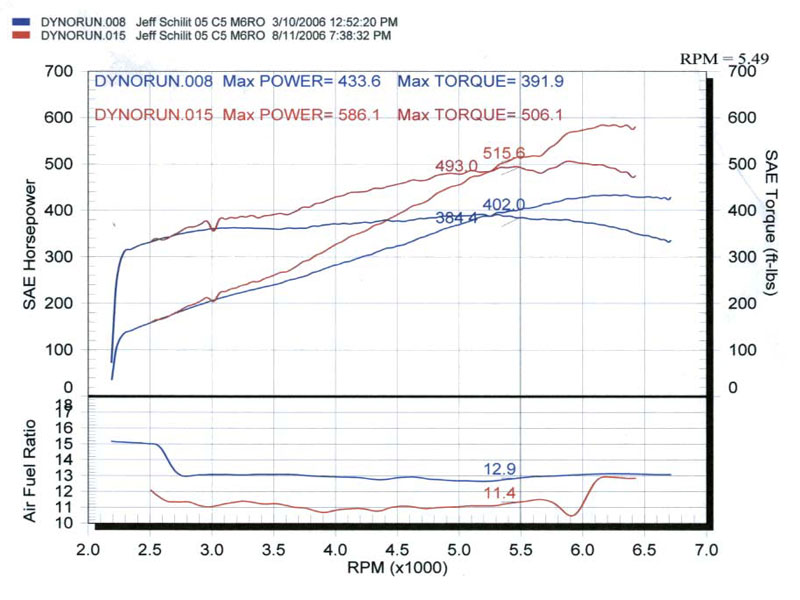
best 1/4 mile - 11.1@123.6
Good luck making your decision.
I put the goodyear gatorback belt on and have not had a single bit of trouble after 10,000 miles and numerous runs down the 1/4 mile.
best 1/4 mile - 11.1@123.6
Good luck making your decision.

Le Mans Master

Joined: Mar 2006
Posts: 7,838
Likes: 1
From: Valencia '32 Ford 3 window with 615 HP!!!!
St. Jude Donor '06-'09
Callaway Cars is quite committed to the Magna Charger configuration. We use the Magna Charger in the Callaway SuperCharged Corvettes. We started building these cars in February 2006. We provide 5 year, 100,000 mile warranty on these supercharger systems for 2007 models. They're built in 560 bhp/529 lb-ft and 616 bhp/582 lb-ft versions.
In October 2006, Reeves Callaway and Jerry Magnuson entered into an agreement such that Callaway Cars has become responsible for all product development, sales, marketing and distribution of all Magna Charger systems and parts for C5 and C6 Corvette applications. The systems are still available from all Magna Charger dealers. Callaway engineers could have selected any supercharging or turbocharging device for the Callaway Corvette and selected the Magna Charger direction.
Advantages to the Roots-style Magnuson design:
- Roots-style systems produce more hp per psi than centrifugal superchargers (at any given power level, lower boost easier on engine parts);
- Internal bypass valve provides low parasitic loss during idle and cruise conditions (less than 0.5 bhp);
- Intercooler is located in manifold base simplifying inlet plumbing (patent pending);
- lower speed operation is easier on supercharger components for increased durability, reliability
- supercharger internals are manufactured by Eaton Corp., the leading supercharger supplier to the world's vehicle manufacturers (Corvette components are very similar to the Ford Lightning, Aston Martin and Jaguar units)
- much less complex than turbocharging systems, and allow original location for OEM catalytic converters (less parts to cause problems, and avoids emissions regulation compliance problems).
Disadvantages to the Roots-style Magnuson design:
- increased engine package height (approx. 1.7") requires hood replacement (several aftermarket hoods are available)
- fixed displacement limits maximum hp increase as a function of Magna Charger model (we offer an MP122 system for 400+ inch engines and we're working on a "TVS" system to theoretically support just over 1000 bhp)
To sum up, selection depends on your application. For street-driven Corvettes where you want a broad torque curve with excellent low-end torque, OEM-level durability and reliability, retaining near-original fuel mileage and emissions compliance, and you don't mind changing the hood, then you may want to consider Magna Charger.
In October 2006, Reeves Callaway and Jerry Magnuson entered into an agreement such that Callaway Cars has become responsible for all product development, sales, marketing and distribution of all Magna Charger systems and parts for C5 and C6 Corvette applications. The systems are still available from all Magna Charger dealers. Callaway engineers could have selected any supercharging or turbocharging device for the Callaway Corvette and selected the Magna Charger direction.
Advantages to the Roots-style Magnuson design:
- Roots-style systems produce more hp per psi than centrifugal superchargers (at any given power level, lower boost easier on engine parts);
- Internal bypass valve provides low parasitic loss during idle and cruise conditions (less than 0.5 bhp);
- Intercooler is located in manifold base simplifying inlet plumbing (patent pending);
- lower speed operation is easier on supercharger components for increased durability, reliability
- supercharger internals are manufactured by Eaton Corp., the leading supercharger supplier to the world's vehicle manufacturers (Corvette components are very similar to the Ford Lightning, Aston Martin and Jaguar units)
- much less complex than turbocharging systems, and allow original location for OEM catalytic converters (less parts to cause problems, and avoids emissions regulation compliance problems).
Disadvantages to the Roots-style Magnuson design:
- increased engine package height (approx. 1.7") requires hood replacement (several aftermarket hoods are available)
- fixed displacement limits maximum hp increase as a function of Magna Charger model (we offer an MP122 system for 400+ inch engines and we're working on a "TVS" system to theoretically support just over 1000 bhp)
To sum up, selection depends on your application. For street-driven Corvettes where you want a broad torque curve with excellent low-end torque, OEM-level durability and reliability, retaining near-original fuel mileage and emissions compliance, and you don't mind changing the hood, then you may want to consider Magna Charger.
TOTALLY!!
Corvette Stories
The Best of Corvette for Corvette Enthusiasts

Top 10 Most Expensive Corvettes Ever Sold on Bring A Trailer
Brett Foote
10 Things Every Corvette Owner Needs (2026 Edition)
Michael S. Palmer
8 Most "Only Corvette Owners Understand" Quirks and Problems
Pouria Savadkouei
10 Reasons the C6 Z06 is Still A Performance Benchmark After 20 Years
Joe Kucinski
How Much Horsepower Every Corvette Engine "LOST" in 1972
Joe Kucinski
Top 10 DOs and DON'Ts for Protecting Your Convertible Top!
Michael S. Palmer
Top 10 Most Explosive Corvettes Ever Made: Power-to-Weight Ratio Ranked!
Joe Kucinski
150 hp to 1,250 hp: Every Corvette Generation Compared by the Specs That Matter
Joe Kucinski
8 Coolest Corvette Pace Cars (and Replicas) of All Time
Verdad Gallardo
Le Mans Master


Joined: Jan 2003
Posts: 8,596
Likes: 19
From: Portland Oregon
The maggie systems make for a very clean and OE looking installation. Plus they make boost IMMEDIATELY for excellent low and mid range performance. For those looking for that kind of performance a maggie is the way to go. I am presently installing a maggie into a local owners new 07 M6 C6, while I was in there we decided to add a LPE GT11 camshaft as part of the package. He is also adding a set of Melrose headers to complete the package. It will be very interesting to see what this package will do. I know that the GT11 cam is good for at least 50hp alone with nothing else done to the motor. With a set of headers and a set of ported LS2 heads that combination is worth just shy of 100hp to the wheels.


Drifting
Joined: Mar 2006
Posts: 1,367
Likes: 4
From: Saint Johns Florida
Callaway Cars is quite committed to the Magna Charger configuration. We use the Magna Charger in the Callaway SuperCharged Corvettes. We started building these cars in February 2006. We provide 5 year, 100,000 mile warranty on these supercharger systems for 2007 models. They're built in 560 bhp/529 lb-ft and 616 bhp/582 lb-ft versions.
In October 2006, Reeves Callaway and Jerry Magnuson entered into an agreement such that Callaway Cars has become responsible for all product development, sales, marketing and distribution of all Magna Charger systems and parts for C5 and C6 Corvette applications. The systems are still available from all Magna Charger dealers. Callaway engineers could have selected any supercharging or turbocharging device for the Callaway Corvette and selected the Magna Charger direction.
Advantages to the Roots-style Magnuson design:
- Roots-style systems produce more hp per psi than centrifugal superchargers (at any given power level, lower boost easier on engine parts);
- Internal bypass valve provides low parasitic loss during idle and cruise conditions (less than 0.5 bhp);
- Intercooler is located in manifold base simplifying inlet plumbing (patent pending);
- lower speed operation is easier on supercharger components for increased durability, reliability
- supercharger internals are manufactured by Eaton Corp., the leading supercharger supplier to the world's vehicle manufacturers (Corvette components are very similar to the Ford Lightning, Aston Martin and Jaguar units)
- much less complex than turbocharging systems, and allow original location for OEM catalytic converters (less parts to cause problems, and avoids emissions regulation compliance problems).
Disadvantages to the Roots-style Magnuson design:
- increased engine package height (approx. 1.7") requires hood replacement (several aftermarket hoods are available)
- fixed displacement limits maximum hp increase as a function of Magna Charger model (we offer an MP122 system for 400+ inch engines and we're working on a "TVS" system to theoretically support just over 1000 bhp)
To sum up, selection depends on your application. For street-driven Corvettes where you want a broad torque curve with excellent low-end torque, OEM-level durability and reliability, retaining near-original fuel mileage and emissions compliance, and you don't mind changing the hood, then you may want to consider Magna Charger.
In October 2006, Reeves Callaway and Jerry Magnuson entered into an agreement such that Callaway Cars has become responsible for all product development, sales, marketing and distribution of all Magna Charger systems and parts for C5 and C6 Corvette applications. The systems are still available from all Magna Charger dealers. Callaway engineers could have selected any supercharging or turbocharging device for the Callaway Corvette and selected the Magna Charger direction.
Advantages to the Roots-style Magnuson design:
- Roots-style systems produce more hp per psi than centrifugal superchargers (at any given power level, lower boost easier on engine parts);
- Internal bypass valve provides low parasitic loss during idle and cruise conditions (less than 0.5 bhp);
- Intercooler is located in manifold base simplifying inlet plumbing (patent pending);
- lower speed operation is easier on supercharger components for increased durability, reliability
- supercharger internals are manufactured by Eaton Corp., the leading supercharger supplier to the world's vehicle manufacturers (Corvette components are very similar to the Ford Lightning, Aston Martin and Jaguar units)
- much less complex than turbocharging systems, and allow original location for OEM catalytic converters (less parts to cause problems, and avoids emissions regulation compliance problems).
Disadvantages to the Roots-style Magnuson design:
- increased engine package height (approx. 1.7") requires hood replacement (several aftermarket hoods are available)
- fixed displacement limits maximum hp increase as a function of Magna Charger model (we offer an MP122 system for 400+ inch engines and we're working on a "TVS" system to theoretically support just over 1000 bhp)
To sum up, selection depends on your application. For street-driven Corvettes where you want a broad torque curve with excellent low-end torque, OEM-level durability and reliability, retaining near-original fuel mileage and emissions compliance, and you don't mind changing the hood, then you may want to consider Magna Charger.
I love my Maggie 122.

Former Vendor
Joined: Dec 2006
Posts: 2,239
Likes: 1
I feel that these cars already make plenty of low end power, they need more mid range and top end power. An ATI ProCharger will start pulling in the mid range, and the power just keeps coming on stronger and stronger.

We rebuilt the engine in this Corvette using the stock crankshaft, but we used Callies Compstar rods and Diamond pistons, and Total Seal rings. We installed a mild Lingenfelter GT2-3 camshaft and Patriot Stage 2 LQ9 heads. Nothing expensive, just a good selection of parts.
An ATI ProCharger D-1SC was used and is pushing 16 psi of boost. Bob
We rebuilt the engine in this Corvette using the stock crankshaft, but we used Callies Compstar rods and Diamond pistons, and Total Seal rings. We installed a mild Lingenfelter GT2-3 camshaft and Patriot Stage 2 LQ9 heads. Nothing expensive, just a good selection of parts.
An ATI ProCharger D-1SC was used and is pushing 16 psi of boost. Bob



4th Gear
Joined: Feb 2007
Posts: 4
Likes: 0
KENNE BELL 2.8 H 
It was tested against a roots 112 and destroyed it by 200hp at the same psi . The roots fell off at higher rpm .
A stock vette with a Kenne Bell 2.6 or 2.8 will produce over 400 rwtq at 1,500 rpm and hold that solid until you shift .
They have a dyno on the site of a vette making 700rwtq at 2,000 rpm , its torque before the peak was 1,000 lb/ ft at the flywheel , 900 something flywheel hp .
Some little 281 ci mustang cobras are trapping 135-140 mph with the same screw supercharger . Imagine a 364ci with one
It was tested against a roots 112 and destroyed it by 200hp
at the same psi . The roots fell off at higher rpm .A stock vette with a Kenne Bell 2.6 or 2.8 will produce over 400 rwtq at 1,500 rpm and hold that solid until you shift .
They have a dyno on the site of a vette making 700rwtq at 2,000 rpm , its torque before the peak was 1,000 lb/ ft at the flywheel , 900 something flywheel hp .
Some little 281 ci mustang cobras are trapping 135-140 mph with the same screw supercharger . Imagine a 364ci with one
Safety Car
Joined: Jun 2004
Posts: 4,430
Likes: 81
From: Whidbey Island WA
KENNE BELL 2.8 H
It was tested against a roots 112 and destroyed it by 200hp at the same psi . The roots fell off at higher rpm .
A stock vette with a Kenne Bell 2.6 or 2.8 will produce over 400 rwtq at 1,500 rpm and hold that solid until you shift .
They have a dyno on the site of a vette making 700rwtq at 2,000 rpm , its torque before the peak was 1,000 lb/ ft at the flywheel , 900 something flywheel hp .
Some little 281 ci mustang cobras are trapping 135-140 mph with the same screw supercharger . Imagine a 364ci with one
It was tested against a roots 112 and destroyed it by 200hp
at the same psi . The roots fell off at higher rpm .A stock vette with a Kenne Bell 2.6 or 2.8 will produce over 400 rwtq at 1,500 rpm and hold that solid until you shift .
They have a dyno on the site of a vette making 700rwtq at 2,000 rpm , its torque before the peak was 1,000 lb/ ft at the flywheel , 900 something flywheel hp .
Some little 281 ci mustang cobras are trapping 135-140 mph with the same screw supercharger . Imagine a 364ci with one

Race Director

Joined: Oct 2005
Posts: 14,555
Likes: 1,255
From: Saint Albans, WV
Most belt problems on any supercharger are usually the result of improper pulley alignment. BTW...as expected, I love my ProCharger!

Race Director
Joined: Dec 2006
Posts: 14,006
Likes: 26
From: JawJa
Can these be be used in conjunction with the Vararam and spacer? If so, is their an added advantage? I just put mine on and I'm just curious. I also realize, that this is another giant step up.
BTW, couldn't be more happier with Steve and Patrick at Vararam.
BTW, couldn't be more happier with Steve and Patrick at Vararam.