


Base v Z51 in Stopping Distance on the Street?


Thread Starter
Safety Car


Joined: Nov 2007
Posts: 4,537
Likes: 1,403
From: Bethesda MD
 Base v Z51 in Stopping Distance on the Street?
I found a post where two members mentioned that the cross drilled Z51 rotors were mostly for show, as opposed to significantly improving the stopping capability of the car. The discussion of brakes was a secondary criteria in that particular thread, so there was not any mention of any measured tests of the base brakes vs the Z51s.
I know the larger brakes with cross drilling help on the track where heat can cause fade, but what about for accident avoidance on the street when the pads and rotors are are in normal operating temps? Do the larger cross drilled brakes used on the Z51 reduce stopping distance on the street?
I know the larger brakes with cross drilling help on the track where heat can cause fade, but what about for accident avoidance on the street when the pads and rotors are are in normal operating temps? Do the larger cross drilled brakes used on the Z51 reduce stopping distance on the street?
Le Mans Master

Joined: Sep 2004
Posts: 5,707
Likes: 4
From: Los Angeles
The Z51 brakes have the same calipers but slightly larger rotors. Even the non Z51 is capable of locking up the front wheels in a panic stop. In that sense, the Z will not stop any faster since you are limited by the tire grip and not the brakes capability of stopping the wheel. Having said that, I believe the Z has a slightly grippier tire compound and should help reduce stopping distance a bit.
The crossdrilled rotors are just bling. The people who track their cars use the rotors till they crack. Crossdrilled rotors crack sooner around the holes. Some years ago, crossdrilled rotors were used to enhance the performance of cars using a certain type of brake pad, which is no longer in use but the look stayed.
The crossdrilled rotors are just bling. The people who track their cars use the rotors till they crack. Crossdrilled rotors crack sooner around the holes. Some years ago, crossdrilled rotors were used to enhance the performance of cars using a certain type of brake pad, which is no longer in use but the look stayed.
Safety Car


Joined: Feb 2007
Posts: 4,939
Likes: 448
From: CHOCOWINITY NC
The Z51 brakes have the same calipers but slightly larger rotors. Even the non Z51 is capable of locking up the front wheels in a panic stop. In that sense, the Z will not stop any faster since you are limited by the tire grip and not the brakes capability of stopping the wheel. Having said that, I believe the Z has a slightly grippier tire compound and should help reduce stopping distance a bit.
 Exactly.

Le Mans Master

Joined: Oct 2007
Posts: 6,149
Likes: 11
From: Greater Detroit Metro MI, when I'm not travelling.
Z51 cars do stop quicker but this is mainly due to the grippier tire compound of the Z51 tires.
The Z51 brakes have more thermal mass and "better" brake pads (higher operating temperature rating) so they will withstand more abuse at the track before brake fade sets in, but once you get to that point many people found that the cross drilling will make the rotors crack sooner.
I would expect slightly better brake pedal feel with the larger rotors since there is more leverage working on the wheel. This could be offset by a possibly poorer "initial bite" of the higher working temp brake pad material though.
Regardless, I have a Z51 and I like its brakes a lot, but I wouldn't expect a non Z51 car to be any worse on the street. I got the Z51 because of the suspension and the gear ratios and the coolers more than anything.
The Z51 brakes have more thermal mass and "better" brake pads (higher operating temperature rating) so they will withstand more abuse at the track before brake fade sets in, but once you get to that point many people found that the cross drilling will make the rotors crack sooner.
I would expect slightly better brake pedal feel with the larger rotors since there is more leverage working on the wheel. This could be offset by a possibly poorer "initial bite" of the higher working temp brake pad material though.
Regardless, I have a Z51 and I like its brakes a lot, but I wouldn't expect a non Z51 car to be any worse on the street. I got the Z51 because of the suspension and the gear ratios and the coolers more than anything.
Le Mans Master
Joined: Sep 2004
Posts: 5,707
Likes: 4
From: Los Angeles

Team Owner


Joined: Oct 2001
Posts: 56,381
Likes: 79
The bigger rotors help dissipate more heat with a larger swept area and less required brake pressure. This helps when making repeated stops, particularly on the track. A panic stop or two with almost any braking system will stop the car just as fast as any brake system on the market. They are all made to be capable of lockup or engagement of the ABS if so equipped, at least once before fade. Once the wheels are locked up nothing else matters but the tire size and compound in relation to vehicle weight and balance.
Stopping on the street order of importance.
1. Tires (compound)
2. Suspension
3. Alignment
4. Brake pads
and the difference between 2,3, and 4 is not much.
A Z51 should have a slightly better stopping distance over base because of tires and suspension.

Drifting

Joined: Feb 2007
Posts: 1,537
Likes: 1
From: Southlake Texas
The added leverage of the larger rotors can apply slightly more braking force initially (will lock the wheel more quickly and activate ABS). Even a fraction of a second is important when travelling at 88 feet per second or faster!
I installed larger calipers on my 2008 that use the same pads as the stock caliper but have 3 pistons instead of two. The stopping distance is much less than stock and the only difference is the larger caliper.
I installed larger calipers on my 2008 that use the same pads as the stock caliper but have 3 pistons instead of two. The stopping distance is much less than stock and the only difference is the larger caliper.

Team Owner
Joined: Oct 2001
Posts: 56,381
Likes: 79
The added leverage of the larger rotors can apply slightly more braking force initially (will lock the wheel more quickly and activate ABS). Even a fraction of a second is important when travelling at 88 feet per second or faster!
I installed larger calipers on my 2008 that use the same pads as the stock caliper but have 3 pistons instead of two. The stopping distance is much less than stock and the only difference is the larger caliper.
I installed larger calipers on my 2008 that use the same pads as the stock caliper but have 3 pistons instead of two. The stopping distance is much less than stock and the only difference is the larger caliper.
Team Owner
Joined: Oct 2001
Posts: 56,381
Likes: 79
Safety Car
Joined: Feb 2007
Posts: 4,939
Likes: 448
From: CHOCOWINITY NC
When one of the most respected companies in aftermarket high performance brake systems says:1) The brakes don't stop the vehicle - the tires do. The brakes slow the rotation of the wheels and tires. This means that braking distance measured on a single stop from a highway legal speed or higher is almost totally dependent upon the stopping ability of the tires in use - which, in the case of aftermarket advertising, may or may not be the ones originally fitted to the car by the OE manufacturer.
You should probably listen....

Safety Car
Joined: Jun 2004
Posts: 4,430
Likes: 81
From: Whidbey Island WA
Folks who have been around for a while will recall that the supercars were not available when they were first testing out pre-production cars and on the base tires the Z51 optioned cars did not stop measurably shorter. GM later came out with a 9' shorter stopping distance (60-0) when the supercars became available.
Thread Starter
Safety Car
Joined: Nov 2007
Posts: 4,537
Likes: 1,403
From: Bethesda MD
This is very helpful. I had wondered if the stock brakes can lock-up the wheels, how much more bigger brakes could really do, assuming heat wasn't an issue.
Nice find on the stoptech link.
I understand what WHT is saying. The question is how long does it take from the instant that the brakes are applied to reach the edge of lock-up on the stock system versus the Z51. If hypothetically that difference was .1 seconds, that would cut a few feet off the stopping distance (persumably less than 8' at 60 MPH as we are looking at the delta in deceleration between two systems, not the difference between 88'/sec and zero.). If that difference was .03 seconds, it would be almost undetectable.
Nice find on the stoptech link.
I understand what WHT is saying. The question is how long does it take from the instant that the brakes are applied to reach the edge of lock-up on the stock system versus the Z51. If hypothetically that difference was .1 seconds, that would cut a few feet off the stopping distance (persumably less than 8' at 60 MPH as we are looking at the delta in deceleration between two systems, not the difference between 88'/sec and zero.). If that difference was .03 seconds, it would be almost undetectable.
Drifting
Joined: Feb 2007
Posts: 1,537
Likes: 1
From: Southlake Texas
This is very helpful. I had wondered if the stock brakes can lock-up the wheels, how much more bigger brakes could really do, assuming heat wasn't an issue.
Nice find on the stoptech link.
I understand what WHT is saying. The question is how long does it take from the instant that the brakes are applied to reach the edge of lock-up on the stock system versus the Z51. If hypothetically that difference was .1 seconds, that would cut a few feet off the stopping distance (persumably less than 8' at 60 MPH as we are looking at the delta in deceleration between two systems, not the difference between 88'/sec and zero.). If that difference was .03 seconds, it would be almost undetectable.
Nice find on the stoptech link.
I understand what WHT is saying. The question is how long does it take from the instant that the brakes are applied to reach the edge of lock-up on the stock system versus the Z51. If hypothetically that difference was .1 seconds, that would cut a few feet off the stopping distance (persumably less than 8' at 60 MPH as we are looking at the delta in deceleration between two systems, not the difference between 88'/sec and zero.). If that difference was .03 seconds, it would be almost undetectable.
The big fixed caliper brakes like StopTech do handle heat and repeated stops very well. I did considerable research before installing new calipers and read a number of technical articles and forum posts where people spent $3000 to $5000 dollars buying StopTech brakes and were upset when they took longer to stop than their OEM floating caliper brakes (they were more consistent for repeated stops and easier to modulate as mentioned).
I have a Ducati that is run fairly hard on Sunday mornings before the local police set up their radar stations. I added 6-piston Nissin calipers several years ago and they were a great addition after you learned how to use them. Initial bite was less that the OEM calipers (which is good in a panic situation
 ) but braking force increased after the brakes were applied and feel and modulation were outstanding.
 However, the slower initial bite slows the motorcycle less in the first fraction of a second when you are moving the fastest and that can increase stopping distances by 3 to 10 feet. The trade off is they stop the same after repeated hard stops.
EDIT: The latest Japanese and European "super cars" are moving to 15-inch rotors despite the increased unsprung mass because larger rotors and increased torque can improve stopping distance. The same reason many BBK use larger rotors.
Last edited by WHT; Dec 15, 2007 at 01:23 PM.
Drifting

Joined: Nov 2005
Posts: 1,745
Likes: 35
From: Turlock CA
I know the larger brakes with cross drilling help on the track where heat can cause fade, but what about for accident avoidance on the street when the pads and rotors are are in normal operating temps? Do the larger cross drilled brakes used on the Z51 reduce stopping distance on the street?
On the street, as others have said, the limit of your braking ability is the tires. The Z51 tires grip better in WARM to hot weather but have been said to be noticeably less grippy in the cold than the base tires.
The Z51 package springs and shocks will also work better on smooth surfaces but will not handle choppy surfaces as well as the base suspension.
So ... which one is better depends. Under what conditions do you plan to have your emergency situation?
As a DD in varying conditions you may find the base package superior. As a weekend driver in fair weather only, the Z51 brakes and tires will be an improvement.
--Dan
Le Mans Master
Joined: Sep 2004
Posts: 5,707
Likes: 4
From: Los Angeles
Le Mans Master
Joined: Oct 2007
Posts: 6,149
Likes: 11
From: Greater Detroit Metro MI, when I'm not travelling.
Of course tires and traction are extremely important. Caliper function is also important and you need to understand how different calipers operate.
The big fixed caliper brakes like StopTech do handle heat and repeated stops very well. I did considerable research before installing new calipers and read a number of technical articles and forum posts where people spent $3000 to $5000 dollars buying StopTech brakes and were upset when they took longer to stop than their OEM floating caliper brakes (they were more consistent for repeated stops and easier to modulate as mentioned).
I have a Ducati that is run fairly hard on Sunday mornings before the local police set up their radar stations. I added 6-piston Nissin calipers several years ago and they were a great addition after you learned how to use them. Initial bite was less that the OEM calipers (which is good in a panic situation ) but braking force increased after the brakes were applied and feel and modulation were outstanding.
However, the slower initial bite slows the motorcycle less in the first fraction of a second when you are moving the fastest and that can increase stopping distances by 3 to 10 feet. The trade off is they stop the same after repeated hard stops.
EDIT: The latest Japanese and European "super cars" are moving to 15-inch rotors despite the increased unsprung mass because larger rotors and increased torque can improve stopping distance. The same reason many BBK use larger rotors.
The big fixed caliper brakes like StopTech do handle heat and repeated stops very well. I did considerable research before installing new calipers and read a number of technical articles and forum posts where people spent $3000 to $5000 dollars buying StopTech brakes and were upset when they took longer to stop than their OEM floating caliper brakes (they were more consistent for repeated stops and easier to modulate as mentioned).
I have a Ducati that is run fairly hard on Sunday mornings before the local police set up their radar stations. I added 6-piston Nissin calipers several years ago and they were a great addition after you learned how to use them. Initial bite was less that the OEM calipers (which is good in a panic situation
) but braking force increased after the brakes were applied and feel and modulation were outstanding. However, the slower initial bite slows the motorcycle less in the first fraction of a second when you are moving the fastest and that can increase stopping distances by 3 to 10 feet. The trade off is they stop the same after repeated hard stops.
EDIT: The latest Japanese and European "super cars" are moving to 15-inch rotors despite the increased unsprung mass because larger rotors and increased torque can improve stopping distance. The same reason many BBK use larger rotors.
Not true. If more brake torque was needed it could very easily be provided by a larger master cylinder, which would not carry with it penalties in increased unsprung mass.
The latest Japanese and European "Super Cars" are very powerful and VERY, VERY HEAVY. Thus they require the heat capacity of a 15 inch brake rotor to dissipate the enormous amounts of kinetic energy associated with 4000lbs moving at high speeds.
Melting Slicks


Joined: Nov 2006
Posts: 2,463
Likes: 2
From: Santa Barbara, CA
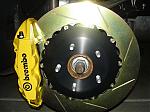
With the 15" rotors and Brembo brake kit you absolutely get shorter stopping distances. The rotors are lighter so you have less rotational mass. The pads are considerably thicker so they absorb heat better. The 15" rotors absorb heat way better as well. You are converting all the speed into heat so when you deal with the heat better, your going to stop faster. While the differences may be only 5-7 feet from 100-0. Those numbers go up dramatically when repeated braking. The 15" rotors have tremendous leverage. Imagine using a small socket vs a torque wrench. The same amout of force applied to the torque wrench nets much larger levels of force to the nut. It's the same principle. I barely touch the brakes and it just slows dramatically.
Plus when 60-0 isn't that much speed. But when you're doing 160mph the heat transfer is like 4x more. The amount of heat generated during braking is not linear the faster you go it's exponential. So stock brakes vs 15" from 150mph plus is going to net more difference. Also the stock brakes only have 2 pistons in front and 1 in the rear. The pistons are only on one side of the caliper so basically your smashing the pad into the other side of the caliper and the pad is waiting. Brembos are a monoblock caliper that's ultra stiff and massive pistons with thick piston bores. While it's true the tires make a huge difference, the brakes do too. The faster you go and the more repeated the braking duty, the bigger the differences.
In regard to stock vs Z51 the Z rotors crack as soon as you put some race pads in there. I have pics of the cracked rotors if you want to see. You are better off spending that money on a front brake kit from StopTech, Brembo or Alcon. If not brake kit a lighter two piece rotor and upgraded pads will yield better results than swapping to a Z51 setup. If you're in NorCal, you can demo my 15" brakes and you can see for yourself. It's one thing to read it and quite another to feel the difference. Hope this helps.
Suspension makes a big difference to. A controlled weight transfer by the shocks also helps load the tires sooner. The stiffer spring rates reduce the dive. When you have more weight centered over the car instead of all on the front you'll have more overall grip.
Plus when 60-0 isn't that much speed. But when you're doing 160mph the heat transfer is like 4x more. The amount of heat generated during braking is not linear the faster you go it's exponential. So stock brakes vs 15" from 150mph plus is going to net more difference. Also the stock brakes only have 2 pistons in front and 1 in the rear. The pistons are only on one side of the caliper so basically your smashing the pad into the other side of the caliper and the pad is waiting. Brembos are a monoblock caliper that's ultra stiff and massive pistons with thick piston bores. While it's true the tires make a huge difference, the brakes do too. The faster you go and the more repeated the braking duty, the bigger the differences.
In regard to stock vs Z51 the Z rotors crack as soon as you put some race pads in there. I have pics of the cracked rotors if you want to see. You are better off spending that money on a front brake kit from StopTech, Brembo or Alcon. If not brake kit a lighter two piece rotor and upgraded pads will yield better results than swapping to a Z51 setup. If you're in NorCal, you can demo my 15" brakes and you can see for yourself. It's one thing to read it and quite another to feel the difference. Hope this helps.
Suspension makes a big difference to. A controlled weight transfer by the shocks also helps load the tires sooner. The stiffer spring rates reduce the dive. When you have more weight centered over the car instead of all on the front you'll have more overall grip.
Last edited by bowmanized; Dec 16, 2007 at 04:23 AM.
Team Owner
Joined: Oct 2001
Posts: 56,381
Likes: 79
I would like to see a link showing the difference in stopping distance for rotor size change. The larger 15" rotors are for heat dissipation on tracks, not "stopping distance". Racing brakes are not even used for panic "stopping". They are used for "slowing" and RARELY do you ever STOP on a race track, so no one cares what the "stopping distance" is.
Not true. If more brake torque was needed it could very easily be provided by a larger master cylinder, which would not carry with it penalties in increased unsprung mass.
The latest Japanese and European "Super Cars" are very powerful and VERY, VERY HEAVY. Thus they require the heat capacity of a 15 inch brake rotor to dissipate the enormous amounts of kinetic energy associated with 4000lbs moving at high speeds.
The latest Japanese and European "Super Cars" are very powerful and VERY, VERY HEAVY. Thus they require the heat capacity of a 15 inch brake rotor to dissipate the enormous amounts of kinetic energy associated with 4000lbs moving at high speeds.