When you click on links to various merchants on this site and make a purchase, this can result in this site earning a commission. Affiliate programs and affiliations include, but are not limited to, the eBay Partner Network.
Finally took my '66 L-79 for a dyno run. I recalled this engine being much stronger when it was new (original owner). It also does not idle like an L-79. It was rebuilt years ago then sat until the restoration was complete. The re-builder is gone from the area, but I've wondered if a true L-79 clone cam was used and whether the engine was balanced after installation of 10:1 pistons to cope with the gasoline available 12 years ago.
Chevy spec says 350HP at 5800 rpm, torque 360 @ 3600 for the L-79. I know those are flywheel numbers with no accessories, so I'm not expecting anything close to them.
Here's what the dyno runs showed (70 degree day, low humidity). Took the engine to 5500 rpm.
Peak RWHP 186.2 @ 4350rpm, max torque of 269.2 @ 2750rpm. HP and torque falling off after the rpms noted. Engine sounded strong all the way to 5500rpm, so I don't think there was an ignition problem.
Given the relatively low rpms where power and torque peaked, and the low RWHP, I'm suspecting the cam is not an L-79 clone.
On a Dynojet inertia type dyno most 327s will make about 270-280 SAE corrected RW torque since torque is primarily a function of displacement and compression ratio.
A decent L-79 should make about 220 SAE corrected RWHP and a 327/300 about 190. So your engine's performance is closer to a 327/300 than an L-79.
You need to specify the dyno type and what, if any, correction method was used. If you have a graph scan and post it.
Once way to estimate the installed cam is to know manifold vacuum at observed idle speed. These are well know for OE engines.
2020 Corvette of the Year Finalist (appearance mods)
C1 of Year Finalist (appearance mods) 2019
Originally Posted by SWCDuke
On a Dynojet inertia type dyno most 327s will make about 270-280 SAE corrected RW torque since torque is primarily a function of displacement and compression ratio.
A decent L-79 should make about 220 SAE corrected RWHP and a 327/300 about 190. So your engine's performance is closer to a 327/300 than an L-79.
You need to specify the dyno type and what, if any, correction method was used. If you have a graph scan and post it.
Once way to estimate the installed cam is to know manifold vacuum at observed idle speed. These are well know for OE engines.
So...?
Duke
I think his results would be closer to a 300hp 327 with the 10-1 pistons he had installed. The cam might be an L-79 but it can only do as much as it can with the lower compression.
From: Middle TN by way of KY, OH, VA, IL, CA, FL, NY, SC, HI
Hard to tell a cam from a chassis dyno readout - lots of variables, but laying down at 5500 would make me think at least it is a hydraulic cam/lifters.
How smooth is the idle? Any lumpiness to it at all? Vacuum at idle? What rear gears are in it and what size tires are you running? Knowing that would narrow it down.
I think his results would be closer to a 300hp 327 with the 10-1 pistons he had installed. The cam might be an L-79 but it can only do as much as it can with the lower compression.
Despite the advertised L-79 CR of 11:1, most left Flint closer to 10.5 due to broach wear that caused deck height to be up to .015" higher than the nominal 9.025".
If the current compression ratio is truly 10.1 versus 10.5, whether a 300 HP or L-79 cam the average difference in torque/power across the rev range would be on the order to 2-3 percent.
Idle behavior is always a good clue to the cam's characteristics.
Those two items only have a very minor effect on chassis dyno results.
Duke
that is something that has always puzzled me... why don't tire size and rer affect dyno readings as they are mechanical torque multipliers.
"I" would think that in identical vehicles with only a difference in tires/rer that one with a 4.56 and short tires should be significantly difference from one with a 3.08 and tall tires.
Hard to tell a cam from a chassis dyno readout - lots of variables, but laying down at 5500 would make me think at least it is a hydraulic cam/lifters.
How smooth is the idle? Any lumpiness to it at all? Vacuum at idle? What rear gears are in it and what size tires are you running? Knowing that would narrow it down.
It's definitely hydraulic lifters. 5500 is the top rpm that I told the dyno guy to run to. Since hp and torque were already falling off below 5500, it didn't make any sense to run it to redline.
I'll be checking vacuum today or tomorrow. Rear gears are 3.36, tires are 215 70 R15.
It's definitely hydraulic lifters. 5500 is the top rpm that I told the dyno guy to run to. Since hp and torque were already falling off below 5500, it didn't make any sense to run it to redline.
I'll be checking vacuum today or tomorrow. Rear gears are 3.36, tires are 215 70 R15.
Thanks, Ralph
My L-79 1966 with Comp Cam X256 , 10.0 compression 18* vc Holley 4160 , original crank, etc, intake....rods
Flat top pistons....on dyno 380 torque 345 HP just the engine dyno
5,300 rpm with crapy distrubtor at the time with scatter ...
The one point drop in SCR will lower torque by about 10% across the entire rev range. Worst thing you could have done was to replace OEM domes with flat tops.
Compare chassis dynoruns to a well built 327 for street use:
Last edited by 65tripleblack; May 1, 2018 at 09:15 AM.
The one point drop in SCR will lower torque by about 10% across the entire rev range. Worst thing you could have done was to replace OEM domes with flat tops.
I ran my Hemi/vette on a DynoJet last summer. I'm familiar with the drive train loses on my 911 Porsche so was interested in the Vette. It came out to about 20-25% at the rear wheels.
I ran my Hemi/vette on a DynoJet last summer. I'm familiar with the drive train loses on my 911 Porsche so was interested in the Vette. It came out to about 20-25% at the rear wheels.
I ran my Hemi/vette on a DynoJet last summer. I'm familiar with the drive train loses on my 911 Porsche so was interested in the Vette. It came out to about 20-25% at the rear wheels.
...more like 15 percent in the direct drive top gear with a manual and 20 percent for automatics. Radial tires and high tire pressure are the best way to get the best number.
...more like 15 percent in the direct drive top gear with a manual and 20 percent for automatics. Radial tires and high tire pressure are the best way to get the best number.
Duke
15% is what I use although there are probably many variables to consider. I would think that lower viscosity gear oil would make a difference. Almost certainly the reason that OEMs went to ATF for manual gearboxes in the 1980s. I understand that energy loss is proportional to heat generated, so higher shear in the traditional gear lube means more heat, although slightly more friction at gear interface due to the less viscous ATF might translate to more sliding friction and more heat...................partially offsetting the shear heat generation advantage.
Other variables would probably be differential gear ratio, assuming that dyno pulls are always done at 1:1 trans ratio. Check Test C here (a 3.70:1 diff should translate to higher power loss percentages and higher trans input shaft speed would do the same:
331 CI, pump-friendly 9.5:1 CR
K&N 14"x4" air filter, Corvette drop base and lid
Holley 600 dp, choke horn milled and blended, Primary - 69, Secondary – 74, Squirters - 21
1/2" Aluminum open spacer port matched to manifold, exterior polished
Edelbrock Performer RPM intake manifold, port matched, exterior polished with all extraneous castings and lettering removed
Homemade lifter valley splash shield to keep hot oil off manifold bottom
Manifold heat riser crossover blocked
Camel hump 1.94/1.50 heads hogged out to 2.02/1.60, pocket ported, port matched, pump-friendly hardened seats, 3-angle valve job
All porting and port matching performed by Juan Mendoza of Flow Technology
Cylinder bores clearanced to unshroud the valves
Comp Cams 1.52:1 roller-tip rockers
Crane Cam Vintage Muscle 327/350 hp cam, 222 degrees @ 0.05, 0.447" lift (with 1.50 rockers)
Doug Thorley headers, dechromed and ceramic-coated
2.5" mandral-bent exhaust (including tips), 2" cross-over just before rear axle
DynoMax stainless Ultra Flow mufflers
Millerspeed 1-1/2” Gilmer under drive belt drive system
Mallory Hyfire IV CD ignition box triggered off Accel points
Mallory high voltage chrome coil
Mallory spiral-wound coil wire
Mallory solid copper plug wires, ends soldered to wires
Champion plugs
37 degrees total ignition advance
Carter high volume fuel pump
Melling high volume oil pump
Open breathers
Polished aluminum high flow water pump
160-degree thermostat
Flex fan with polished aluminum spacer
Polished aluminum one-wire 100 amp alternator
Header Power Bracket
Keisler TKO600 5-Speed
Hurst shifter
3.70:1 positraction with Big Block yokes
225/60/15 Firestone Firehawk SZ50s on 7”-wide Western 30-spoke Turbine Wheels
Actually the hp is down a bit because the valve springs had gone over 30# weak. They have now been replaced and the engine pulls better but has not been on the dyno again since.




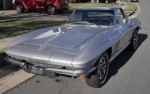


 What do these numbers say about the cam?




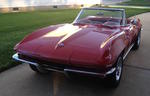















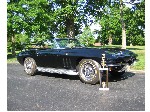

 .. depends on your perspective

 ... the usual 'rule of thumb'


