When you click on links to various merchants on this site and make a purchase, this can result in this site earning a commission. Affiliate programs and affiliations include, but are not limited to, the eBay Partner Network.
Thanks for the document barkingrats. I've saved it to my files for possible reference if greasing all joints doesn't solve the problems. I've seen Jim Shea documents before and they're always comprehensive.
The combination of stiff and not returning to center does not sound like a suspension or alignment issue to me. I am looking into my own steering issues and reading up on all sorts of papers. In my Jim Shea folder, I found the following about adjusting the steering box gears (attached pdf):
You shouldn't have to adjust anything in your rebuilt box, reread post 5.
Update:
Greased all joints. Adjusted hydraulic cylinder to center ram with engine running.
When driving - steering seems slightly better. Little more force required turning right, especially at low rpm. Seems to self-center. Very little drift from straight ahead. Remember, no alignment yet.
When parked with engine running MUCH force is needed to turn right. Left turn might be "normal," but not as easy as a newer non-Vette.
Car on jack stands - Removed tie rod ends from spindles and both wheels turn easily with hands on tires. Steering wheel turns easily in both directions.
Engine not running.
This seems to give a thumbs up to gear box and relay rod???
Tie rods reattached, hydraulic ram disconnected. A LOT of effort required to move the wheels by hand. Engine started, "a fair amount" of effort to turn the steering wheel to force ram movement. (Sorry, can't quantify "a fair amount.") Seems to be more effort than when everything is attached for normal driving.
As previously stated, the fluid level is within range...no foaming or bubbles. Belt tight. Both the pump and control valve are "remanufactured."
Any time you are applying hand or steering wheel pressure to a connected P/S system, you are having to force fluid in the system. This is very tough to do and I'm not surprised the effort is greatly increased over disconnected tie-rods.
When you adjusted the valve, you had the ram disconnected at the frame and adjusted the valve so the rod did not move in or out, yes?
If so, I'm thinking your control valve is not switching directions properly/effectively. It should switch the high pressure through the appropriate ram hose depending on direction input changes from the steering box. I don't think it's a pump problem, otherwise you'd see the trouble in both directions.
Sounds like your car started a manual steering conversion on its own. My 80 did this within a few months of buying her. No new leaks, no explanation, the power steering just became manual steering*. I completed the conversion with the proper parts from an earlier car.
For $115-, swap out the power steering control valve for a Borgeson 990002 manual drag link adapter. Using your PSC valve in manual mode will destroy it.
Then you'll be halfway to a Borgeson conversion when the rest of the kit comes off of backorder.
* The original version of this joke was about the C3 Corvette's power steering. Mitch Hedburg changed it to appeal to a broader audience.
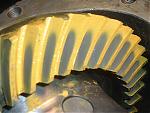
This is a "restored" 67 steering box, off a "restored" 67. The only thing is, their version of restored was to paint it and put a yellow dab on it. No preload left, no high lash, never rebuilt, no grease left.
Now, it is blueprinted, beyond rebuilt, and is dialed in.
The only way you will know the condition of the box is to check- out of the car and do not go by YT videos, they're all wrong- at least those I have seen.
I am not speaking of the paint, that means nothing. Internal mods and custom parts make the difference. The yellow line is where the box has to be.
With the ram nut adjusted so there is no ram movement, how much force should be required to move the ram in and out by hand - engine off? A video I watched showed the tech moving the ram back and forth with two fingers. Not so with mine, much force is required.
Videos I saw demonstrated very little rotation of the adjustment nut to get the ram to change direction. Mine required at least one full rotation.
With the ram nut adjusted so there is no ram movement, how much force should be required to move the ram in and out by hand - engine off? A video I watched showed the tech moving the ram back and forth with two fingers. Not so with mine, much force is required.
Videos I saw demonstrated very little rotation of the adjustment nut to get the ram to change direction. Mine required at least one full rotation.
In my opinion, if the system still has all 4 hoses connected to the valve and pump, you're going to have a very difficult time pushing/pulling the ram. You're fighting against hydraulic valves and seals, similar to trying to push a shock absorber rod back into the cylinder.
I don't recall the amount of nut movement to change directions on the ram, when I did it several years back, but I think it was just about 1/8 to 1/4 turn to switch directions when you get to that balance point.
With the ram nut adjusted so there is no ram movement, how much force should be required to move the ram in and out by hand - engine off? A video I watched showed the tech moving the ram back and forth with two fingers. Not so with mine, much force is required.
Videos I saw demonstrated very little rotation of the adjustment nut to get the ram to change direction. Mine required at least one full rotation.
PS pump generates over 1,000 psi, don't think the system was designed to move with your fingers.
This sounds like a question for the guys at TURN ONE Performance Steering. They might have the answer for you or they can point you in the right direction. They even helped me with my Steeroids Power rack and pinion getting the right output pressure from a power steering pump.
I got so tired of the old steering system and it's quirks that I removed it from service and installed a new power rack and pinion on my C3 and I love it. The Steeroids system makes the C3 drive like a modern Corvette with little effort required to turn and it tracks dead-on straight while cruising on the highways. The whole installation was done on my garage floor by a guy with five crushed discs in his lower back....
Today I can steer my C3 with one finger and still enjoy doing it. For some reason the manual steering of a VW Bug was easy to get used to, a manual steering Corvette is another whole different matter. Manual steering has it's places and most of it is in a lightweight car with a tiny 4 cylinder aluminum engine on top of it. I drove my cousin's 1969 SB Corvette with manual steering and it was more than I would deal with on a normal basis, it would be a nightmare with a BB in front.
Problem solved - maybe. The stiffness seems to be eliminated. After some pointers from a couple of forum members on another post it became clear that I wasn't following control valve balancing instructions to the T. I wasn't changing the rotation of the adjustment nut as soon as the ram changed direction. Following instructions precisely sometimes helps. I say "maybe" solved because my testing is limited to the shop - rain chances too high to risk a road trip.
Thanks Bikespace for reminding me to provide an update. The car steers much better after properly balancing the power steering valve. Equal force required for right and left turns. Because it’s been so long since I last drove i don’t know if it’s as good as it can be, BUT I’ll take it…for now. Other challenges to address, but at least I can drive it. I guess an old Vette is never really “done.”
Designer Imagines A Corvette That Looks More Like a Corvette Than the Corvette
Slideshow: A Jaguar designer's personal project imagines what a modern front-engined Corvette might look like if Chevrolet revisited the golden age of the Stingray.