When you click on links to various merchants on this site and make a purchase, this can result in this site earning a commission. Affiliate programs and affiliations include, but are not limited to, the eBay Partner Network.
There's no need for a small cam like that to be idling at 900 RPM, if it won't idle at 650-700 RPM you have tuning issues. With a 110 lobe separation there is going to be a slight lope to the idle, but with 400 cubes it's going to be slight.
You should check/adjust the rockers, as the oscillation of that vacuum needle might suggest you have a valve hanging open slightly (valve preload to tight)
Even the wimpiest of valve springs would do fine in that engine up to 4500-5000 rpm, and at Idle RPM, it won't be the cause of your issue. What springs are in there anyhow? It wouldn't take much extra spring to control the valvetrain at 6000 RPM.
Those XR cams are known for having very fast ramps on the lobes that cause quite a bit of valvetrain noise (not your issue, but something to be aware of).
I am indeed experiencing valve train noise. No matter how much I try to adjust them, I always get tapping/clattering. I understand it’s normal for the cam but it annoys me.
I have no idea what springs are on there.
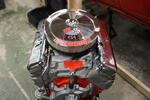
The heads are these aluminum RPC. They came with the 400. I can only presume that the springs came with the head.
I replaced the rather peaky hydraulic flat tappet cam with a retrofit hydraulic roller cam.
As I say, the idle seems to be fine, even at 750 RPM. It is just not as smooth as I would have expected.
Will pull and inspect the plugs later today
Water pump needs to come off. It’s making a racket. Won’t be able to test until new water pump comes in.
Take a spring off and run to a machine shop and have them test a spring....at installed height and then at full lift. That will tell you what you need to know about the springs
Yes. Time to take action with regards to the valve springs. They need to come off and I need to measure the installed height.
----------------------------------------------------- EDIT: @OMF , thanks for the input. Again, being overseas is always more challenging... Access to tools and parts and... skill.
I submitted a Summit order for the tools required to efficiently remove the valve springs. Included in the order are a micrometer to measure seat height and tool to measure the seat pressure. At this point, I am curious about the seat pressure and have decided that I will replace these springs anyway, whatever the reading. The seat pressure tool will be necessary for the installation of the new springs anyway.
Looking at all the symptoms. From subtle idle issues, to flat spot at mid-range RPM (with what sounds like exhaust lead clatter), to pulling strong at higher RPM and then suddenly giving up... I think the springs do need to be ruled out.
-----------------------------------------------------
Stay tuned.
Last edited by DorianC3; Apr 13, 2026 at 02:38 AM.
I am indeed experiencing valve train noise. No matter how much I try to adjust them, I always get tapping/clattering. I understand it’s normal for the cam but it annoys me.
I have no idea what springs are on there.
The heads are these aluminum RPC. They came with the 400. I can only presume that the springs came with the head.
I replaced the rather peaky hydraulic flat tappet cam with a retrofit hydraulic roller cam.
As I say, the idle seems to be fine, even at 750 RPM. It is just not as smooth as I would have expected.
Will pull and inspect the plugs later today
Water pump needs to come off. It’s making a racket. Won’t be able to test until new water pump comes in.
Minutes ago, I looked at RPC site; the site itself is garbage.
I cannot find any assembled heads or any valve springs.
No significant specs for any assembled head components either.
Suggest you measure Both lobe lift and valve lift; from those two your can calculate Your approximate rocker arm ratio.
Suggest measure both Intake And Exhaust valve lengths.
Suggest you measure your valve springs Installed Height when closed-On Seat as well as when Fully-Open.
Suggest you inspect valve springs for Any coil bind; check when Fully-Open.
If No bind, measure total cumulative distance of gaps between coils when Fully-Open ?
No mention of rocker arms' brand, type etc. Suggest you pull a few off and closely inspect. Perhaps RAs are noisy ?
But my understanding is that Roller Lifter Cams require much higher spring pressures than flat tappet cams would. So if ones is running flat tappet cams on a roller there could be issues with lifters ramping off the cam lobes and rapping back down.
Personally I do not think the springs themselves have anything to do with the rough idle.
Comps HR lifters do make noise and one could get bleeding down.
If the springs are way too strong for the HR lifters, then yes they could get bleeding down. But that would just mean more noise, less power, not sure it would even affect the idle.Maybe?
With mild .510" valve lift you should not have any retainer clearance issues.
That mild cam should make great vacuum at idle, and be steady.
Fluctuating vacuum at idle could easily be one valve adjusted to tight, and leaking. Find a good video online to carefully adjust your hydraulic lifter preload. 1/4 turn or 1/2 turn. It is surprisingly easy to mess this up. And doing so will definitely cause a rough idle. My best guess is this. If not, likely the springs.
Valve springs must match the cam. I know you had a high rpm race cam in there when you bought it. It would have had stiff springs. If you left them in that could be the source of your lifter issues. Check comp cams site for spring recommendations for that specific cam
Link for comps recommended springs. 284# open. 134# seat.
Not sure why you are looking at valve springs for an idle problem. That wouldn't be the first item on my list.
That 106 deg LSA is going to give you a rougher idle than the same cam with a more standard 110-112 LSA, but I wouldn't expect it to be objectionable. I would be looking at idle mixture and timing. Idle timing I would expect to be around 25-27 degrees with the vacuum advance connected. Those plugs look like your mixture is lean, which would explain the rough idle.
That 106 deg LSA is going to give you a rougher idle than the same cam with a more standard 110-112 LSA,
That cam he's running has a LSA of 110 degrees not 106. The 106 is for the intake centerline.
I do agree though that 110 LSA will produce more of a lope compared to 112 LSA.....with 400 cubes and a small cam I don't think this is the issue, I'm sure he has one valve with to much preload and it's hanging open.
That's the thing, this is a 400. I was expecting smoother.
The reason I am looking at the valve springs is because the "problem" appeared when I converted to a roller-cam. The idle feels... off. I think it should be relatively smooth with this cam.
Also, I pretty much checked everything else.
I think it would be a good move to replace the unknown springs with appropriate ones.
So, this camshaft wants: 134# seat. and 284# open. Is that correct ? The cam card has "986-16" written on it. I presume those are the recommended springs... but they seem to be no longer available on Summit, my favorite source.
The primary reason Roller cams need more spring is because Their Roller LIFTERS are much heavier than flat tappets; that Additional heft needs More spring pressure to control it.
Typically, Retro-Roller LIFTERS are considerably heavier versus OE Roller LIFTERS; heavier needs more spring pressure in order to maintain control.
Back when CUP motors still had Flat Tappets, they could & did rev higher than today's Roller CUP motors; because they had less valvetrain mass to control. And, to further complicate things, their Intentional Lifter LOFTING resulted in very short lives of both lifters & lobes. Spring technology still has physical limitations.
FWIW: I suspect OP's rocker arms are (in some respects) much like his heads.
That cam he's running has a LSA of 110 degrees not 106. The 106 is for the intake centerline.
I do agree though that 110 LSA will produce more of a lope compared to 112 LSA.....with 400 cubes and a small cam I don't think this is the issue, I'm sure he has one valve with to much preload and it's hanging open.
Cheers, Forrest
My bad. I read the cam card too quickly.
I agree with 400 CID and that cam, the idle should be pretty smooth. I looked at the videos and they didn't tell me much. The idle is too high and that is masking any problem, if it exists. At 900 rpm it seems to run fine.
A valve hanging open wouldn't be the first thing I thought of, but of course it's possible. A compression check will tell us that in a hurry.
As for the valve train noise, that's the roller cam. Mine does the same thing.
My advice to the OP would be to do the compression test to satisfy yourself that the valves are closing properly. Then check the timing at idle. Make sure you have about 25 degrees of advance. If all that checks out, it's the idle mixture.







 Idle quality question - too much rumble ?


 Will pull plugs tomorrow. Maybe something to see there.