


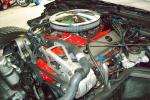


Distributor Not Seating

Thread Starter
Heel & Toe

Joined: Apr 2026
Posts: 22
Likes: 1
 Distributor Not Seating
I took out the distributor to get at a socket that fell behind it and the firewall, and it refuses to seat in the same position it came out. In fact, it only wants to seat in one orientation, which moves as I turn the engine over. The distributor and drive gear aren't keyed, right? I'm sure it isn't, and it in no way looks like it is. But I have to ask, since it definitely feels like it is. I have a '71 Alfa Spider, and that does have a distributor drive that's keyed. Is there something I'm missing?

Team Owner


Joined: Jan 2003
Posts: 20,305
Likes: 240
From: Summerland B.C. Canada
It’s not keyed, but the oil pump drive shaft is like a key.
A long handle flat screw driver can be used to turn the pump shat so it aligns with coupler on distributor gear.
Also note the you have will have start installing with the rotor slightly retarded from where you want it to finish when fully seated, as the gears will cause it to rotate when installing.
A long handle flat screw driver can be used to turn the pump shat so it aligns with coupler on distributor gear.
Also note the you have will have start installing with the rotor slightly retarded from where you want it to finish when fully seated, as the gears will cause it to rotate when installing.

Drifting


Joined: Nov 2018
Posts: 1,752
Likes: 645
From: USA
I took out the distributor to get at a socket that fell behind it and the firewall, and it refuses to seat in the same position it came out. In fact, it only wants to seat in one orientation, which moves as I turn the engine over. The distributor and drive gear aren't keyed, right? I'm sure it isn't, and it in no way looks like it is. But I have to ask, since it definitely feels like it is. I have a '71 Alfa Spider, and that does have a distributor drive that's keyed. Is there something I'm missing?

Pro


Joined: Feb 2001
Posts: 504
Likes: 13
From: Calgary, Alberta, Canada
To seat the distributer after spinning the engine over is a relatively complex, but not impossible process as mentioned above. This exact scenario just happened to me on my 1985 Corvette while removing the intake.
It would be essential, as a start, to reseach many of the existing video's on the entire process on setting top dead center (TDC) on #1 cylinder on a 350 engine, as already mentioned.
However from my recent experience, you will have to know and be sure that you are on TDC #1 Cylinder "On The Compression Stroke" on piston #1. I assure you that getting this absolutely correct will save you alot of time and effort as this is required before you even get to the distributer / rotor step. To ensure that I was on the compression stroke on #1 piston, I removed the #1 spark plug had a camera bore scope to see inside the block and watch the piston progress upwards as I was turning the crank bolt with a "flex head long bar ratchet" slowly by hand. Once I saw that the piston was going upward close to the top (this confiirmed to me that I was on the compression stroke). I then finally aligned the timing mark with the mark on harmonic balancer to achieve TDC.
Some of the videos show only how to achive top dead center (TDC) with the cylinder heads already removed from the block.
Note 1 - I did remove my driver side valve cover earlier on as a double check to ensure that I was on the compression stroke, but looking back now, it wasn't required.
Note 2 - A flex head ratchet simplified the TDC process for me as I had limited space to access the crank bolt between my radiator and Vansteel camber brace in which I preferreed not to remove.
https://directlift.ca/ratchet-3-8-dr...eC3ws88C6iq_S_
The distributer step will be the next step in which I'm sure there are videos on the process that likely already exist. Allocate time and extra patience in this procedure.
I hope this helps.
It would be essential, as a start, to reseach many of the existing video's on the entire process on setting top dead center (TDC) on #1 cylinder on a 350 engine, as already mentioned.
However from my recent experience, you will have to know and be sure that you are on TDC #1 Cylinder "On The Compression Stroke" on piston #1. I assure you that getting this absolutely correct will save you alot of time and effort as this is required before you even get to the distributer / rotor step. To ensure that I was on the compression stroke on #1 piston, I removed the #1 spark plug had a camera bore scope to see inside the block and watch the piston progress upwards as I was turning the crank bolt with a "flex head long bar ratchet" slowly by hand. Once I saw that the piston was going upward close to the top (this confiirmed to me that I was on the compression stroke). I then finally aligned the timing mark with the mark on harmonic balancer to achieve TDC.
Some of the videos show only how to achive top dead center (TDC) with the cylinder heads already removed from the block.
Note 1 - I did remove my driver side valve cover earlier on as a double check to ensure that I was on the compression stroke, but looking back now, it wasn't required.
Note 2 - A flex head ratchet simplified the TDC process for me as I had limited space to access the crank bolt between my radiator and Vansteel camber brace in which I preferreed not to remove.
https://directlift.ca/ratchet-3-8-dr...eC3ws88C6iq_S_
The distributer step will be the next step in which I'm sure there are videos on the process that likely already exist. Allocate time and extra patience in this procedure.
I hope this helps.
Last edited by Magnet; May 24, 2026 at 03:04 PM.

Melting Slicks


Joined: Feb 2003
Posts: 2,673
Likes: 810
From: Saskatoon Sask.
To seat the distributer after spinning the engine over is a relatively complex, but not impossible process as mentioned above. This exact scenario just happened to me on my 1985 Corvette while removing the intake.
It would be essential, as a start, to reseach many of the existing video's on the entire process on setting top dead center (TDC) on #1 cylinder on a 350 engine, as already mentioned.
However from my recent experience, you will have to know and be sure that you are on TDC #1 Cylinder "On The Compression Stroke" on piston #1. I assure you that getting this absolutely correct will save you alot of time and effort as this is required before you even get to the distributer / rotor step. To ensure that I was on the compression stroke on #1 piston, I removed the #1 spark plug had a camera bore scope to see inside the block and watch the piston progress upwards as I was turning the crank bolt with a "flex head long bar ratchet" slowly by hand. Once I saw that the piston was going upward close to the top (this confiirmed to me that I was on the compression stroke). I then finally aligned the timing mark with the mark on harmonic balancer to achieve TDC.
Some of the videos show only how to achive top dead center (TDC) with the cylinder heads already removed from the block.
Note 1 - I did remove my driver side valve cover earlier on as a double check to ensure that I was on the compression stroke, but looking back now, it wasn't required.
Note 2 - A flex head ratchet simplified the TDC process for me as I had limited space to access the crank bolt between my radiator and Vansteel camber brace in which I preferreed not to remove.
https://directlift.ca/ratchet-3-8-dr...eC3ws88C6iq_S_
The distributer step will be the next step in which I'm sure there are videos on the process that likely already exist. Allocate time and extra patience in this procedure.
I hope this helps.
It would be essential, as a start, to reseach many of the existing video's on the entire process on setting top dead center (TDC) on #1 cylinder on a 350 engine, as already mentioned.
However from my recent experience, you will have to know and be sure that you are on TDC #1 Cylinder "On The Compression Stroke" on piston #1. I assure you that getting this absolutely correct will save you alot of time and effort as this is required before you even get to the distributer / rotor step. To ensure that I was on the compression stroke on #1 piston, I removed the #1 spark plug had a camera bore scope to see inside the block and watch the piston progress upwards as I was turning the crank bolt with a "flex head long bar ratchet" slowly by hand. Once I saw that the piston was going upward close to the top (this confiirmed to me that I was on the compression stroke). I then finally aligned the timing mark with the mark on harmonic balancer to achieve TDC.
Some of the videos show only how to achive top dead center (TDC) with the cylinder heads already removed from the block.
Note 1 - I did remove my driver side valve cover earlier on as a double check to ensure that I was on the compression stroke, but looking back now, it wasn't required.
Note 2 - A flex head ratchet simplified the TDC process for me as I had limited space to access the crank bolt between my radiator and Vansteel camber brace in which I preferreed not to remove.
https://directlift.ca/ratchet-3-8-dr...eC3ws88C6iq_S_
The distributer step will be the next step in which I'm sure there are videos on the process that likely already exist. Allocate time and extra patience in this procedure.
I hope this helps.
^^^^^^^ You may have got lucky (50% chance) or you are leaving something out but the description above does not guarantee you are on the compression stroke. You could have just as likely been on the exhaust stroke. Feeling for compression with your thumb/finger blocking the spark plug hole on #1 indicates the right stroke, not a borescope unless it also tells you both valves are closed.
Pro
Joined: Feb 2001
Posts: 504
Likes: 13
From: Calgary, Alberta, Canada
Thanks for the message.
I had the driver side valve cover removed, which proved to me by the position of the intake/exhaust valves on #1 that I was on the compression stroke. "Feeling for compression with your thumb/finger blocking the spark plug hole on #1 indicates the right stroke" certainly is another way of confirming compression stroke, but that's not what I did as I was posting from my direct experience which was successful. Likely, there are other way to confirm the compression stroke too.
My intention here is not to rewrite the complete GM procedure manual here or replace some great and informative videos already in existance. My intention is to share from my experience on what I did and add some beneficial information to this thread. In my opinion, your comment does add value and information to this thread.
I had the driver side valve cover removed, which proved to me by the position of the intake/exhaust valves on #1 that I was on the compression stroke. "Feeling for compression with your thumb/finger blocking the spark plug hole on #1 indicates the right stroke" certainly is another way of confirming compression stroke, but that's not what I did as I was posting from my direct experience which was successful. Likely, there are other way to confirm the compression stroke too.
My intention here is not to rewrite the complete GM procedure manual here or replace some great and informative videos already in existance. My intention is to share from my experience on what I did and add some beneficial information to this thread. In my opinion, your comment does add value and information to this thread.
Last edited by Magnet; May 24, 2026 at 07:23 PM.
Drifting
Joined: Nov 2018
Posts: 1,752
Likes: 645
From: USA
The compression stroke at TDC will occur right after you observe the intake valve/rocker arm finish its stroke and close....When things are "right" for cylinder #1, the timing line on the harmonic balancer will line-up with the "0" notch on the the timing cover tab/indicator....if on #6 TDC/compression stroke, the timing line on the balancer will be rotated 180° and pointed towards the ground of the passenger side. I didn't go into specifics about this, because I didn't want to write a book either and figured these details would be addressed in a legitimate video(s)/article(s) that I suggested to research👍
Last edited by '78CorvetteS.A.; Yesterday at 06:40 AM.
Corvette Stories
The Best of Corvette for Corvette Enthusiasts

Top 10 Most Explosive Corvettes Ever Made: Power-to-Weight Ratio Ranked!
Joe Kucinski
150 hp to 1,250 hp: Every Corvette Generation Compared by the Specs That Matter
Joe Kucinski
8 Coolest Corvette Pace Cars (and Replicas) of All Time
Verdad Gallardo
Top 10 Corvette Engines RANKED by Peak Torque (70+ Years of Muscle!)
Joe Kucinski
Corvette ZR1X Will Be Pacing the Indy 500, And Could Probably Race, Too!
Verdad Gallardo
Top 10 Corvettes Coming to Mecum Indy 2026!
Brett Foote
Top 10 C9 Corvette MUST-HAVES to Fix These C8 Generation Flaws!
Michael S. Palmer
10 Revolutionary 'Corvette Firsts' Most People Don't Know
Joe Kucinski
5 Reasons to Upgrade to an LS6-Powered Corvette; 5 Reasons to Stay LT2
Michael S. Palmer
Melting Slicks


Joined: Nov 2016
Posts: 2,251
Likes: 3,071
From: So Cal
2023 C4 of the Year Finalist - Unmodified
There are 4 pairs of pistons that are at TDC simultaneously every 90deg of crankshaft rotation. In an 8 cyl, 90deg V, 4 stroke configuration a cyl fires every 90 deg of crankshaft rotation, so 2 revolutions of the crankshaft for all 8 to fire.
Here's another tid-bit to consider. With common crank-pins in a 90deg V8, the paired cyls reach TDC 90 degrees of crank rotation apart. In the SBC, the right bank reaches TDC 90 deg crank before the left bank. The crank pin cyl parings are 1&2, 3&4, 5&6 and 7&8. 1 fires 90deg after 2, 3 fires 90deg after 4, 5 fires 90 deg after 6. The 7&8 pair is different. 7 fires 450deg after 8. (360 of crank + 90 for the V).
Last edited by IHBD; Yesterday at 08:45 AM.

Melting Slicks

Joined: Oct 2003
Posts: 2,171
Likes: 820
From: Chapel Hill NC
2025 c3 ('68-'73) of the Year Finalist - Unmodified
2025 C4 of the Year Finalist - Unmodified
2025 C8 Stingray of the Year Finalist - Unmodified
Is the Alpha Spider engine distributor the same setup as a SBC?
Drifting
Joined: Nov 2018
Posts: 1,752
Likes: 645
From: USA
No. Both #1 and #6 pistons are at TDC at the same time. So the mark on the balancer lines up for both of them. The TDC firings are 360º crankshaft apart. The distributor rotates at 1/2 the speed of the crankshaft. So the #1 and #6 firing positions on the distributor are 180º apart. (78SA seldom gets makes a mistake like this. Maybe he stayed up too late or something. Cheers.)
There are 4 pairs of pistons that are at TDC simultaneously every 90deg of crankshaft rotation. In an 8 cyl, 90deg V, 4 stroke configuration a cyl fires every 90 deg of crankshaft rotation, so 2 revolutions of the crankshaft for all 8 to fire.
Here's another tid-bit to consider. With common crank-pins in a 90deg V8, the paired cyls reach TDC 90 degrees of crank rotation apart. In the SBC, the right bank reaches TDC 90 deg crank before the left bank. The crank pin cyl parings are 1&2, 3&4, 5&6 and 7&8. 1 fires 90deg after 2, 3 fires 90deg after 2, 5 fires 90 deg after 6. The 7&8 pair is different. 8 fires 270deg after 7.
There are 4 pairs of pistons that are at TDC simultaneously every 90deg of crankshaft rotation. In an 8 cyl, 90deg V, 4 stroke configuration a cyl fires every 90 deg of crankshaft rotation, so 2 revolutions of the crankshaft for all 8 to fire.
Here's another tid-bit to consider. With common crank-pins in a 90deg V8, the paired cyls reach TDC 90 degrees of crank rotation apart. In the SBC, the right bank reaches TDC 90 deg crank before the left bank. The crank pin cyl parings are 1&2, 3&4, 5&6 and 7&8. 1 fires 90deg after 2, 3 fires 90deg after 2, 5 fires 90 deg after 6. The 7&8 pair is different. 8 fires 270deg after 7.
Last edited by '78CorvetteS.A.; Yesterday at 08:44 AM.

Burning Brakes


Joined: Aug 2008
Posts: 839
Likes: 220
From: Tampa, FL
No. Both #1 and #6 pistons are at TDC at the same time. So the mark on the balancer lines up for both of them. The TDC firings are 360º crankshaft apart. The distributor rotates at 1/2 the speed of the crankshaft. So the #1 and #6 firing positions on the distributor are 180º apart. (78SA seldom makes a mistake like this. Maybe he stayed up too late or something. Cheers.)
There are 4 pairs of pistons that are at TDC simultaneously every 90deg of crankshaft rotation. In an 8 cyl, 90deg V, 4 stroke configuration a cyl fires every 90 deg of crankshaft rotation, so 2 revolutions of the crankshaft for all 8 to fire.
Here's another tid-bit to consider. With common crank-pins in a 90deg V8, the paired cyls reach TDC 90 degrees of crank rotation apart. In the SBC, the right bank reaches TDC 90 deg crank before the left bank. The crank pin cyl parings are 1&2, 3&4, 5&6 and 7&8. 1 fires 90deg after 2, 3 fires 90deg after 4, 5 fires 90 deg after 6. The 7&8 pair is different. 7 fires 450deg after 8. (360 of crank + 90 for the V).
There are 4 pairs of pistons that are at TDC simultaneously every 90deg of crankshaft rotation. In an 8 cyl, 90deg V, 4 stroke configuration a cyl fires every 90 deg of crankshaft rotation, so 2 revolutions of the crankshaft for all 8 to fire.
Here's another tid-bit to consider. With common crank-pins in a 90deg V8, the paired cyls reach TDC 90 degrees of crank rotation apart. In the SBC, the right bank reaches TDC 90 deg crank before the left bank. The crank pin cyl parings are 1&2, 3&4, 5&6 and 7&8. 1 fires 90deg after 2, 3 fires 90deg after 4, 5 fires 90 deg after 6. The 7&8 pair is different. 7 fires 450deg after 8. (360 of crank + 90 for the V).
If spark plug hole one (or cyl 1) is under compression at the time the harmonic balancer indicator is at the 0 degree mark, it's safe to say that piston #1 is at TDC, and is an OK location for her to re-install the distributor with it pointing to the #1 spark plug wire location on the distributor cap, correct?
We were trying to turn the crank with a socket wrench, and instead, my daughter had the idea to stuff a silicone plug into the spark plug hole, and then slowly crank the engine using the starter. All of a sudden, we heard a crazy pop, and the silicone plug was sent flying across the room. We looked at the balancer, and it was perfectly on the 0 mark.
Thank you, yes I know better, it was early this morning...don't know how I transposed the distributor and crank...I even sat there thinking about it, and I was like...yeah that's right...wait...no...yeah that's right. Should have stopped with watching the intake valve close! Very embarrassing!!! My whole point in posting initially, is after the OP mentioned rotating the engine without the distributor installed, I didn't want him to think that as long as he got the distributor to drop-in that everything was gonna be good to go! I apologize for the misinformation, seriously a "DUH" moment...I don't what I was thinking, iyiyiy...please don't lose faith in me!👍
We installed the distributor back, and it's maybe a few teeth off. So, we'll take it off again and spin the rotor over a few so I can get it back to where it needs to be. Ugh... haha...
Last edited by 82-T/A; Today at 07:57 AM.


Burning Brakes
Joined: Aug 2008
Posts: 839
Likes: 220
From: Tampa, FL
You can get a whistle tool that helps find TDC on the compression stroke. Take look here:
https://www.amazon.com/LVOUP-Engine-...9798023&sr=8-4
https://www.amazon.com/LVOUP-Engine-...9798023&sr=8-4