





C2 Prototype testing

Melting Slicks


Joined: Jan 2010
Posts: 2,565
Likes: 1
From: Melbourne victoria

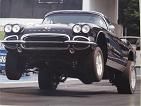
That's what we needed. I was surprised to see the C1 cd figure so bad. After that wind tunnel test seeing the windscreen coping a beating by the wind it doesn't surprise me. The C2 lift is amazing ! The c4/5/6 are real slippery buggers ah. Interesting thread. Stewy

Race Director

Joined: Jul 2005
Posts: 13,685
Likes: 61
Race Director
Joined: Jul 2005
Posts: 13,685
Likes: 61
But I'd take a C2 anyway. Less to go wrong, and MUCH simpler to fix when it did.
Drifting


Joined: Oct 2008
Posts: 1,936
Likes: 92
From: Rochester Hills Michigan
The Sting Ray shape was that of an inverted airfoil. The idea was to create downforce with that shape. Frank Winchell's comment years later was something like "We were clueless about ground effects. It would have worked if it were 50 feet off the ground!."
They probably did their high-speed testing on a banked track, where the lift was masked by additional downforce due to the banking.
Barry Bock ran a 396 Sting Ray coupe at Bonneville in 1965 to 170 mph and didn't have a blowover...
They probably did their high-speed testing on a banked track, where the lift was masked by additional downforce due to the banking.
Barry Bock ran a 396 Sting Ray coupe at Bonneville in 1965 to 170 mph and didn't have a blowover...

Le Mans Master

Joined: Apr 2001
Posts: 9,556
Likes: 288
From: Granbury Texas
Racer


Joined: Feb 2007
Posts: 312
Likes: 2
From: San Antonio Texas
Gimmicks and Gadgets
Credit Bill Mitchell with the lift. He was warned by Pete Brock, a designer at GM who worked on the first renderings of the Stingray, of the potential aero problems presented by the front end. Brock went on to design the Cobra Daytona Coupes which, incidentally, did not lift at 190 mph.
Wally Wyss, who has written extensively on everything automotive, once said that while Shelby & Co. was pouring much of Ford's money into making the Cobra and Mustang more competitive and world beaters, "Mitchell was spending millions of dollars on James Bond type gadgets like revolving license plates"......
No argument on the Stingray design, though. It was one of a kind.
Wally Wyss, who has written extensively on everything automotive, once said that while Shelby & Co. was pouring much of Ford's money into making the Cobra and Mustang more competitive and world beaters, "Mitchell was spending millions of dollars on James Bond type gadgets like revolving license plates"......
No argument on the Stingray design, though. It was one of a kind.
in lieu of functionality..
Melting Slicks
Joined: Jan 2010
Posts: 2,565
Likes: 1
From: Melbourne victoria
I was following a local made car the other day. The latest offering from the factory is to put a rear defuser under the car. Most Race cars seem to be running them. The car was a GM Corvette motored, Holden Special Vehicle that we make. It pumps out 410 bhp and it ain't a shabby car. While I was following this car I noticed the rear diffuser was flexing so much it was acting as a parachute. When we pulled up at the lights I signaled the guy to pull over. I told him he was going to loose his rear diffuser. He got out and I showed the guy that it was going to come off. When we pulled at it it wouldn't budge ? I got under the car and pulled at it real hard and it only moved slightly ? I was shocked and he was telling me the fuel economy was real bad. I told him while he was traveling at 50 mph it was flexing half a foot and more.
It was the first time I have ever thought about the air that travels under a car. I never realized that it was so significant. Even the add on diffuser from GM doesn't work and it's all for a look. I would say at 150 mph this rear diffuser would of torn off for sure acting like a parachute !
I'm not surprised that the C2 has a large amount of air pushing under the car after looking at this other scenario !
Here is a picture of a rear diffuser. Stewy

It was the first time I have ever thought about the air that travels under a car. I never realized that it was so significant. Even the add on diffuser from GM doesn't work and it's all for a look. I would say at 150 mph this rear diffuser would of torn off for sure acting like a parachute !
I'm not surprised that the C2 has a large amount of air pushing under the car after looking at this other scenario !
Here is a picture of a rear diffuser. Stewy
Corvette Stories
The Best of Corvette for Corvette Enthusiasts

Top 10 Most Expensive Corvettes Ever Sold on Bring A Trailer
Brett Foote
10 Things Every Corvette Owner Needs (2026 Edition)
Michael S. Palmer
8 Most "Only Corvette Owners Understand" Quirks and Problems
Pouria Savadkouei
10 Reasons the C6 Z06 is Still A Performance Benchmark After 20 Years
Joe Kucinski
How Much Horsepower Every Corvette Engine "LOST" in 1972
Joe Kucinski
Top 10 DOs and DON'Ts for Protecting Your Convertible Top!
Michael S. Palmer
Top 10 Most Explosive Corvettes Ever Made: Power-to-Weight Ratio Ranked!
Joe Kucinski
150 hp to 1,250 hp: Every Corvette Generation Compared by the Specs That Matter
Joe Kucinski
8 Coolest Corvette Pace Cars (and Replicas) of All Time
Verdad Gallardo
7th Gear
Joined: Dec 2010
Posts: 7
Likes: 0
From: plant city fl
I have heard on many occations that the C2s front lifts at high speeds. What kind of testing did they have in the early 60s to test such things? Couldnt this problem if its true have been prevented while the car was in its design stage? Was the C1 more stable at high speeds? Anyone?
dick

Team Owner


Joined: Oct 2000
Posts: 38,897
Likes: 1,926
From: Washington Michigan


Melting Slicks
Joined: Nov 2007
Posts: 2,162
Likes: 649
From: Chattanooga TN
They did the same thing in the wind tunnel - photo below is the full-size fiberglass styling model of the Corvette SS in the Lockheed tunnel in Marietta, Georgia, in December, 1956. This model was cut up after the tunnel tests and the skin ended up on the SS "mule" (the chassis of which later became Mitchell's Sting Ray).
Government owns the property know as Air Force Plant 6. Plant 6 was closed in 1946 and remained closed until Lockheed rented it in 1951 to do AC modification work.
My career with Lockheed at Plant 6 Marietta, GA did not start until Feb of 1963, so I could be wrong. To my knowledge the government did not build a Wind Tunnel on the Plant 6 campus. Never saw a building that came close to resembling base design needed to support fans large enough for up to 200 MPH wind test.
Lockheed did not opened their Commercial Low Speed Wind tunnel built on property they own adjacent to Plant 6 until 1967.

Are you sure testing location is correct for date it took place?
I could probably verify I'm right or wrong. I know one manager that transferred from Lockheed's old Burbank Plant in 1951 to run manufacturing planning devision that would know as he spearheaded the Plants Museum effort, plus Air Force files on Plant 6 should list building.
If you think "Government Bail Outs" and "To Big to Fail" is new, you might want to take a look at article below...LOL
http://www.georgiaencyclopedia.org/n....jsp?id=h-1337
Last edited by Poorhousenext; Dec 13, 2010 at 12:26 PM.
Team Owner
Joined: Oct 2000
Posts: 38,897
Likes: 1,926
From: Washington Michigan
I'm a little puzzled by any Wind Tunnel testing being done by Lockheed Aircraft in Marietta, Georgia in 1956. Not saying it's not possible.
Government owns the property know as Air Force Plant 6. Plant 6 was closed in 1946 and remained closed until Lockheed rented it in 1951 to do AC modification work.
My career with Lockheed at Plant 6 Marietta, GA did not start until Feb of 1963, so I could be wrong. To my knowledge the government did not build a Wind Tunnel on the Plant 6 campus. Never saw a building that came close to resembling base design needed to support fans large enough for up to 200 MPH wind test.
Lockheed did not opened their Commercial Low Speed Wind tunnel built on property they own adjacent to Plant 6 until 1967.
Government owns the property know as Air Force Plant 6. Plant 6 was closed in 1946 and remained closed until Lockheed rented it in 1951 to do AC modification work.
My career with Lockheed at Plant 6 Marietta, GA did not start until Feb of 1963, so I could be wrong. To my knowledge the government did not build a Wind Tunnel on the Plant 6 campus. Never saw a building that came close to resembling base design needed to support fans large enough for up to 200 MPH wind test.
Lockheed did not opened their Commercial Low Speed Wind tunnel built on property they own adjacent to Plant 6 until 1967.
