




another overheater.

Thread Starter
Intermediate

Joined: Aug 2011
Posts: 29
Likes: 0
From: Weyauwega Wisconsin
 another overheater.
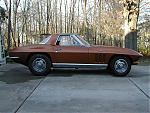
I have a 60 vet that I installed a 327 in/medium cam stock duel 4's a 1960 aluminium radiator new hoses, has all the shrouds,5 blade fan and it over heats on the road but will cool off while idleing. It did this with the old motor and the copper radiator also. I thought it was the old motor because it was bored 60 over. The only thing that is still common between the two is the dual 4's with stock manifold and I didn't hook up the heater, this is plugged off at the pump and manifold. I checked the hoses a couple of times and changed water pumps, I even tried a 30% over pump. I know I must be overlooking something. I read all the forums on C1 overheating and didn't see any clues that I should look at. I am keeping the stock fan system and am not interested in an electric fan, I read that forum also. It has 3.73 gears so the RPM 's are high. Until I can solve the problem I will have to keep it to short trips.
thanks Jim_er
thanks Jim_er

Le Mans Master


Joined: Feb 2001
Posts: 6,317
Likes: 291
From: Ocala FL
Are you sure it is really overheating? Using the stock gauge, an IR thermometer, or is it puking coolant out all over the ground?
The sending units available for the last ten years or so have not been accurate with the stock gauges, and frequently show hotter than the car really is. So if you want to check, use an IR thermometer and shoot the thermostat housing on the front of the engine and see what it reads. If it is hot, then your car is hot.
The sending units available for the last ten years or so have not been accurate with the stock gauges, and frequently show hotter than the car really is. So if you want to check, use an IR thermometer and shoot the thermostat housing on the front of the engine and see what it reads. If it is hot, then your car is hot.
Thread Starter
Intermediate
Joined: Aug 2011
Posts: 29
Likes: 0
From: Weyauwega Wisconsin
I haven't used an IR temp gauge yet. It has had loss of coolant, it smells hot and it will sizzle if ran long enough. I don't go very far 20 miles or so in the summer and you can tell it's hot by the way it runs. I don't know what that number is other than I have a pegged gauge.

Melting Slicks


Joined: May 2007
Posts: 3,461
Likes: 18
From: cooper city florida
Well since you changed motors, and it still does it, that doesn't leave a lot. I know you said you changed all the hoses, but are you sure your bottom radiator hose isn't collapsing at speed, and it has the spring inside? When you say a 1960 aluminum radiator, I assume you mean a new aluminum radiator, for a 1960 Corvette. Although it sure sounds like you are overheating, I would still stop by Harbour Freight, and buy an IR gun. It would be nice to know the temperature difference between the top rad hose, and the bottom one......if any. New radiator cap? Also it wouldn't hurt to pressure test the system.....weird problem.

Pro


Joined: Oct 2009
Posts: 604
Likes: 14
From: Harleysville Pa
Overheating
I have had the same problem although I have lost no coolant. I have a newly rebuilt 283 with two fours. My gage runs right to the top, and I have an IR thermometer which reads 220 degrees. Everyone tells me that until I break in the engine (300 miles since rebuild) it will continue to run hot.
Pro
Joined: Oct 2009
Posts: 604
Likes: 14
From: Harleysville Pa
Overheating
I have had the same problem although I have lost no coolant. I have a newly rebuilt 283 with two fours. My gage runs right to the top, and I have an IR thermometer which reads 220 degrees. Everyone tells me that until I break in the engine (300 miles since rebuild) it will continue to run hot. It also has a new Dewitt radiator.
Thread Starter
Intermediate
Joined: Aug 2011
Posts: 29
Likes: 0
From: Weyauwega Wisconsin
The 1960 radiator was puchased in '85 from a fellow NCRS member. He had purchased this new with correct cap for a C1 he wanted to restore. As I did he was tired of looking for correct date tags so he sold off his goodies. The hoses are from Paragon purchased 4 yrs ago. ( maybe 500 miles if that ) I had them off twice checking for a problem and it still could be, I just haven't proven it. The timing is at 12 degrees, I like timing and I advanced it until it started running rough and the backed off ,it's at 12 degrees. I pulled the dual point and put in an Accel pointless, less work. Just for grins tonight I installed a short hose from the water pump to the intake because I didn't have the heater hooked up and these ports were blocked. The thought was maybe I was short circuiting the pump some. Out there a ways I know but it's free.
Corvette Stories
The Best of Corvette for Corvette Enthusiasts

Top 10 Most Expensive Corvettes Ever Sold on Bring A Trailer
Brett Foote
10 Things Every Corvette Owner Needs (2026 Edition)
Michael S. Palmer
8 Most "Only Corvette Owners Understand" Quirks and Problems
Pouria Savadkouei
10 Reasons the C6 Z06 is Still A Performance Benchmark After 20 Years
Joe Kucinski
How Much Horsepower Every Corvette Engine "LOST" in 1972
Joe Kucinski
Top 10 DOs and DON'Ts for Protecting Your Convertible Top!
Michael S. Palmer
Top 10 Most Explosive Corvettes Ever Made: Power-to-Weight Ratio Ranked!
Joe Kucinski
150 hp to 1,250 hp: Every Corvette Generation Compared by the Specs That Matter
Joe Kucinski
8 Coolest Corvette Pace Cars (and Replicas) of All Time
Verdad Gallardo
Tech Contributor


Joined: May 2005
Posts: 15,576
Likes: 118
From: Conroe Texas
How long has that radiator been in service? It sounds like you are saying the radiator was purchased in 1985 and left in a box until some recent period where you purchase/installed it?

Thread Starter
Intermediate
Joined: Aug 2011
Posts: 29
Likes: 0
From: Weyauwega Wisconsin
The radiator was installed in 2007 with the new motor it was in a foam packed crate until that time. The thermostat, I have 4 new ones of various temps that I tried. Now for some really weird news that I never would imagined. I mentioned that I installed a heater bypass hose from the pump to the manifold. This idea was from a local vette owner that I have cruzed with and threw a shot in the dark. I had it out tonight and it ran about 200 degrees all evening. I am going to put some miles on it tomorrow to see if this is a fluke. I had it cranked to 3450 RPM, 70 MPH on the 4 lane for a short while and it held that temp, it also held that temp in town. To be honest I don't believe my problem is over but tonight looks promising.

Melting Slicks

Joined: Nov 2006
Posts: 2,618
Likes: 149
From: Anaheim California
Are you sure it is really overheating? Using the stock gauge, an IR thermometer, or is it puking coolant out all over the ground?
The sending units available for the last ten years or so have not been accurate with the stock gauges, and frequently show hotter than the car really is. So if you want to check, use an IR thermometer and shoot the thermostat housing on the front of the engine and see what it reads. If it is hot, then your car is hot.
The sending units available for the last ten years or so have not been accurate with the stock gauges, and frequently show hotter than the car really is. So if you want to check, use an IR thermometer and shoot the thermostat housing on the front of the engine and see what it reads. If it is hot, then your car is hot.
Le Mans Master
Joined: Feb 2001
Posts: 6,317
Likes: 291
From: Ocala FL
The housing is heated only by the coolant, the block is heated by the cylinders, the intake by the heads, and so on.
Jim_er
If it is running consistently at 200 on the gauge, then I'd say you have found the norm.
Just check for air leaks around the shroud and be sure all air gets pulled through the radiator and past the fan.
Your timing sounds a bit high for the gas that is around. Are you sure you aren't pinging at speed?
The lack of a heater core is the loss of a quart or more of coolant and it has a chance to lose heat.
Le Mans Master

Joined: Feb 2008
Posts: 6,482
Likes: 1,918
From: Folsom CA
The fact that it heats up while driving at speed seems to be a circulation issue or an air flow issue.
The Lower Radiator Hose needs to have a spring in it to keep it from collapsing at speed.
Check your Lower Hose for the spring, it is not optional. As RPM increases a vacuum is formed in the supply side of the water pump as it sucks water in, this can collapse the lower hose restricting coolant flow.
No spring needed in the top hose as heat and pressure will open the top hose when needed. The top hose can collapse when an engine cools off as the pressure recedes it forms a vacuum that collapes the upper hose.
The Lower Radiator Hose needs to have a spring in it to keep it from collapsing at speed.
Check your Lower Hose for the spring, it is not optional. As RPM increases a vacuum is formed in the supply side of the water pump as it sucks water in, this can collapse the lower hose restricting coolant flow.
No spring needed in the top hose as heat and pressure will open the top hose when needed. The top hose can collapse when an engine cools off as the pressure recedes it forms a vacuum that collapes the upper hose.

Le Mans Master

Joined: Aug 2009
Posts: 5,474
Likes: 16
From: Houston Texas
St. Jude Donor '10-'12-'13
Are you using the latest and greatest "high flow" water pump? Or the good ol reliable factory pump?
If using the former? Could be the water is moving too fast to cool effectively.
Hence the better cooling at idle.
Just a thought.

If using the former? Could be the water is moving too fast to cool effectively.
Hence the better cooling at idle.
Just a thought.


Team Owner


Joined: Oct 2000
Posts: 38,897
Likes: 1,926
From: Washington Michigan
I mentioned that I installed a heater bypass hose from the pump to the manifold. This idea was from a local vette owner that I have cruzed with and threw a shot in the dark. I had it out tonight and it ran about 200 degrees all evening. I am going to put some miles on it tomorrow to see if this is a fluke. To be honest I don't believe my problem is over but tonight looks promising.
Most recently-manufactured radiator hoses are made of far better materials than the originals were, and don't have (or require) the internal coil spring.
Thread Starter
Intermediate
Joined: Aug 2011
Posts: 29
Likes: 0
From: Weyauwega Wisconsin
I haven't made it anywhere to get an IR temp gun but it's on the list. I think the air flow is OK, it will clean the floor under the car and you can feel the flow in front of the radiator if you get your hand in there. The lower hose is from Paragon and while running the trottle by hand I can see it quiver on the sides some. I think its a good canidate to change out soon before it gets me. It was 85 degrees outside today and I put about 50 miles on the vette and it hit 210 on my gauge but it didn't act like it was overly hot, another reason for the IR gun. The hose I installed seems to be contoversial. This hose would be the same as having a heater hooked up only a lot shorter. The pump gets fed from the bottom and into the block (high pressure area)and the thurmostat is restriction even when it is open. Should the pump seperate air from the water, Cavitation, the pump will lose flow because of the air forming around the impellor. Installing the short heater hose, this smaller orfice on the pump allows the air and water to go to a low pressure side which is in the manifold, remember main pump pressure is going in the block. After I saw that my motor was running cooler than before I did some research to find out why. Through engineers at work,water pump manuals and flow diagrams that I pulled from the maint. dept, cavitation is what I now believe was happening. I am happy with the performance of my car, so far I don't have to stop to let it cool down,but it's only the second day, and I really enjoyed everyones help and imput. Thanks from an old guy.
Jim_er pictures on my corvette photos are coming.
Jim_er pictures on my corvette photos are coming.

Advanced
Joined: Nov 2010
Posts: 54
Likes: 4
HELP!!!
i am having the same problem with my 1959 283 2 Four carb. I have HAD the gauge
re calibrated and was told it was fine. Changed the water pump, thermostat, cleaned the heads, rodded the radiator, and flushed the system. The gauge pegs at 220 but the IR at the sending unit shows 180???
i am having the same problem with my 1959 283 2 Four carb. I have HAD the gauge
re calibrated and was told it was fine. Changed the water pump, thermostat, cleaned the heads, rodded the radiator, and flushed the system. The gauge pegs at 220 but the IR at the sending unit shows 180???
Le Mans Master
Joined: Aug 2009
Posts: 5,474
Likes: 16
From: Houston Texas
St. Jude Donor '10-'12-'13
HELP!!!
i am having the same problem with my 1959 283 2 Four carb. I have HAD the gauge
re calibrated and was told it was fine. Changed the water pump, thermostat, cleaned the heads, rodded the radiator, and flushed the system. The gauge pegs at 220 but the IR at the sending unit shows 180???
i am having the same problem with my 1959 283 2 Four carb. I have HAD the gauge
re calibrated and was told it was fine. Changed the water pump, thermostat, cleaned the heads, rodded the radiator, and flushed the system. The gauge pegs at 220 but the IR at the sending unit shows 180???
Well the good news is, your not overheating.
The bad news is your gauge is way off.

Trust the IR gun.
