When you click on links to various merchants on this site and make a purchase, this can result in this site earning a commission. Affiliate programs and affiliations include, but are not limited to, the eBay Partner Network.
It's a solid lifter cam.
I don't see the need to nitride treat a roller cam.
Ok, but how to know which cam is installed and if it is a good cam for the engine ?
The engine rebuild was in 2004, I have the invoice, I have this comp cam specs but I don't know when it was installed and I have another invoice of cam change in 2009 but without any detail by JF automotive machine shop.
Do you think it is important to know wich parts are really in the engine ?
Ok, but how to know which cam is installed and if it is a good cam for the engine ?
The engine rebuild was in 2004, I have the invoice, I have this comp cam specs but I don't know when it was installed and I have another invoice of cam change in 2009 but without any detail by JF automotive machine shop.
Do you think it is important to know wich parts are really in the engine ?
Depends on your curiosity. The only reason would be to know if parts are compatible with each other. If the engine has been running since the 2009 cam change, then I wouldn't worry about it unless something's wrong.
If you want to know if it has hydraulics, then run the engine and pump up all the lifters, then remove the left valve cover and wiggle any rockers that are in closed position. If they're tight or show resistance, then you have a hydraulic cam and lifters. To be dead sure, put #1 cylinder @ TDC of the compression stroke (rotor points to #1, not #6), and wiggle both #1 rockers; they should have resistance. If you have solids with .020 lash, then you should be able to hear them at idle. If they're adjusted properly (at .020/.020) then the sound will be like a chorus gently singing a single note, not a clatter.
Overlap is 10.5 degrees, which is fairly mild for a 427. What's your engine's idle vacuum? I'd guess it's in the neighborhood of 11-13 in-hg @ 750 RPM.
Last edited by 65tripleblack; Nov 8, 2016 at 11:26 AM.
The spec sheet has a serial number. Call Competition Cams and ask when this cam was manufactured which will tell you if it is the 2004 or 2009 spec sheet.
Depends on your curiosity. The only reason would be to know if parts are compatible with each other. If the engine has been running since the 2009 cam change, then I wouldn't worry about it unless something's wrong.
If you want to know if it has hydraulics, then run the engine and pump up all the lifters, then remove the left valve cover and wiggle any rockers that are in closed position. If they're tight or show resistance, then you have a hydraulic cam and lifters. To be dead sure, put #1 cylinder @ TDC of the compression stroke (rotor points to #1, not #6), and wiggle both #1 rockers; they should have resistance. If you have solids with .020 lash, then you should be able to hear them at idle. If they're adjusted properly (at .020/.020) then the sound will be like a chorus gently singing a single note, not a clatter.
Overlap is 10.5 degrees, which is fairly mild for a 427. What's your engine's idle vacuum? I'd guess it's in the neighborhood of 11-13 in-hg @ 750 RPM.
I will make this test.
I have the detail of what has been changed in 2004 and there was hyd roller lifters and roller rockers, I doubt someone reopened the block to change that parts but I'm not sure :
The spec sheet has a serial number. Call Competition Cams and ask when this cam was manufactured which will tell you if it is the 2004 or 2009 spec sheet.
From: Middle TN by way of KY, OH, VA, IL, CA, FL, NY, SC, HI
Originally Posted by waveguerilla
You are a genius
So the cam is a cam for solid lifter but works with hydraulic roller lifters, I imagine it is not optimal ?
The speculation was that it was built for solid lifters because it was nitrited. However, who knows if roller cams care about being nitrited? I for one don't. I would think the bigger difference would be the cam ramps, but I'm no genius.
Lobe #5681 is a solid flat tappet.
Since the cam described in the cam card a flat tappet cam, then that would explain the nitride treatment. Nitriding hardens the surface, and provides more durability against sliding friction, which is needed with flat tappets. As I said earlier: there's no good reason to nitride treat a roller cam..........solid or hydraulic.
But the OP doesn't know if this is the cam in his engine, or not.
Last edited by 65tripleblack; Nov 8, 2016 at 02:49 PM.
From: Middle TN by way of KY, OH, VA, IL, CA, FL, NY, SC, HI
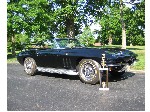
Beautiful car, OP.
That idle sounds poor, but you labelled it "cold idle". If it improves upon warmup, then I would not start with working on the cam, but on the carb (and check the ignition).
Of course, these cars idle nothing like modern cars, but yours is pretty rough.
That idle sounds poor, but you labelled it "cold idle". If it improves upon warmup, then I would not start with working on the cam, but on the carb (and check the ignition).
Of course, these cars idle nothing like modern cars, but yours is pretty rough.
What do you expect at 500 RPM. I'm surprised that it even idles at all at so low a setting.
It should be idling at more like 700-800 with the stated durations.
From: Middle TN by way of KY, OH, VA, IL, CA, FL, NY, SC, HI
Originally Posted by waveguerilla
Ok, I will see when it is warm and maybe I will raise that idle, I imagine it is a sort of screw ?
I think that you should fly me over to France to make sure that your cold and warm tuneup settings are correct for that fine car.
Not wanting to sound harsh, but it might be wise to get someone who knows these carbs to get you set up right. Either that, or break out the books (and this site) to make sure that you are adjusting it right. You have to start with the choke settings first (cold and hot), then set the cold idle stop.
Last edited by Easy Rhino; Nov 10, 2016 at 09:21 AM.










 Comp Cam Specs