When you click on links to various merchants on this site and make a purchase, this can result in this site earning a commission. Affiliate programs and affiliations include, but are not limited to, the eBay Partner Network.
I know of them. There are problems with adapters because they all seem to require a late model 12 volt starter. I will not change my 6 volt system for the sake of a transmission swap.
Thanks for your information,
Don
'back in the day' when 6V systems were being upgraded, there were resistor assemblies that would allow the use of both 6 and 12 volts as needed by various electronics (and there still are....). seems as though the starter could be separated from the rest of the electrical system and allow the use of the 12 volt starter you need.
'back in the day' when 6V systems were being upgraded, there were resistor assemblies that would allow the use of both 6 and 12 volts as needed by various electronics (and there still are....). seems as though the starter could be separated from the rest of the electrical system and allow the use of the 12 volt starter you need.
Bill
There are DC inverters that will step down 12 volts to 6 volts. I guess one could use an inverter for the radio and convert everything else to 12 volts, but that's not an option I am currently considering. Ah, the trials and tribulations of owning an old car.
Chevy II and full size pass cars used a tail shaft mounted shift as well so the mounting bosses don't make the transmission a Corvette model by itself.
Chevy II and full size pass cars used a tail shaft mounted shift as well so the mounting bosses don't make the transmission a Corvette model by itself.
Didn't the Chevy II version have a shorter tail shaft? I pulled a lot of images of powerglides, and none of the Chevy II versions I saw had the mounting bosses. Also, I now have information about casting codes and I am going to check later today.
Thanks for getting my attention about this. It has made me investigate further; something I probably should have done in the first place.
Didn't the Chevy II version have a shorter tail shaft? I pulled a lot of images of powerglides, and none of the Chevy II versions I saw had the mounting bosses. Also, I now have information about casting codes and I am going to check later today.
Thanks for getting my attention about this. It has made me investigate further; something I probably should have done in the first place.
Don
The Chevy II SS used a floor mounted shifter bolted to the tailshaft as did the full size cars. Chevy II transmissions used the standard length PG, 3 speed or 4 speed length as the rest of the fleet.
Did not entirely read all of the threads... But a pumped up 292 is just cool.
Lump port it.
Add a bigger cam
split exhaust or use langdon exhaust.
Offy or Clifford intake
Take two heads from a 350 and make one long one.
Cool to see and quite different.
Run extra lines to cool down everything.
My son's C30 has a 292 and its something to see running. Now, his does not have a lump port or modified head or bigger cam. Maybe someday it will. But for now, it just has an offenhauser and two bbl holley on it. Sounds way different than a v-8.
Last edited by jimh_1962; Mar 9, 2017 at 06:45 PM.
I have a 1955 261 engine in my 1953 Corvette #276 - the 261 has been in the car for more than 50 years. My website has some details, and includes a good back in the day article about putting 261 engines in the early Corvettes. 1953 #276 engine story.
I put #276 on the dyno after rebuilding the engine. 190hp and gobs of tree stump pulling torque:
My 53 has a 4 speed, so I don't know about the need for an alum power glide. But the car is still a 6 volt job, and it starts right up using a correct 53 corvette starter motor. The other mods to the engine are described in the link above.
Hope this help,
Russ
Russ,
How was Pro Machine to work with? I did not know they did dyno testing. I know of one more shop north of town.
Did not entirely read all of the threads... But a pumped up 292 is just cool.
Lump port it.
Add a bigger cam
split exhaust or use langdon exhaust.
Offy or Clifford intake
Take two heads from a 350 and make one long one.
Cool to see and quite different.
Run extra lines to cool down everything.
My son's C30 has a 292 and its something to see running. Now, his does not have a lump port or modified head or bigger cam. Maybe someday it will. But for now, it just has an offenhauser and two bbl holley on it. Sounds way different than a v-8.
I am aware of the 250/292 engine family. My main goal in fixing up my '54 Corvette was to preserve its character. I could have installed an alternator, but instead I found an alternator built inside a generator housing that is difficult to distinguish from stock. Swapping a 292 for my 235 would mean I couldn't use the 3x1 carter carburetors. The 235/261 engine family are indistinguishable from each other without checking casting numbers; at least that is my understanding, so that's why I picked the 261 for a possible swap. Hopefully I won't need to do that.
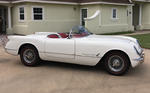
I am told my stock engine/trans now purrs, and on Monday I will get a chance to see for myself. Hopefully this is the final test drive before I ship my beautiful new 1954 Corvette home.
I'm building a 261ci based motor for my 54 project. It's all custom starting with crank and piston. Offenhauser intake, 12v and a mcculloch vs57s Supercharger to top it off. Not sure if I'll use a 3-speed or a 4-speed manual with it. Vision is to build a 1954 corvette that could have been a dealer build high power option pack, just like the Yenko's etc were in the 60's...
I'm building a 261ci based motor for my 54 project. It's all custom starting with crank and piston. Offenhauser intake, 12v and a mcculloch vs57s Supercharger to top it off. Not sure if I'll use a 3-speed or a 4-speed manual with it. Vision is to build a 1954 corvette that could have been a dealer build high power option pack, just like the Yenko's etc were in the 60's...
I like it! I'm a big fan of the "road less taken" way of building cars. It always ends up being something unique and often inspiring. Kudos to you!
That's why I put knock off wire wheels on my '54 Vette. I think it's something a guy who wanted to jazz up his new Corvette would have done back in 1954.
I am aware of the 250/292 engine family. My main goal in fixing up my '54 Corvette was to preserve its character. I could have installed an alternator, but instead I found an alternator built inside a generator housing that is difficult to distinguish from stock. Swapping a 292 for my 235 would mean I couldn't use the 3x1 carter carburetors. The 235/261 engine family are indistinguishable from each other without checking casting numbers; at least that is my understanding, so that's why I picked the 261 for a possible swap. Hopefully I won't need to do that.
I am told my stock engine/trans now purrs, and on Monday I will get a chance to see for myself. Hopefully this is the final test drive before I ship my beautiful new 1954 Corvette home.
Don
I guess my point s leave it as a inline... They are very cool.
I guess my point s leave it as a inline... They are very cool.
Oh, of course. I like inline six engines. The 292 was one of the best ever produced. Gobs of power, and some very cool performance parts can still be had; 12 port heads, 3x2 Webers, etc. Somebody once made a 3x2 Weber manifold for the 235 L6, but try and find one now. Damn, can you see a 250/292 with 3x2 Webers under the hood of a '54 Vette?! The 292 might be a little tall, but I never checked. Anyway, i like inlines too.
Designer Imagines A Corvette That Looks More Like a Corvette Than the Corvette
Slideshow: A Jaguar designer's personal project imagines what a modern front-engined Corvette might look like if Chevrolet revisited the golden age of the Stingray.