When you click on links to various merchants on this site and make a purchase, this can result in this site earning a commission. Affiliate programs and affiliations include, but are not limited to, the eBay Partner Network.
Mike, beg to differ, 56-62 solid lifter C1s got the non-vented 1552719 cap. I never really trust my memory, so I looked it up in Noland's book. That was to solve the "misting" problem.
A better question might be, was/is that the best solution? I've heard tell those engines were prone to sludging.
Mike, beg to differ, 56-62 solid lifter C1s got the non-vented 1552719 cap. I never really trust my memory, so I looked it up in Noland's book. That was to solve the "misting" problem.
A better question might be, was/is that the best solution? I've heard tell those engines were prone to sludging.
Not too sure I d trust that Adams guy completely. The first '57 FI engines left the factory with vented caps. Later changed to non-vented. Don't know about '56, '58-'62 solid lifter engines
The '61-'62 California PCV option used vented filler caps.
All that aside, I'd use the vented cap like most of the rest of production and if my engine got covered in oil mist, I'd either not run it so hard or fix the blow by problem.
Mike, beg to differ, 56-62 solid lifter C1s got the non-vented 1552719 cap. I never really trust my memory, so I looked it up in Noland's book. That was to solve the "misting" problem.
A better question might be, was/is that the best solution? I've heard tell those engines were prone to sludging.
I believe that is correct, however when I added RPO-242 PCV option to my '61 I did move to a vented oil filler cap though.....
Last edited by Frankie the Fink; Jan 2, 2019 at 01:19 PM.
Not too sure I d trust that Adams guy completely. The first '57 FI engines left the factory with vented caps. Later changed to non-vented. Don't know about '56, '58-'62 solid lifter engines
The '61-'62 California PCV option used vented filler caps.
All that aside, I'd use the vented cap like most of the rest of production and if my engine got covered in oil mist, I'd either not run it so hard or fix the blow by problem.
The very design of a road draft system DEPENDS on having a vented oil filler cap or another vent on the top side of the engine. The venturi effect of air being drawn past the tip of the road draft tube pulls atmospheric air into the engine at the breather, which the road draft tube pulls out, along with crankcase vapors. If the breather cap is closed, the road draft tube can't effectively scavenge crankcase vapors....sort of like trying to suck through a collapsed straw.
The very design of a road draft system DEPENDS on having a vented oil filler cap or another vent on the top side of the engine. The venturi effect of air being drawn past the tip of the road draft tube pulls atmospheric air into the engine at the breather, which the road draft tube pulls out, along with crankcase vapors. If the breather cap is closed, the road draft tube can't effectively scavenge crankcase vapors....sort of like trying to suck through a collapsed straw.
You are correct and the same goes for PCV system. Maybe Chevy thought the road draft tube could suck enough air from around the leaky non-vented oil fill cap and the unsealed dip stick tube?
Apparently, too many owners that had the solid lifter cams where the rpm would get to 6000 and higher didn't like all that oil blown all over the top of the engine when run hard so the factory released the solid cap..
One of the posters here that ran at the '57 Beach race said his engine had oil blowing out. Said a factory guy was walking the pits, handing out non-vented oil fill caps to Chevy racers to stop that problem.
And if you ran extended, high RPM, the oil got blown out past the front seal instead, if it overcame the PCV valve, or someone put an inline PCV valve in backwards....
Doug
Originally Posted by MikeM
Y
Apparently, too many owners that had the solid lifter cams where the rpm would get to 6000 and higher didn't like all that oil blown all over the top of the engine when run hard so the factory released the solid cap..
One of the posters here that ran at the '57 Beach race said his engine had oil blowing out. Said a factory guy was walking the pits, handing out non-vented oil fill caps to Chevy racers to stop that problem.
It is BEST to use a vented cap. BUT, if a non-vented cap is used, pressure buildup in the crankcase will still be relieved by the road draft tube. An option is to go with a vented cap and install an adapter in the rear hole and plumb in a PCV system. These adapters came into use in 63 (62 in CA).
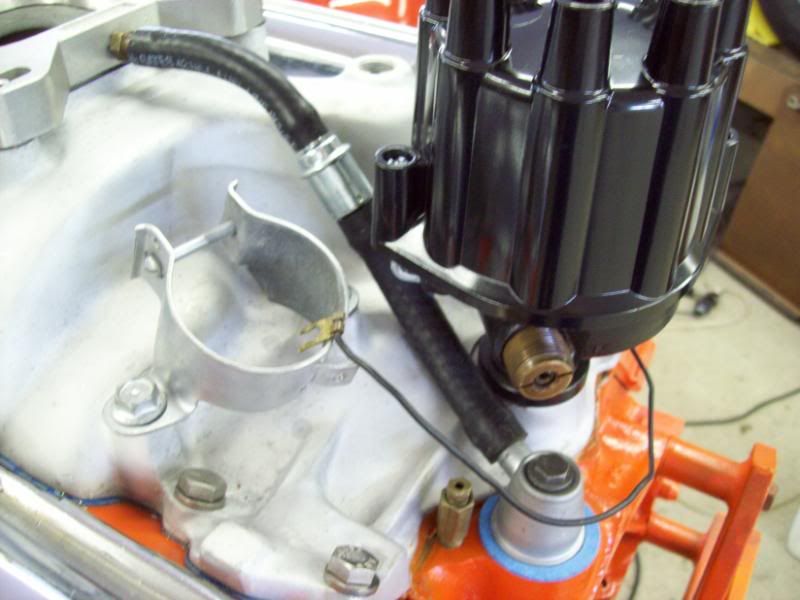
This is how I connected a PCV system on the 383 that's in my 51 Chevy.
Actually Tom the adapter in the first pic came into use for the RPO-242 (California) PCV option in 61....here is a pic from my 61 AIM: The "FRT CARBURETOR" note was for hooking the hose up to the forward carb on dual quad carbs (which weren't around in 62)...
Last edited by Frankie the Fink; Jan 2, 2019 at 05:56 PM.
During World War II a different type of crankcase ventilation had to be invented to allow tank engines to operate during deep fording operations, where the normal draft tube ventilator would have allowed water to enter the crankcase and destroy the engine.[3] The PCV system and its control valve were invented to meet this need, but no need for it on automobiles was recognized.
It depends on what you want, or don't want, original, comes with smoke and vapor out the bottom with normal driving, mist and smoke on top with high rpm driving, eliminate draft tube and open pcv system fixes some smoke and vapor issues , closed pcv system will re-burn any vapors and contain misting. Chip
I recall there was a TSB that recommended replacing the vented oil fill tube cap with a non-vented type to placate customers who complained of "oil misting" in the engine compartment, which was primarily a problem on mechanical lifter engines at high revs.
Road draft tubes are a very poor way to ventilate the crankcase, and the engine oil will become contaminated much more quickly than with a PVC system, so your best course of action would be to install the RPO 242 parts to create a PCV system that was a required option on all '61 and '62 vehicles that were shipped to California dealers.
Yes, and make sure you put the inline PCV valve in the correct way, other wise it can cause problems. Off the top of my head, i don't recall which way is correct. I know if you suck hard enough on the valve, it will pull the plunger closed, I am not sure if pull cosed is the direction to keep the valve closed during high vacuum idle conditions (pull closed toward carb), or the pull closed direction should be towards the road draft tube hole to prevent flame from a manifold backfire out of the crankcase, where a crank case explosion would do more damage to your pan and valve covers.
Doug
Originally Posted by DZAUTO
It is BEST to use a vented cap. BUT, if a non-vented cap is used, pressure buildup in the crankcase will still be relieved by the road draft tube. An option is to go with a vented cap and install an adapter in the rear hole and plumb in a PCV system. These adapters came into use in 63 (62 in CA).
This is how I connected a PCV system on the 383 that's in my 51 Chevy.
In this "open" system the intake manifold vacuum sucks the crankcase vapors out of the old road draft tube hole down into the intake to be burned out the exhaust. To wit, the PCV valve should allow air passage into the manifold but not the other way into the crankcase where a backfire could ignite explosive combustion vapors (very "not good")...
If you install this system you will notice an immediate and dramatic change in how clean your oil stays between changes. A testimony to the greater effectiveness of the PCV over the road draft "scavenging"...
Last edited by Frankie the Fink; Jan 3, 2019 at 11:41 AM.
If you drive the car much I would agree - that's what I did....those "bell" adapters can be tricky to find but there are kits on ebay that use a rubber grommet that serves the same purpose (like a 63 motor uses)...
If you drive the car much I would agree - that's what I did....those "bell" adapters can be tricky to find but there are kits on ebay that use a rubber grommet that serves the same purpose (like a 63 motor uses)...
Hold the presses! Apparently, the adapter is being reproduced:







 Crankcase vent question