When you click on links to various merchants on this site and make a purchase, this can result in this site earning a commission. Affiliate programs and affiliations include, but are not limited to, the eBay Partner Network.
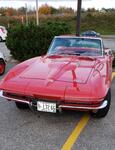
I recently bought a 1960 Corvette from my father. I know it's not the original engine and trying to learn the full specifications of what exactly it is. It is definitely a GM engine but would like to learn as much as possible. Here is the information that I have:
- The stamp on the block reads: 3959512
- On the passenger side of the engine near the front there is another number: CE 0091704
Any help in understanding exactly what I have would be great.
cast 3959512 is a 327 block used 1962-67 counter exchange CE.
Ed,
Thank you for the quick reply. Do you know what information is embedded in the CE 0091704 number? Does this number speak to any options or specifications about the engine?
cast 3959512 is a 327 block used 1962-67 counter exchange CE.
^ agreed, with the minor nit that CE = Chevrolet Engine. This casting was produced from some time in the late 60s into the 70s, and was a service-only block to replace pre-68 327 and 350 blocks. CE indicates it was a warranty replacement. It was a warranty replacement for some other car's engine however--your '60 originally came with a 283.
If you are wondering what is inside your 3959512 engine, there is no good way to tell by external inspection. The engine would have been built to match whatever it was replacing. Of course it may have been rebuilt yet again since that time.
Because it is a vented block (pre '68 configuration), IMO it's a good replacement for an early Corvette engine, at least to maintain cosmetics. The rear vent will allow the use of a road draft tube or an early PCV system, and allow use of the unvented Corvette valve covers (which it appears you have).
Ed,
Thank you for the quick reply. Do you know what information is embedded in the CE 0091704 number? Does this number speak to any options or specifications about the engine?
Hopefully answered above
Edit to add: If you are game for some more detective work, look for the casting date at the rear of the block. Also have a look at the heads (casing number and dates). 512 blocks were sometimes built as partial engine assemblies, and then heads reinstalled from the engine that suffered the casualty.
Do you belong to the NCRS? If not, you should. They have a spec guide that sells for 5 dollars, it covers all the cars from 53 to 67.....all the correct numbers and where to find them. It will enhance the joy of owning such a classic car.
If the engine runs, what is manifold vacuum at idle speed (specify) idling in neutral if a manual trans. This will determine whether it has a base or type SHP cam... manifold casting number, carburetor type and any numbers, head casting symbols or casting numbers if you want to remove valve covers. Photos might help, too.
cast 3959512 is a 327 block used 1962-67 counter exchange CE.
I'm not sure when the ...512 block came into use, but a part number beginning with 39 couldn't be earlier than about '67... certainly not '62, and I don't think the CE designation came into use until '67. Also the ...512 block could be processed for either 283/327 or 350 main bearing journal sizes. It was only used in OTC engines, never in production. It was likely available bare, short block, and long block, the intent being that existing parts off the old engine be installed - heads, manifolds, carburetor water pump, starter, etc., so other major engine parts on this engine may be original and help ID the original engine configuration.
Yes, the CE engine could be anything. I bought a CE short block over the counter in 1976, the one I bought was an L79 350/327 flavor, except it came with the later L82 cam. I still have it, but it is in another vehicle, now. It could also be a lesser HP motor. It could also ahve been modified or completely rebuilt into anything in the past 50 years.
Doug
There might be a bit too much Vette/engine speak for our new owner/poster to absorb and understand. He might think 512 means the size of the engine, bare, short, and long block, who knows what he may think. I hope this works out for him. I might suggest the he purchase some "Corvette only" tech books to help in his enjoyment of a fun car. Dennis
Google etc will answer loads of questions without having to buy books, though books are nice for leisurely sitting around the fireplace and reading in the evening.
As far as CE motors, again, when i bought my 350 HP/327 short block from Chev in 1976 for $370 (I got the 25% good guy discount), i could have bought an LT-1 350 short block for another $90, but i didn't really ahve the extra $90, as i had just bought some used, but recently rebuilt 2.02" heads for $100, for my new short block.
Doug
This is off the Mortec site.3959512....327...62-67...2...Was also used for some "CE" replacement blocks
That Mortec entry is vague and potentially confusing. This thread chronicles the history a little better (and why a 3959512 block thought to be cast in '63 was actually cast in '73):
Not being as up on small blocks as many of y'all, and figuring the OP isn't planning to tear down a decent running motor, then what's it most likely to be? A 327 or 350. Its prolly a small journal block, so a 383/400 crank isn't likely. Didn't say nor possible, just not likely. A 302? Who intentionally built those if not replacing a Z28 motor? Not too many, I suspect. Yeah, it could be anything, but to the OPs question, the block narrows down what's likely quite a bit.
I am going to suggest that if it has road draft tube provision, it is a 283 or 327.
I believe the 350 CE LT-1 block i mentioned not buying would have a diff block casting number with no road draft tube provision, as i under stand it.
My 512 CE block was cast and assembled in the early 1970s. I posted the numbers a long time ago, but can't recall what they were.
Doug
I am going to suggest that if it has road draft tube provision, it is a 283 or 327.
I believe the 350 CE LT-1 block i mentioned not buying would have a diff block casting number with no road draft tube provision, as i under stand it.
My 512 CE block was cast and assembled in the early 1970s. I posted the numbers a long time ago, but can't recall what they were.
Doug
There was at least one pre '68 350 application that took a vented block--the '67 SS 350 Camaro. I have a large journal 512 block, and I figured that's what it came from (unless somebody line bored it).
The ...512 blocks were processed by the plant for both small and large journal, and I'm pretty sure that like the 3892657 block used for '68 327s the ...512 has notches for both small and large bearings. So if it's small bearing 327, it's simply a matter align boring the mains for large bearings for a 3.48" stroke crank or more, but a larger stroke will probably require the use of "stroker" rods and some block grinding for adequate clearance.
As I stated earlier with slightly different wording the ...512 block was service only - why I don't know. The '67 350 SB available only in the Camaro used the same ...657 block as the 327 Corvette SBs, but it was processed with the larger main journal size.






 Learning about my engine -



















 Dennis