When you click on links to various merchants on this site and make a purchase, this can result in this site earning a commission. Affiliate programs and affiliations include, but are not limited to, the eBay Partner Network.
How To Remove a Broken Dipstick Tube, Many Pictures
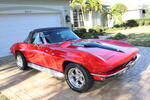
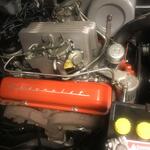
The car is a 1966, 327 engine but this should apply to any small block Chevy engine. I had a oil dipstick tube that broke off just on top of the flared end where it goes into the block.
I looked through the archives for advice and found several different methods. I tried a few different ways without success, my tube was just too tight in the block. This is what I devised and did to remove my broken tube from the block. Perhaps this method will help others in the future.
To start, get a 3/8-16 NC tap.
Install the tap into a holder that will allow you to use a 3/8 drive extension and a short handle ratchet. Use plenty of grease on the tap to capture and hold any chips you might make. Tap threads into the broken off dipstick tube very slowly and carefully. Make sure to do this slowly and deliberately. The threads you are making in the tube will be shallow and you want any metal chips to peal off the tap slowly and get stuck to the grease on the tap. Gently run the tap into the tube until you feel the tap bottom out. Remove the tap slowly to keep metal chips stuck to the tap.
Next, with a tubing cutter, cut off a short section of 3/4" dia.copper pipe, about 7/8" long. Get a 3/8" NC bolt 1.5 " long and 2 washers.
The copper pipe has to be large enough in dia to fit over the flare on the broken dipstick tube, seen above inside the copper pipe, but small enough to fit into the recess on the engine block around the dipstick tube. 3/4" pipe works nicely.
Place the washers on the bolt and slide the copper pipe over the bolt as seen above. Now gently thread this assembly into the newly threaded, broken dipstick tube. Once the bolt is completely threaded into the tube you'll start to feel resistance. As you continue to thread the bolt further into the broken tube, it will pull the tube out of the block, with the copper pipe acting as a spacer against the washers.
With the copper pipe removed, you can see that the 3/8" bolt threaded itself into the broken tube.
The threads you tap into the broken tube will be very shallow, that's why when threading the bolt into it, you want to work slowly to prevent stripping those shallow threads as the tube is being pulled from the block.
When installing the new tube, I slightly chamfered the end to help it press into the block. I also placed the new tube in the freezer for a few hours to shrink its diameter.
A 1/2" crows foot and a long extension was placed on the flare of the new tube and successfully installed it into the block.
When it's all done, as precaution against any metal chips that might have fallen into the pan during the threading, you can do an oil change before engine startup if you feel the need.
As I said in the beginning, my broken tube was very tight in the block so this was the way I used to remove it. Working slowly and carefully I found it to be a very positive method with success never in doubt. Following these steps should remove any similar broken tube with no difficulties or extraordinary feats of strength. Best of luck to you.
Well done. Congrats. I would change the oil, and would also run some Marvel Mystery Oil down the new dipstick tube while the drain plug is out, in the hope that it might flush out any remaining greasy fragments that might be clinging to the passage.
One of my worst days when I was a gas station wrench was when I broke off a dipstick tube while placing a cylinder head back onto a 400 CID Pontiac after a valve job. That turned into a VERY long night for both myself and the other mechanic who worked with me. It didn't occur to us to try your approach to the problem. It might have saved us a ton of time and frustration.
Very ingenious method...great pictures and explanation. I recently had the same thing happen but was a bit more fortunate in that I was able to slowly tap the broken piece out of the block using a cold chisel from underneath the car. Mine was snug but, most likely, not as tight as yours was. One other word of caution. Be SURE you have the correct length dipstick tube. The one from Paragon wasn't even close in appearance to what was original. The LIC part had the correct appearance but wasn't bent exactly as it needed to be to insure a snug fit against the exhaust manifold. I fixed that by using a line bending tool before I inserted it.
Very pro aerospace factory. Are you an engineer or work on aircraft, rockets? Did you write procedures for a living? I would have grabbed it with a small vicegrip and twist that mother out. Then try the next idea. Who broke that thing on the first place?Very crafty. Well done. What would Floyd have done in 1978? I think something alot more expedient.
Very pro aerospace factory. Are you an engineer or work on aircraft, rockets? Did you write procedures for a living? I would have grabbed it with a small vicegrip and twist that mother out. Then try the next idea. Who broke that thing on the first place?Very crafty. Well done. What would Floyd have done in 1978? I think something alot more expedient.
Hi there John, not sure if you were being serious or just tongue-in-cheek?!
Before a 28+ year career with Continental Airlines (piloting 727, 737, 757, 767's - hence BB767 ) I was a technical instructor at Parkland College and my formal mechanical training was done at the University of Illinois, Institute of Aviation. That is where I did all my pre airline pilot training and at the same time received training to become a certified Airframe and Power Plant technician, A&P. So the aerospace-engineer-aircraft connection wasn't too far off.
Hope you or others might find the post to be helpful in the future. Happy to add technical information to the forum archives. Cheers.
Thanks again for posting this procedure, I used it today with success! Just wanted to share I had to use a slightly bigger thread and bolt (metric M10) to make it work.
And now the exhaust manifold is off anyway, I'll do the other one as well and have them ceramic coated
Nice write up. Only thing I would do different is use an appropriate sized socket 3/8 drive x 3/4" instead of the copper pipe. You already have it in your tool box.




















 How To Remove a Broken Dipstick Tube, Many Pictures