

1964 Corvette cooling issues

Thread Starter
Advanced


Joined: Feb 2023
Posts: 80
Likes: 2
From: Mobile, AL

Thanks for posting that photo.
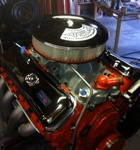
It looks like the hoses are routed correctly. But, it's hard to see the two upper connections. The one that goes to the radiator is supposed to go into the expansion tank about 1/3 of the way down. The overflow hose connects to the neck where the cap attaches. In your photo it almost looks like those two connections are joined together. That's not true, is it?
It looks like the hoses are routed correctly. But, it's hard to see the two upper connections. The one that goes to the radiator is supposed to go into the expansion tank about 1/3 of the way down. The overflow hose connects to the neck where the cap attaches. In your photo it almost looks like those two connections are joined together. That's not true, is it?

Race Director


Joined: Feb 2007
Posts: 15,479
Likes: 8,959
From: northern california
C2 of Year Finalist (track prepared) 2019
Modern replacement sending units are notorious for causing vintage gauges to read higher than the actual temperature. Glossing over the details, it's because the sending units generate their own heat in addition to the engine heat they are supposed to be measuring. The combination of engine heat and self-generated heat makes the gauge read high.
Thread Starter
Advanced
Joined: Feb 2023
Posts: 80
Likes: 2
From: Mobile, AL
Your symptoms don't scream "gauge" to me. Rather they point to the sending unit
Modern replacement sending units are notorious for causing vintage gauges to read higher than the actual temperature. Glossing over the details, it's because the sending units generate their own heat in addition to the engine heat they are supposed to be measuring. The combination of engine heat and self-generated heat makes the gauge read high.
Modern replacement sending units are notorious for causing vintage gauges to read higher than the actual temperature. Glossing over the details, it's because the sending units generate their own heat in addition to the engine heat they are supposed to be measuring. The combination of engine heat and self-generated heat makes the gauge read high.
Le Mans Master


Joined: Jan 2007
Posts: 6,005
Likes: 1,510
From: Prescott Arizona
That's very good news that the Block Check Fluid stayed blue. All along, the members, like myself, have been focusing on two things...temperature indications that might lead you to believe it's overheating and...the loss of coolant.
Most times when someone starts a thread and one of the first telltale signs is a guage that's reading much higher than normal, most figure the cause to be the sending unit. Tons of old threads on the subect and it's happened to a lot of us.
Even the so-called 'best' temp sending units are not that great but they are closer to actual true temperatures. In a lot of cases, most folks who've gotten the 'better' sending units get used to seeing 210 on the dash gauge but know, from
using an IR gun, that the actual temp is more like 190-195 and just live with it.
The second focus for most of us was your loss of coolant. As you've read, that's not expected to happen when the actual temp is in the 190 or 200 region.
In a few of your last posts, it seems your loss of coolant isn't happening anymore, or at least not as often as it once did. If that's the case and you're left with just an incorrect temperature on the factory dash gauges,
you can try a different temp sending unit. The one that used to get good reviews was the Wells TU-5. In the last few years, one source for that sending unit is Autozone but it's now called the Duralast TU-5, I believe.
Give it a try if the only problem you're now having is just temperature indications.
Mike T - Prescott AZ
Most times when someone starts a thread and one of the first telltale signs is a guage that's reading much higher than normal, most figure the cause to be the sending unit. Tons of old threads on the subect and it's happened to a lot of us.
Even the so-called 'best' temp sending units are not that great but they are closer to actual true temperatures. In a lot of cases, most folks who've gotten the 'better' sending units get used to seeing 210 on the dash gauge but know, from
using an IR gun, that the actual temp is more like 190-195 and just live with it.
The second focus for most of us was your loss of coolant. As you've read, that's not expected to happen when the actual temp is in the 190 or 200 region.
In a few of your last posts, it seems your loss of coolant isn't happening anymore, or at least not as often as it once did. If that's the case and you're left with just an incorrect temperature on the factory dash gauges,
you can try a different temp sending unit. The one that used to get good reviews was the Wells TU-5. In the last few years, one source for that sending unit is Autozone but it's now called the Duralast TU-5, I believe.
Give it a try if the only problem you're now having is just temperature indications.
Mike T - Prescott AZ
Last edited by Vet65te; Jul 5, 2023 at 11:26 AM.
Race Director
Joined: Feb 2007
Posts: 15,479
Likes: 8,959
From: northern california
C2 of Year Finalist (track prepared) 2019
The wedging action of the tapered pipe threads completely cuts through any sealer, assuring metal to metal contact. That eliminates any possible effect on the temperature reading. But to that point, if the sealer did have an effect, it would be to make the gauge read low.
Corvette Stories
The Best of Corvette for Corvette Enthusiasts

Every 2027 Corvette Engine Explained
Joe Kucinski
Designer Imagines A Corvette That Looks More Like a Corvette Than the Corvette
Verdad Gallardo
10 Ugly Corvettes That We Still Kinda Love
Joe Kucinski
Top 10 Most Expensive Corvettes Ever Sold on Bring A Trailer
Brett Foote
10 Things Every Corvette Owner Needs (2026 Edition)
Michael S. Palmer
8 Most "Only Corvette Owners Understand" Quirks and Problems
Pouria Savadkouei
10 Reasons the C6 Z06 is Still A Performance Benchmark After 20 Years
Joe Kucinski
How Much Horsepower Every Corvette Engine "LOST" in 1972
Joe Kucinski