When you click on links to various merchants on this site and make a purchase, this can result in this site earning a commission. Affiliate programs and affiliations include, but are not limited to, the eBay Partner Network.
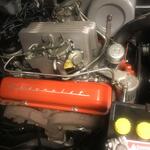
My future plan is to build a 383 stroker out of a “ correct” 2657 block.
the plan is to use the Trick Flow DHC ( double hump, aluminum). perhaps a roller cam. Using the stock L79 intake. I doubt I’ll take near redline very often, so I’ll probably build more for torque than top-end hp.
I kind of want to keep a mostly “stock” original look, so I figured I’d keep stock exhaust manifolds.
When should I consider going with 2-1/2” manifolds? I’d be buying repro 2–/2” exhaust and N11 Off-Road exhaust mufflers.
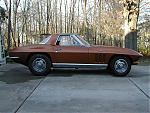
I was looking at the 3846563 drivers-side exhaust manifold, as it appears to have the same alternator mounting as my current 1967 manifolds.
should I start looking for these manifolds, or should I be fine with the stock 2” setup?
You are pumping more air with the larger displacement and better flowing heads. I'd definitely go with the 2 1/2" manifolds. Porting the manifolds either yourself or sending them off would also improve the flow.
Having been down this road here are some things to consider:
After market aluminum heads may flow better than your iron heads do BUT all of the aluminum heads I have seen do not have heat riser provisions. This is the chamber that allows hot exhaust gas to warm the carburetor as found on the iron heads. I found that as much as 15 minutes of warm-up is necessary before the car is fit to drive. Chevrolet went to great lengths to include this chamber in their iron heads to provide better cold engine driving manors. Then there is the big difference in port size between your L79 intake manifold and the aluminum heads (that I have seen). I found matching the different port size to be a formable challenge. Getting the intake to seal properly is obviously very important. As cool as the aluminum double hump head look, the keen eye will note the difference between them and iron heads. My put is if I had it to do over I would stay with iron heads. Your question about 2.5" exhaust is unknown to me, what is you expectation for this engine? The stock L79 is arguably one of the best engines that Chevrolet made... Al
Many true experts on modifications to engines, chassis, etc. Guys with real experience. I have a general observation from some minimal experience drag racing and tracking Japanese bikes. Took my GSXR 1100 to Union Grove years ago - all stock and nearly brand new. Many guys from Chicago there on "bike day" with the same or nearly same bike. Wheelie bars, headers, velocity stacks, extended swing arms. Guess what? My stock bike was turning more or less the same times. Previously had my FJ 1100 there with a jet kit and pipes. Ran better trap speeds when it was stock (did take out 2nd gear - a common fault on those bikes). Ran my FZR 1000 around Blackhawk Farms and was passed many times by smaller bikes which were ridden better. So.... modification is fun, but expecting a C2 corvette to change its stripes to a great degree isn't that easy.
Tony there is no doubt increasing exhaust flow frees up horsepower. As already stated a 383 will flow more exhaust than your L79. As far as a 327 with the 2.5 or 2" manifolds one of our site experts on this is Donny Brass, he runs his L79 at the all stock drags, (which are not all stock but look all stock). Last I heard I think his 66 L79 was about to enter the 11 second bracket. As I recall he switched from his stock 2" to the larger 2.5" manifolds and his time did not improve? Not at all what was expected. There was a forum discussion on the subject several years ago. Again, he is limited to 327 inches and you are talking 383 inches.
As far as manifolds the 2.5" are available imported Chinese product, in Dorman and a couple other suppliers for reasonable money, I think it is around $150 each. The OEM 2.5" manifolds are available but much more bank. DZ has run the imported 2.5" on 400 inch small blocks and is happy with the quality. I am thinking of these for my 406 project.
My future plan is to build a 383 stroker out of a “ correct” 2657 block.
the plan is to use the Trick Flow DHC ( double hump, aluminum). perhaps a roller cam. Using the stock L79 intake. I doubt I’ll take near redline very often, so I’ll probably build more for torque than top-end hp.
I kind of want to keep a mostly “stock” original look, so I figured I’d keep stock exhaust manifolds.
When should I consider going with 2-1/2” manifolds? I’d be buying repro 2–/2” exhaust and N11 Off-Road exhaust mufflers.
I was looking at the 3846563 drivers-side exhaust manifold, as it appears to have the same alternator mounting as my current 1967 manifolds.
should I start looking for these manifolds, or should I be fine with the stock 2” setup?
The Trick Flow DHC head intake ports are bigger than the stock GM L76 & L79 intakes, but so are the stock 461x, 461, & 462 heads intake ports. Air flow from a smaller manifold to a larger head port is not bad as the interface step walls help prevent flow reversion of the fuel laden airflow. A matched port interface with a minimal step is better, but grinding a stock intake may not work well if you ever go back to stock heads.
Go with 2-1/2” manifolds or headers if you want better torque at all rpm. The same reversion step benefit applies to the exhaust port interface transition, so grinding the exhaust ports of the exhaust manifolds makes a greater improvement than the intake.
I run a matched C3BX intake and ported 2-1/2" manifolds on my 350+ with ported Bowtie heads.
Head intake port differences ( here ), intake port match ( here ).
For Brezinski ported China 2-1/2" exhaust manifolds look ( here ).
The Brezinski manifold openings are ported to a larger Felpro 1405 exhaust gasket size that is larger than the Bowtie head's D-ports for a good reversion step. I recommend a similar exhaust gasket for the DHC heads. Stock ramshorns can be ported to the 1405 gasket easily with a die grinder and carbide burr (it just takes or costs time).
The ramshorn manifolds lost some midrange torque below 3500 rpm compared to 1 3/4" long tube headers, but essentially made the same peak torque and horsepower on the dyno (and iron runs quieter than steel tubing). I choose to run the ramshorn manifolds as the loss of torque was minimal. I still made 430lb.ft. torque with the 350+, and a 383 would expect to see less under 3500 rpm losses. People are surprised to see the ramshorns, including some of the 383 crate engine chevelle and camaro owners (who played catch up when challenged).
My original L76 sits on a stand. No original numbers matching corvette parts were harmed in my 350+ engine swap (it's an option if I ever want to go back to stock)
It's your corvette and your enjoyment. Make it do what makes you happy.
… here are some things to consider:
After market aluminum heads may flow better than your iron heads do BUT all of the aluminum heads I have seen do not have heat riser provisions. This is the chamber that allows hot exhaust gas to warm the carburetor as found on the iron heads...
…..Then there is the big difference in port size between your L79 intake manifold and the aluminum heads (that I have seen). I found matching the different port size to be a formable challenge. Getting the intake to seal properly is obviously very important. As cool as the aluminum double hump head look, the keen eye will note the difference between them and iron heads. My put is if I had it to do over I would stay with iron heads.
Your question about 2.5" exhaust is unknown to me, what is you expectation for this engine? Al
Thanks.
I am not worried about the lack of the heat riser. I have been blocking off the intake port (with the metal block-off plates) for decades. Even back when my classics were daily drivers, I still blocked the ports. I don’t recall ever having a carb that still had the divorced choke, and aftermarket chokes were disabled or removed.
as for the aluminum heads, I am not looking to fool experts (internally debating if I’d paint the exterior or leave bare), But I know that modern heads usually have better ports and chambers.
As a plus ( maybe), I have been hearing that doing a performance valve job with springs, valves, PC seals and screw-in studs can cost a similar range compared to brand new heads. And then I have the option to sell my current heads to recoup some of the costs…
not a huge deal, but the weight reduction also helps a bit for handling…
Similar for the short block, I have heard that a typical performance rebuild (say a 0.050 overbore “327”), the machining costs are similar, and the cost of new roads versus resizing originals is comparable too, with new rods being stronger.
New 383 crank versus sending mine out for wet-mag and grinding/polishing is also similar range…
I know there will be some extra grinding needed to add clearance for the rods.
Now, I also live in California, so labor costs are probably higher than most other areas of the country….
My expectations are a nice street/performance engine. I don’t think I’ll be taking this to redline much anymore, and I don’t want to upgrade the transmission and rearend at this point ( maybe someday, but years down the road).
I doubt I’ll even build this engine in the next year or two…
Hear is a great article that gave me some ideas…. I want the engine to look stock to the casual observer…
Tony there is no doubt increasing exhaust flow frees up horsepower. As already stated a 383 will flow more exhaust than your L79. As far as a 327 with the 2.5 or 2" manifolds one of our site experts on this is Donny Brass, he runs his L79 at the all stock drags, (which are not all stock but look all stock). Last I heard I think his 66 L79 was about to enter the 11 second bracket. As I recall he switched from his stock 2" to the larger 2.5" manifolds and his time did not improve? Not at all what was expected. There was a forum discussion on the subject several years ago. Again, he is limited to 327 inches and you are talking 383 inches.
As far as manifolds the 2.5" are available imported Chinese product, in Dorman and a couple other suppliers for reasonable money, I think it is around $150 each. The OEM 2.5" manifolds are available but much more bank. DZ has run the imported 2.5" on 400 inch small blocks and is happy with the quality. I am thinking of these for my 406 project.
Thanks,
I guess I should rephrase my question….
I know 2-1/2” manifolds will support more HP, but will I notice much improvement from a relatively mild 383? Even if I tested back-to-back, would I notice any seat of the pants difference, or a significant drop in rpm? I don’t really plan on spinning over 5500 rpm, so will I benefit much from the increase at the collector?
I looked at the imported manifolds, but the casting looks kind of “chunky”. I was also only seeing the imported manifolds with AIR ports….
Yes, “originals” are pricey ($$225+ for a single manifold compared to $150 for the Dorman),
but that’s why am trying to decide if I should start hunting down a set?
In my opinion (from experience, NOT hearsay), the addition of 2 1/2in manifolds-------------PLUS, a full, MINIMAL restrictive 2 1/2in ex system is a no brainer.
The ONLY thing which may be more of an improvement, would be full length headers. For street use, stay with the iron manifolds.
Dorman (available from various sources) imports REPLACEMENT (NOT repos) 2 1/2in manifolds (YA, they are from China!!!) which I must admit, are very good manifolds (and yes, I have personal experience with them).
UNFORTUNATELY, they ONLY made replacements for the 901 and 902 manifolds. I have no clue why they did not make a replacement for the 563. BUT, a simple solution for the 563 is to use a 902 and a 63-64 style alternator mounting bracket. Too easy.
BUT, if a 563 is mandatory, they have become rather pricey. For many years, Chevrolet offered 901-902-563 service replacements for about $55. And by the time they were at the end of their availability from Chevy, they were about $98. So no telling how much a service replace will cost today, much less finding an original.
Here are comparisons of the Chinese replacements and Chevy service replacements..
Also, a built, hyd roller cam, SB400 for my son's 73, replacing the very tired original L48, with a FULL 2 1/2in off road ex system from Corvette Central. Once installed with all the factory brackets and accessories, they really are not noticeable. We tried to duplicate the appearance of an LT1.







 2-1/2” exhaust manifolds, questions.