




[C2] Engine stamp question

2nd Gear


Joined: Sep 2014
Posts: 2
Likes: 0

I would be looking for the Original Build Sheet which was attached to the top of the Gas Tank which most likely is missing. Very few cars still have their original engine.
Last edited by 67/427/1 owner; Feb 2, 2025 at 09:50 AM.
Safety Car


Joined: Apr 2007
Posts: 3,849
Likes: 367
From: PHOENIX AZ. WHAT A MAN WON"T SPEND TO GIVE HIS ASS A RIDE
Have attended a few of Al's seminars. He has taken pictures of some of mt engines& I would alys send copies of tank sheets when I got them.

Team Owner


Joined: Feb 2003
Posts: 54,063
Likes: 9,396
From: Sitting in his Nowhere land Hanover Pa
2024 C2 of the Year Finalist - Unmodified
2015 C2 of Year Finalist

Race Director


Joined: Oct 2000
Posts: 12,666
Likes: 3,120
From: Shamong, NJ
As far as finding a Flint stamp to compare it to, you'll need to find one from March 8th, 1966. One from the 14th, the 7th or even the 9th is a no use. The gang holders were usually unloaded at the end of the shift and reloaded the next day. Characteristics common to a stamp made the 8th are going to be completely different the next day or the day before.
As far as the broach marks, the best place to check for them is close to the head. The broach marks are rarely disturbed along the front edge of the head, they don't get removed there when someone gets to rough cleaning paint or rust off the pad. The broach marks are usually weakest under and around the stamping's themselves for the same reason, previous efforts to clean and read them. I'm usually much more suspect of a pad that has strong broach marks in the area of the stamping, than one that has week or no broach marks near the stamping's.

Team Owner
Joined: Jul 2006
Posts: 22,164
Likes: 4,172
From: Kannapolis NC

Safety Car
Joined: Sep 2007
Posts: 4,458
Likes: 331
From: Indy Indiana
There is no way to prove or disprove that there was only one stamper or broacher ( human or tool).
blocks went to various plants ( impallas, Vettes, cameros, chevelles, novas)
the car next in line at the assembly plant ( or engine at the engine plant) could have been built and parts drawn off of inventory and engine top surface broached entirely differently.
Each part could have been by a different man/tool/machine. the theory that close vins should have close characteristics although sensible, is not necessarily true.
blocks went to various plants ( impallas, Vettes, cameros, chevelles, novas)
the car next in line at the assembly plant ( or engine at the engine plant) could have been built and parts drawn off of inventory and engine top surface broached entirely differently.
Each part could have been by a different man/tool/machine. the theory that close vins should have close characteristics although sensible, is not necessarily true.
Race Director
Joined: Oct 2000
Posts: 12,666
Likes: 3,120
From: Shamong, NJ
blocks went to various plants ( impallas, Vettes, cameros, chevelles, novas)
the car next in line at the assembly plant ( or engine at the engine plant) could have been built and parts drawn off of inventory and engine top surface broached entirely differently.
Each part could have been by a different man/tool/machine. the theory that close vins should have close characteristics although sensible, is not necessarily true.
Post number 5 in the link below has a collection of VIN's all stamped the same day. Comparing known originals, like those in the link is the only true way to identify a real stamp from a restamp, but educated guesses can be made without having original examples to compare too.
https://www.corvetteforum.com/forums...a-restamp.html
Corvette Stories
The Best of Corvette for Corvette Enthusiasts

Top 10 Most Explosive Corvettes Ever Made: Power-to-Weight Ratio Ranked!
Joe Kucinski
150 hp to 1,250 hp: Every Corvette Generation Compared by the Specs That Matter
Joe Kucinski
8 Coolest Corvette Pace Cars (and Replicas) of All Time
Verdad Gallardo
Top 10 Corvette Engines RANKED by Peak Torque (70+ Years of Muscle!)
Joe Kucinski
Corvette ZR1X Will Be Pacing the Indy 500, And Could Probably Race, Too!
Verdad Gallardo
Top 10 Corvettes Coming to Mecum Indy 2026!
Brett Foote
Top 10 C9 Corvette MUST-HAVES to Fix These C8 Generation Flaws!
Michael S. Palmer
10 Revolutionary 'Corvette Firsts' Most People Don't Know
Joe Kucinski
5 Reasons to Upgrade to an LS6-Powered Corvette; 5 Reasons to Stay LT2
Michael S. Palmer
Safety Car
Joined: Sep 2007
Posts: 4,458
Likes: 331
From: Indy Indiana
It is well known that the engine information was stamped by hand at both Flint and Tonawanda. This was done using individual stamps placed in a gang holder. There was a station on the assembly line where this was done, generally by one person whose job it was to stamp each block with the assembly plant code, date and engine suffix code.
Yes they did, but the engine code was stamped at the engine plant, not the final assembly plant for the car. The car assembly plant only added the VIN to pad, and before January 1968 (when Federal law required engine VIN stamps) only Corvette engines and engines over 300 horse power going in other Chevrolets got VIN stamps.
Chevrolet V8 engines for US production were built in one of two US assembly plants, Tonawanda NY and Flint MI. The blocks were all machined on the same type of machinery at both plants, leaving a very distinct lined pattern in the surface of the pad. The process used and the marks left behind have been studied for many years by the NCRS, Bloomington Gold and an assortment of very dedicated individuals. One in particular was invited into both engine plants by Chevrolet, and allowed to talk to the people involved in machining, assembling and stamping the blocks. Through the knowledge he gained, he has built a very nice business on verifying stamp pads and giving seminars on identifying real verse restamped pads. I've been fortunate enough to attend a number of his seminars.
It's actually absolutely true. The individual I mentioned above has amassed a library of thousand of pictures of stamp pads and it is quite easy to see that the same characteristics are found in consecutive stampings. Some members of the Forum have also put together collections of stamp pad photos showing the same repeating characteristics, and post them here periodically. Below is a link to post with some examples.
Post number 5 in the link below has a collection of VIN's all stamped the same day. Comparing known originals, like those in the link is the only true way to identify a real stamp from a restamp, but educated guesses can be made without having original examples to compare too.
https://www.corvetteforum.com/forums...a-restamp.html
Yes they did, but the engine code was stamped at the engine plant, not the final assembly plant for the car. The car assembly plant only added the VIN to pad, and before January 1968 (when Federal law required engine VIN stamps) only Corvette engines and engines over 300 horse power going in other Chevrolets got VIN stamps.
Chevrolet V8 engines for US production were built in one of two US assembly plants, Tonawanda NY and Flint MI. The blocks were all machined on the same type of machinery at both plants, leaving a very distinct lined pattern in the surface of the pad. The process used and the marks left behind have been studied for many years by the NCRS, Bloomington Gold and an assortment of very dedicated individuals. One in particular was invited into both engine plants by Chevrolet, and allowed to talk to the people involved in machining, assembling and stamping the blocks. Through the knowledge he gained, he has built a very nice business on verifying stamp pads and giving seminars on identifying real verse restamped pads. I've been fortunate enough to attend a number of his seminars.
It's actually absolutely true. The individual I mentioned above has amassed a library of thousand of pictures of stamp pads and it is quite easy to see that the same characteristics are found in consecutive stampings. Some members of the Forum have also put together collections of stamp pad photos showing the same repeating characteristics, and post them here periodically. Below is a link to post with some examples.
Post number 5 in the link below has a collection of VIN's all stamped the same day. Comparing known originals, like those in the link is the only true way to identify a real stamp from a restamp, but educated guesses can be made without having original examples to compare too.
https://www.corvetteforum.com/forums...a-restamp.html
same is true for the engine build plant... where the broacher is.. the cutting blades of the broacher ( more than one, 2 or more, I dunno) would be worn a certain amount?.. varying degrees of sharpness and wear of the broacher shows up as differences in the surface. one block is not guaranteed to be sitting with another one in a queue to be built that would have no guarantee to come with the same broacher wear patterns.
and the stamper(s) at the engine plant ( tools and humans) had to be more than 1.
in each case you may or may not get consistent patterns in the surface or font/strike/wear of the #s.
same is true for the stamper at the engine plant
one block will go to a impalla, and another to a corvette, the next corvette block may not come along for a hundred blocks.. the vast majority of blocks were NOT corvette blocks. yes, maybe they built them in groups.. I dunno.
as the machining of multiple blocks is progressing from more than 1 machine, the completed blocks are put in another finishing queue in what order? inventory control? we have no idea of how well the rules were enforced.. especially in a day and age where GM allowed drinking at lunch.. strikes, broken, missing tools.
The guys doing plant tours aren't gonna tell you that.
in general that methodology may raise faith of typical factory production.. but when your are comparing VIN X with VIN X+1 you cannot state that your concepts are absolutely true.. and therefor the excuses in the stamps that we see so much come out..
also.. how do you know and guarantee that VIN X is absolutely original when comparing VIN X+1.. or vice versa?
your friend may have a vast library to draw conclusions, but not 300,000 approx c2, c3 corvettes.
a subset don't exist anymore, another subset don't have original engines, and another subset are rebuilt and surface decked, and another subset again are counterfeited.
the vast majority of these cars are not judged by NCRS, BG, or your friend. BG and NCRS do NOT guarantee originality, they only judge as to typical factory. and I am sure your friend's validation report has a back page full of small print stating the same thing.
the point is, there are logical consistencies you could consider, but no, they are not gospel.
IMHO, thanks, I appreciate the debate.

Drifting


Joined: Sep 2009
Posts: 1,800
Likes: 212
From: Metro MI too close to the D
Yes, but although there might have been one human stamper, ( no lunch? no breaks? end of shift? ) there might have been 2 gang holder tools, loaded at the stamper station and the worker grabbed one, changed a few characters and pounded away, put it back on the tray. next car, grab one of the 2 again, each would stamp with its own characteristics that we look so deeply at.
same is true for the engine build plant... where the broacher is.. the cutting blades of the broacher ( more than one, 2 or more, I dunno) would be worn a certain amount?.. varying degrees of sharpness and wear of the broacher shows up as differences in the surface. one block is not guaranteed to be sitting with another one in a queue to be built that would have no guarantee to come with the same broacher wear patterns.
and the stamper(s) at the engine plant ( tools and humans) had to be more than 1.
in each case you may or may not get consistent patterns in the surface or font/strike/wear of the #s.
same is true for the stamper at the engine plant
one block will go to a impalla, and another to a corvette, the next corvette block may not come along for a hundred blocks.. the vast majority of blocks were NOT corvette blocks. yes, maybe they built them in groups.. I dunno.
as the machining of multiple blocks is progressing from more than 1 machine, the completed blocks are put in another finishing queue in what order? inventory control? we have no idea of how well the rules were enforced.. especially in a day and age where GM allowed drinking at lunch.. strikes, broken, missing tools.
The guys doing plant tours aren't gonna tell you that.
in general that methodology may raise faith of typical factory production.. but when your are comparing VIN X with VIN X+1 you cannot state that your concepts are absolutely true.. and therefor the excuses in the stamps that we see so much come out..
also.. how do you know and guarantee that VIN X is absolutely original when comparing VIN X+1.. or vice versa?
your friend may have a vast library to draw conclusions, but not 300,000 approx c2, c3 corvettes.
a subset don't exist anymore, another subset don't have original engines, and another subset are rebuilt and surface decked, and another subset again are counterfeited.
the vast majority of these cars are not judged by NCRS, BG, or your friend. BG and NCRS do NOT guarantee originality, they only judge as to typical factory. and I am sure your friend's validation report has a back page full of small print stating the same thing.
the point is, there are logical consistencies you could consider, but no, they are not gospel.
IMHO, thanks, I appreciate the debate.
same is true for the engine build plant... where the broacher is.. the cutting blades of the broacher ( more than one, 2 or more, I dunno) would be worn a certain amount?.. varying degrees of sharpness and wear of the broacher shows up as differences in the surface. one block is not guaranteed to be sitting with another one in a queue to be built that would have no guarantee to come with the same broacher wear patterns.
and the stamper(s) at the engine plant ( tools and humans) had to be more than 1.
in each case you may or may not get consistent patterns in the surface or font/strike/wear of the #s.
same is true for the stamper at the engine plant
one block will go to a impalla, and another to a corvette, the next corvette block may not come along for a hundred blocks.. the vast majority of blocks were NOT corvette blocks. yes, maybe they built them in groups.. I dunno.
as the machining of multiple blocks is progressing from more than 1 machine, the completed blocks are put in another finishing queue in what order? inventory control? we have no idea of how well the rules were enforced.. especially in a day and age where GM allowed drinking at lunch.. strikes, broken, missing tools.
The guys doing plant tours aren't gonna tell you that.
in general that methodology may raise faith of typical factory production.. but when your are comparing VIN X with VIN X+1 you cannot state that your concepts are absolutely true.. and therefor the excuses in the stamps that we see so much come out..
also.. how do you know and guarantee that VIN X is absolutely original when comparing VIN X+1.. or vice versa?
your friend may have a vast library to draw conclusions, but not 300,000 approx c2, c3 corvettes.
a subset don't exist anymore, another subset don't have original engines, and another subset are rebuilt and surface decked, and another subset again are counterfeited.
the vast majority of these cars are not judged by NCRS, BG, or your friend. BG and NCRS do NOT guarantee originality, they only judge as to typical factory. and I am sure your friend's validation report has a back page full of small print stating the same thing.
the point is, there are logical consistencies you could consider, but no, they are not gospel.
IMHO, thanks, I appreciate the debate.
You guys are going armchair internet overboard.
I suggest you find someone that was in, or still is in these car or truck asy plants.
Stamping - it was one person - fugedabout all the other nonsense, lunch breaks, the line stopped, your hurting brain cells with all this nonsense.
One stamp - set by the stamper for what was coming at him/her.
Engines at the two plants described. So what if a 427 390 was going to Impala or COrvette - the so what was that they were built in batches based upon demand.
Cars - there again there was one stamper, the smacked the vin into the engine and then hit the trans - guys - ONE STAMP, ONE PERSON
then the person changed the gang stamp for the next car coming.
deck blocks?
You are saying that this massive factory machining line had five broaching machines on a MOnday and two on a tuescday ?
nonsense
One line
one broach decking boring - big stuff big money and lots of people
good thing you aren't in manufacturing - those engine block broach machines cost millions - they did NOT have a bunch of these million dollar machines sitting around creating variation--- just for you guys to say all the fake broach marks are legit---- that's why the people that study these look for consistency.
btw - I've been in engine machining @GM, and seen the car VIN stamper hit engine then trans, at GM
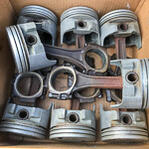
So where are the OP pictures???
1967 Pedal Car Champion

Joined: Mar 2020
Posts: 9,068
Likes: 4,200
From: US-PNW
From John Hinckley in his Small Block Assembly Overview article:
The engines coming at the stamper had the proper build code written in wax crayon on the block. The stamper just saw that code and chose the correct gang holder - there was no need for him to determine what model it was headed for.
John's article is a great read for some insights into the complex process taking castings to finished engines.
One gang-stamp was set up each morning for each engine suffix type to be built that day. If there were 46 different types of engines scheduled to be built, there would be 46 gang-stamps set up and placed in a rack adjacent to the stamping operation for the stamping operator to select from.
John's article is a great read for some insights into the complex process taking castings to finished engines.


Team Owner


Joined: Apr 2008
Posts: 31,737
Likes: 2,376
From: Middle TN by way of KY, OH, VA, IL, CA, FL, NY, SC, HI
Drifting
Joined: Sep 2009
Posts: 1,800
Likes: 212
From: Metro MI too close to the D
Team Owner
Joined: Apr 2008
Posts: 31,737
Likes: 2,376
From: Middle TN by way of KY, OH, VA, IL, CA, FL, NY, SC, HI
 Not wishing whatsoever to be argumentative, but https://www.thehenryford.org/visit/h...its/railroads/ this says 125' long. That's huge but not a city block long, is it?
Safety Car
Joined: Sep 2007
Posts: 4,458
Likes: 331
From: Indy Indiana
Still, in one sentence:
The methodology of comparing close VIN #s in determining authenticity, although logical, is not a foolproof methodology.
we haven't even started discussion on how the counterfeiters do it.
The methodology of comparing close VIN #s in determining authenticity, although logical, is not a foolproof methodology.
we haven't even started discussion on how the counterfeiters do it.
Drifting
Joined: Sep 2009
Posts: 1,800
Likes: 212
From: Metro MI too close to the D
[QUOTE=joewill;1608539449]Still, in one sentence:
The methodology of comparing close VIN #s in determining authenticity, although logical, is not a foolproof methodology.
we haven't even started discussion on how the counterfeiters do it.[/QUOTE
Good ones have gang stamp holders and number sets from the same manufacturer
best has a surface broached that produces very similar to original
then they put 50 years on
keep in mind they’ve been at this 50 years
The methodology of comparing close VIN #s in determining authenticity, although logical, is not a foolproof methodology.
we haven't even started discussion on how the counterfeiters do it.[/QUOTE
Good ones have gang stamp holders and number sets from the same manufacturer
best has a surface broached that produces very similar to original
then they put 50 years on
keep in mind they’ve been at this 50 years

Melting Slicks


Joined: Dec 2009
Posts: 2,099
Likes: 59
From: Grande Prairie
2024 C2 of the Year Finalist - Modified
2020 C2 of the Year Finalist - Modified
2019 C2 of Year Finalist (appearance mods)
Perhaps so, but John wasn't that specific in his description. Not wishing whatsoever to be argumentative, but https://www.thehenryford.org/visit/h...its/railroads/ this says 125' long. That's huge but not a city block long, is it?
Not wishing whatsoever to be argumentative, but https://www.thehenryford.org/visit/h...its/railroads/ this says 125' long. That's huge but not a city block long, is it?
Here’s one that Buick used for blocks and heads. I think “locomotive” sized is about right.
Drifting
Joined: Sep 2009
Posts: 1,800
Likes: 212
From: Metro MI too close to the D
That's definitly for heads, the engine machining line will be just for the block
you bore the crank, set it up from there, GM archives I'd expect has some pictures
Guys - the plant was about 1/4 mile deep, giving 1/4 mile for the parking lot, it ran the length to machine the entire block, not just making broach marks to be discussed 50 years later
and
we did heads
pistons
cams
heat treating rocker arms, studs, all of it
you bore the crank, set it up from there, GM archives I'd expect has some pictures
Guys - the plant was about 1/4 mile deep, giving 1/4 mile for the parking lot, it ran the length to machine the entire block, not just making broach marks to be discussed 50 years later
and
we did heads
pistons
cams
heat treating rocker arms, studs, all of it