When you click on links to various merchants on this site and make a purchase, this can result in this site earning a commission. Affiliate programs and affiliations include, but are not limited to, the eBay Partner Network.
From this older thread: https://www.corvetteforum.com/forums...t-on-c2-s.html
Posted by SWCDuke "At high speed a C2 has front lift and neutral to a bit of rear downforce. The primary culprit is the body design, but the tendency is exacerbated by lack of squat control in the rear suspension. The best way to mitigate the problem is a deep front air dam. This will break the airflow under the car and allow the engine compartment air to escape below without jamming up and creating high pressure in the engine compartment, which is the source of the front lift. For best results, wrap the front dam "around the corners" and get it as close to the tires as possible. If you look at the pressure distribution on a typical car is it high ahead of the grille, low over the hood (that's why hood scoops are not a good way to collect combustion air), high at the base of the windshield, low at the top of the windshield (with a low spike just aft of the top of the windshield, which is why sunroofs, even open a crack dramatically increase ventilation air) , then low on to the back of the car. The underneath is a real mess. Front end designs typically force lots of air under the car and this competes with radiator exit air for a place to go, and the result is lots of turbulence, drag, and pressure built up under the car. Like an airplane wing, the total lift - positive or negative - is the net sum of the pressure distributions over the affected areas. Mitchells/Shinoda's design for the original Stingray racer was based on an "inverted wing" that they had cooked up from some other sources. The trouble was, none of them really understood aero, and if they had talked to a real aero engineer, he would have probably told them that it wouldn't work because of the so-called "ground effect" that is familiar to pilots. A wing close to the ground behaves very different from a wing in a free airstream. The grille vents were a fix to try to vent the high pressure air from inside the engine compartment, and they were planned for the production car, but made fake when they realized (duh!) that the hot air exiting the engine room would be drawn into the HVAC inlets at the base of the windshield Duntov knew the car was seriously flawed, but Mitchell controlled the design, and wouldn't let Duntov influence it. GM claimed the car was very aerodyanamic and even had 3/8" scale models tested at the Cal Tech wind tunnel under the supervision of Dr. Peter Kyropolis, but I'm not sure it he understood "low speed" ground effects aero either. He was at the leading edge of supersonic aircraft aero, but they are two very different animals. Back in that era, cars were intuitively designed to be "aerodymanic", but little was really understood about high speed ground vehicle aerodymanics. The model was solid and did not account for air flowing through the car, so the results, which weren't published, probably had limited validity. It was just a marketing stunt. I expect the data showed problems even with the crude model, but Mitchell just wouldn't change the design. Look under the front of a C5 and note the deep air dam, hinged to keep one front tearing it off on every parking stop. The air dam forces air up into the front of the radiator and minimizes the amount of air that gets trapped under the car. This minimizes undercar pressure, which gives radiator/engine room air a place to exhaust (under the car), without building up high pressure, turbulence, and drag. Nowadays design studios employ aero engineers who advise the designers and test both models and full size cars. The "design" - shape of the car, and aero considerations are much more integrated today. It was really CAFE that forced this, because of the effect of aero drag on fuel economy. Designers now understand aero tricks to miminize drag and reduce lift, and the C5 is a prime example - deep air dam, top of hood higher than fenders so air smoothly spills over the side ahead of the A-pillars, and flush everything. The C5 Coupe has a claimed Cd of 0.29. The Cd of my SWC is somewhere between 0.50 and 0.55. They've come a long way in 40 years. The C2 is not "unstable" in the sense of a rear engine car with the center of pressure not far enough aft of the center of gravity, which can result in serious directional stability (that's why aircraft and LSR cars have big vertical stabilizers - to move the center of pressure (in side view) well aft of the CG), but the front lift makes it reluctant to turn at high speed. Going fast in a straight line without a big cross wind component is not too scary, but you don't want to have to maneuver much, because the car will be sluggish and unresponsive, and if you try to overdrive it, it could become unstable and go out of control. Lift forces can increase dramatically when a car develops a big yaw angle. NASCAR found this out the hard way, and mandated the flip up panel so the aero forces wouldn't lift the car off the ground at 200 MPH when they got sideways due to pressure buildup in the cockpit. Chevrolet tests on a '66 model with F-41 suspension showed that it would take about 600 HP at the flywheel to drive a C2 through still air at 200 MPH, and at that speed there would be zero weight on the front wheels due to aero lift making the car uncontollable." Duke
Is a front air dam or spoiler enough to keep the front end from rising, say at 150 mph?
John
Duke sez it helps significantly so if you aren't bound by some organization's rules against an air dam, that's what you should do.
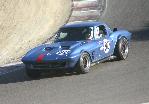
My Grand Sport vintage racer is bound by rules against non-period air dams. I mitigated the front end lift (exacerbated by my car's Nassau hood) by leaving the hood loosely tied down at the rear with leather straps. At air speeds over 100 MPH, the hood of my car rises about 3", relieving the pressure which causes lift. The fastest I've ever gone was right at 140 MPH and at that speed the car remained stable and planted.
Take a look at this thread. https://www.corvetteforum.com/forums...e-classic.html "His target speed is 130 mph, meaning he plans to average that speed over the 90 miles with a top speed permissible of 165 mph."
Interesting spoiler design and front bumper positioning.
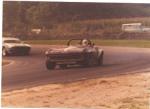
Short answer is ...yes. You also need some rake in the car. (Raise the rear) I used to race the 66 (in my avatar) for a few yrs. and had many laps at 140 and it was rock solid. Your air dam /spoiler needs to be about 6" and the width of the nose + if you can.
You might ask @427Hotrod about his car. If I remember correctly he broke 200 at the Texas mile.
Thanks Elwood13....
I was running 140+ in the 1/4 mile for years...and now with turbos it's in the 162 MPH range in the 1/4. Always handled fine to me.
My first attempt at higher speeds was at a half mile event on a dusty runway where I did 177 MPH...but even though they let me run drag radials and I was only making 10 PSI of boost...I couldn't really get my foot all the way in it until 140 MPH. Again...no handling issues...but since the runway ended in a lake...it took all I could do to get it stopped as compared the Lambos, and Audi's with giant brakes and giant sticky tires.
At the TX Mile I cracked 200 MPH a few months later where I had to run "less than sticky" speed rated all season tires. I couldn't bury my foot until 180 MPH with the same tune. Again, handling was fine to me. I was waiting and expecting something weird to happen but it never came.
I added the simple Ecklers spoiler on the front end before the first event figuring it couldn't hurt. Can't say I noticed anything special...but I hadn't been that fast previously. Not sure how it would have acted without it. My biggest challenge was keeping the nose down as I applied throttle as my car is setup more for street and drag racing...so weight transfer is good. Probably would have helped to limit travel and adjust shocks much tighter than I did. I've always installed hood latch extensions to crack the rear of the hood open and relieve pressure also. I've run 1/4 mile with it shut all the way and again can't say I noticed any difference...but figure it can't hurt either. As mentioned earlier. I think a good "rake" which lowers the nose and gets out of the typical nose high/rear squat situation is a big key to handling on C2's and C3's.
This pic was taken at 177 MPH. You can see my 25+ year old soft top wasn't having any fun (I was adding Gorilla tape to the seams to make it through the day). I installed a hardtop for the TX Mile. The front end is topped out pretty high and would be better if it was lower for sure. I did tighten it down for the TX Mile. Folks who race this stuff regularly told me the picture was great because you can see the "bulge" and "wrinkle" in the tires. The rear one is still applying downforce but it might continue to move if lift becomes an issue. The front one shows similar. I was told one of the "bad" areas of a C2 is the beltline area down the center of the side panels. Lift generates below it and tries to unsettle things.
Now you know why one of the primary tools of Formula 1 racing is a supercomputer along with aerodynamic simulation software. Race teams make 100's of simulations per week just to dial-in their car's aerodynamics for the upcoming race.
Kimmo (from Finland) stayed @ my house on the way to Texas to run over 200 MPH in his '65 . . . he uses a similar front spoiler to mine! I'd say it gets the job done!