


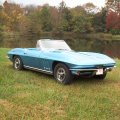



Replacing C2 Windshield

Thread Starter
Racer


Joined: Sep 2001
Posts: 371
Likes: 1
From: Nashville TN
 Replacing C2 Windshield
While traveling down the interstate today with the top down and a smile, a piece of metal bounced out from underneath the car in front of me and hit my windshield with a bang. Considering the 6" circle of crushed glass, spider web cracks to all corners and a shower of glass inside the car, I got off easy that it didn't hit the body. But, I need to get back into the car as quickly as possible before the withdrawal sets in. You know what I mean.
Is replacing the windshield possible for an ameteur or should I hire it out? Is there anything to look out for? My parts man told me that it is possible and there is no glue involved; just new rubber. Any suggestions would be much appreciated.
Is replacing the windshield possible for an ameteur or should I hire it out? Is there anything to look out for? My parts man told me that it is possible and there is no glue involved; just new rubber. Any suggestions would be much appreciated.

Burning Brakes


Joined: Oct 1999
Posts: 816
Likes: 37
From: Wilmington NC
Re: Replacing C2 Windshield (Dave McDufford)
Brian,
Your parts man is incorrect. When installing the windshield you need to apply both a body sealer and cement.
If you do decide to do it yourself, I suggest that you get either the Shop Manual or the AIMs manual first. Read as much as you can and then install it.
One very important thing you need to do is when you remove the broken windshield, aside from being careful with removing the trim pieces, record where each of the clips are located. There are a few different types of clips so, to make it easier for yourself, you may want to ensure that you install the clips back to their original locations (i.e., don't just toss them together into a bag).
Good luck,
GaryC
Your parts man is incorrect. When installing the windshield you need to apply both a body sealer and cement.
If you do decide to do it yourself, I suggest that you get either the Shop Manual or the AIMs manual first. Read as much as you can and then install it.
One very important thing you need to do is when you remove the broken windshield, aside from being careful with removing the trim pieces, record where each of the clips are located. There are a few different types of clips so, to make it easier for yourself, you may want to ensure that you install the clips back to their original locations (i.e., don't just toss them together into a bag).
Good luck,
GaryC

Safety Car


Joined: Oct 2000
Posts: 4,236
Likes: 355
From: Albuquerque, NM
Re: Replacing C2 Windshield (stngry63)
I tried installing a windshield in my '63 coupe, and there's no way I'd try it again. The problem I had was getting it to seal around the bottom corners. I tried for about two weeks, but water would still come in around the clips for the moldings.
Here are a couple things to consider: 1) You'll have to remove and then replace the moldings, which is not hard but you risk scratching the paint. Not as big a problem on the convertible, but you have to be very carefull at the bottom. 2) This is an extremely messy job. The black urethane tends to get all over the dash and the paint. You can clean it with paint thinner or mineral spirits when it's soft, but it's hard to get off once it's cured. 3) The broken glass could complicate things. You could put a blanket on the front of the car, but you still risk scratching the paint and injuring yourself if the windshield comes apart when you're taking it out. Remember, it's glued in.
After the hassle I had trying to get mine to seal and the mess I made, I was more than happy to pay a professional to redo it. He had to remove the windshield, clean up all the sealer, and reinstall it. I would recommend doing some research before you drop the car off with someone. Talk to people in clubs, and try to find someone with lots of experience, preferably with classic or custom cars. There's just too much to potentially screw up (paint scratches, leaks, and urethane all over the car) to risk leaving your car at the shop with the biggest ad in the phonebook. A lot of those guys are not that experienced, and they mostly do insurance work on newer cars. Plus, if you just drop it off at one of those big places, you usually don't know who will work on your car... it'll probably just be the next available installer (good luck!)
As someone who has tried it, my opinion is that this is not a job for the amateur. I'd let someone else do it, but make sure you find the right person.
Here are a couple things to consider: 1) You'll have to remove and then replace the moldings, which is not hard but you risk scratching the paint. Not as big a problem on the convertible, but you have to be very carefull at the bottom. 2) This is an extremely messy job. The black urethane tends to get all over the dash and the paint. You can clean it with paint thinner or mineral spirits when it's soft, but it's hard to get off once it's cured. 3) The broken glass could complicate things. You could put a blanket on the front of the car, but you still risk scratching the paint and injuring yourself if the windshield comes apart when you're taking it out. Remember, it's glued in.
After the hassle I had trying to get mine to seal and the mess I made, I was more than happy to pay a professional to redo it. He had to remove the windshield, clean up all the sealer, and reinstall it. I would recommend doing some research before you drop the car off with someone. Talk to people in clubs, and try to find someone with lots of experience, preferably with classic or custom cars. There's just too much to potentially screw up (paint scratches, leaks, and urethane all over the car) to risk leaving your car at the shop with the biggest ad in the phonebook. A lot of those guys are not that experienced, and they mostly do insurance work on newer cars. Plus, if you just drop it off at one of those big places, you usually don't know who will work on your car... it'll probably just be the next available installer (good luck!)
As someone who has tried it, my opinion is that this is not a job for the amateur. I'd let someone else do it, but make sure you find the right person.

Melting Slicks


Joined: Oct 2001
Posts: 2,740
Likes: 4
From: Marblehead MA
Re: Replacing C2 Windshield (stngry63)
I have a new tinted windshield going in my 63 SWC and I did exactly what BlackBirdZ07 said to do. Got references from my local Vette club, and 3 people recommended the same place, which was a classic car restoration shop. I visited the shop and they quoted me $75 an hour, and said it was a two to three hour job. The only down side I was told was that if there is significan rust on the birdcage all bets are off. They keep the car overnite to make sure everything cures up nicely, then you have to bring it back about a month later for a final check.
Oh, one other thing they always replace the windshield rubber so plan on about $40 for that piece.
I think for $75 an hour, its money well spent.... :smash:
Oh, one other thing they always replace the windshield rubber so plan on about $40 for that piece.
I think for $75 an hour, its money well spent.... :smash:

Melting Slicks

Joined: May 1999
Posts: 2,897
Likes: 0
From: Moon Township PA
Re: Replacing C2 Windshield (GaryC)
The mid-years have a one piece windwhield gasket that is held in place by the seal around the windshield lip and the glass. Glue or adhesive is not normally a part of this operation although some sealant can be used. The sealant isn't used as an adhesive but to fill in the minor gaps between the windshield frame and the gasket. When my 66 needed a new windshield I decided to do this myself, never having done it before. I am not sure how old you are but all of the cars in "the old days" used a rubber gasket that sealed around the frame. The common technique was to get the gasket warm and pliable and then two guys would lay a small diameter cord in the bottom of the gasket. Then, after fitting the gasket and forcing the lip of the gasket over the windshield frame, you will come to a point at which you can no longer make the gasket fit. That is when you take the ends of the cord and pull, while the helper gently pushes the windshield into place. This has the effect of pulling the lip of the gasket out and, as it pulls back into place, the lip falls over the frame. I know, very poor mental image here, but once you have seen it, you will understand it. It is simple, easy, and goes fairly quickly. I have done it once, would do it again, and have no qualms about recommending that technique to others.
Once the windshield is in place and has had a chance to sit in the sit for a while, dribble water around the frame, with a helper in the interior looking for the inevitable leaks. My 66 leaked at the bottom corners. I just pulled the gasket back, laid a small bead of black silicone in there and then squashed the gasket back down.
Gary
Once the windshield is in place and has had a chance to sit in the sit for a while, dribble water around the frame, with a helper in the interior looking for the inevitable leaks. My 66 leaked at the bottom corners. I just pulled the gasket back, laid a small bead of black silicone in there and then squashed the gasket back down.
Gary

Pro

Joined: Mar 2001
Posts: 587
Likes: 0
From: Leonard, MI USA
Re: Replacing C2 Windshield (achapman)
I had mine replaced last fall. I had a professional do it. I removed all the inner trim myself, and most of the outer trim. No small task.
My insurance covered the entire bill.
My insurance covered the entire bill.

Le Mans Master


Joined: Feb 1999
Posts: 5,834
Likes: 373
From: Mobile AL
Re: Replacing C2 Windshield (stngry63)
Fellers, it is not a good idea to use a curing sealer in this application.
There was a sealer that was used by GM on the assembly line, but it stayed gooey for decades. The modern equivalent is 3M Bedding and Sealing Compound. It stays sticky and will keep its seal as the rubber gasket and windshield frame flex over the years. And yes, it is a mess to clean up.
There was a sealer that was used by GM on the assembly line, but it stayed gooey for decades. The modern equivalent is 3M Bedding and Sealing Compound. It stays sticky and will keep its seal as the rubber gasket and windshield frame flex over the years. And yes, it is a mess to clean up.
Corvette Stories
The Best of Corvette for Corvette Enthusiasts

Top 10 Most Expensive Corvettes Ever Sold on Bring A Trailer
Brett Foote
10 Things Every Corvette Owner Needs (2026 Edition)
Michael S. Palmer
8 Most "Only Corvette Owners Understand" Quirks and Problems
Pouria Savadkouei
10 Reasons the C6 Z06 is Still A Performance Benchmark After 20 Years
Joe Kucinski
How Much Horsepower Every Corvette Engine "LOST" in 1972
Joe Kucinski
Top 10 DOs and DON'Ts for Protecting Your Convertible Top!
Michael S. Palmer
Top 10 Most Explosive Corvettes Ever Made: Power-to-Weight Ratio Ranked!
Joe Kucinski
150 hp to 1,250 hp: Every Corvette Generation Compared by the Specs That Matter
Joe Kucinski
8 Coolest Corvette Pace Cars (and Replicas) of All Time
Verdad Gallardo
Burning Brakes
Joined: Oct 1999
Posts: 816
Likes: 37
From: Wilmington NC
Re: Replacing C2 Windshield (jerrybramlett)
Guy's,
If it seems that I was talking about a curing type of adhesive then that is an incorrect assumption. I was just quoting what is stated in the AIM's and Shop manual. I never stated what type to use; I was just stating that per the manuals, something is used.
Sorry if I caused any confusion.
GaryC
If it seems that I was talking about a curing type of adhesive then that is an incorrect assumption. I was just quoting what is stated in the AIM's and Shop manual. I never stated what type to use; I was just stating that per the manuals, something is used.
Sorry if I caused any confusion.
GaryC
Thread Starter
Racer
Joined: Sep 2001
Posts: 371
Likes: 1
From: Nashville TN
Re: Replacing C2 Windshield (GaryS)
GaryS,
My partsman described the same method with a cord around the rubber that you stated. I've ordered the windshield and will have a follow-up next week.
Brian(stngry63)
In response to insurance, the car is only covered with liability and uninsured motorist. This may be a shock and not very smart to some, but I've done it this way on all of the Midyears that I've had since about 1986. Financially I would come out ahead even if the car was just about totaled since I stick to tired drivers. I only get insurance for things that would cause a financial burden if lost; not just for financial pain. To me, a lot of insurance and extended waranties are for peace of mind; not for getting ahead in the long run. Even though the '63 is a second car, it still got over 10,000 miles last year. I'll get off my soap box. Again, full report on the windshield next week...
[Modified by stngry63, 8:53 PM 4/2/2003]
My partsman described the same method with a cord around the rubber that you stated. I've ordered the windshield and will have a follow-up next week.
Brian(stngry63)
In response to insurance, the car is only covered with liability and uninsured motorist. This may be a shock and not very smart to some, but I've done it this way on all of the Midyears that I've had since about 1986. Financially I would come out ahead even if the car was just about totaled since I stick to tired drivers. I only get insurance for things that would cause a financial burden if lost; not just for financial pain. To me, a lot of insurance and extended waranties are for peace of mind; not for getting ahead in the long run. Even though the '63 is a second car, it still got over 10,000 miles last year. I'll get off my soap box. Again, full report on the windshield next week...
[Modified by stngry63, 8:53 PM 4/2/2003]


Race Director


Joined: Jan 2003
Posts: 17,682
Likes: 3,678
From: Central Arkansas
Re: Replacing C2 Windshield (achapman)
It's tempting to try to install it yourself but most people I've heard from say for the cost to have a professional install one, it's cheap insurance. Yes - sealer is necessary. :steering:

Pro
Joined: Jul 2001
Posts: 710
Likes: 0
From: Thornton Co
Re: Replacing C2 Windshield (stngry63)
I have done this project with Brutal64's windshield, it is a pain in the rear. The whole install is very difficult with six hands working all of the time. When it was all said and done the windshield broke within a week's time because of stress that was put on it from either the trim or the rubber windshield mount. If I do mine I will have it done with outside professional help. Some things are just worth paying for, and this is one of them. :yesnod:
I did enjoy the learning experience though, just glad it wasn't my car.
Kurt :cheers:
I did enjoy the learning experience though, just glad it wasn't my car.
Kurt :cheers:
