



Heavy Chevy
Drifting


Joined: May 2005
Posts: 1,909
Likes: 6
From: Lake Arrowhead - Georgia > 72 Base Coupe & 74 BB Roadster

Originally Posted by Paul Borowski
...the "Heavy Chevy" was actually a model(option?)on '71/'72 Chevelles. Kinda like the Rally Nova or Laguna S3 were just another model with different trim/striping/paint scheme.
 CORRECT.....As the fuel prices and the Insurance Companies began to chip away at the muscle car craze in 71 ... models such as a Ralleye Nova and a Heavy Chevy (Chevelle) were offered by GM as a last ditch effort to squeeze a few more bucks out of the dying era. By 71, anything with an SS, Z, GS, SD, RS ... offered by GM was almost uninsurable unless you spent most of your check on insurance. God wouldn't even insure a Big Block...
  These sneaky trim packages were actually pretty stout and were considered a mid range economy model ... therefore tricking the insurance companies for a few years. Then gas busted 50 cents a gallon by about 1975 and it was all over except for the 400 CI Pontiacs.
  I had a 73 SD 455 TA from 73 til 77....sold it when gas hit 77 cents a gallon. Sure wish I still had that car.
I am just glad there are a few of the old Dinosaurs left today !
Last edited by fotyfobravo; Jul 26, 2005 at 05:11 PM. Reason: spelling !

Melting Slicks


Joined: May 2001
Posts: 2,215
Likes: 169
From: PA
Originally Posted by KenSny
OK Heavy Chevy has been beat to death.
How many can define a "LEAD SLED".
How many can define a "LEAD SLED".
I take a shot at this 49/50 mercury were called lead sled i think because there was a lot of lead used to form the custom fenders and other body parts. dont hang me if this is not right.
Race Director

Joined: Apr 1999
Posts: 11,520
Likes: 13
From: CORVETTE 77 385 C.I. TEXAS
Before my time- This should do it anyway (I read a lot about cars at a very young age)- Lead Sled was a term used for custom cars that used lead to modify the body.
As you can see this is the same as Stephen said except he limited it to certain cars. The F*rds of the era Stephen mentioned were popular to customize because of the relatively clean lines at the time.
Adding weight was the opposite of what should be done- therefore Lead Sled.
Bonus:
All show- no go!
I am for all go- no show!

As you can see this is the same as Stephen said except he limited it to certain cars. The F*rds of the era Stephen mentioned were popular to customize because of the relatively clean lines at the time.
Adding weight was the opposite of what should be done- therefore Lead Sled.
Bonus:
All show- no go!
I am for all go- no show!
Last edited by Ganey; Jul 26, 2005 at 06:52 PM. Reason: To add para. 2

Racer


Joined: Mar 2005
Posts: 316
Likes: 0
From: Grand Forks North Dakota
Originally Posted by 68rdstr
In highschool my neighbors boyfriend had a 72 Heavy Chevy. I owned a 76 Laguna S3. Sb 400, black with the white stripes It had the swivel bucket seats!
Beautiful cars, my dad has a '76 S3 in black with the red stripes. 400 and maroon swivel bucket interior. I never appreciated the car back in the day, but now I wish I could find one, the front ends are really nice.
Drifting
Joined: May 2005
Posts: 1,909
Likes: 6
From: Lake Arrowhead - Georgia > 72 Base Coupe & 74 BB Roadster
Originally Posted by KenSny
OK Heavy Chevy has been beat to death.
How many can define a "LEAD SLED".
How many can define a "LEAD SLED".
A fully loaded B-52 with ONE engine shut down ... the dreaded 7 engine approach and landing !

Now this one has been beat to death......going to bed !

Melting Slicks

Joined: Apr 2001
Posts: 3,399
Likes: 278
From: Olmsted Falls, Ohio
Originally Posted by fotyfobravo
Out of the arena here.....but my "background" defines a LEAD SLED as:
A fully loaded B-52 with ONE engine shut down ... the dreaded 7 engine approach and landing !
Now this one has been beat to death......going to bed !
A fully loaded B-52 with ONE engine shut down ... the dreaded 7 engine approach and landing !
Now this one has been beat to death......going to bed !
And yes in the olden days lead was used to fill in fender gaps, door handles, etc. Better than bondo.
Safety Car

Joined: Jun 2002
Posts: 4,135
Likes: 1
Originally Posted by Ganey
Before my time- This should do it anyway (I read a lot about cars at a very young age)- Lead Sled was a term used for custom cars that used lead to modify the body.
As you can see this is the same as Stephen said except he limited it to certain cars. The F*rds of the era Stephen mentioned were popular to customize because of the relatively clean lines at the time.
Adding weight was the opposite of what should be done- therefore Lead Sled.
Bonus:
All show- no go!
I am for all go- no show!
As you can see this is the same as Stephen said except he limited it to certain cars. The F*rds of the era Stephen mentioned were popular to customize because of the relatively clean lines at the time.
Adding weight was the opposite of what should be done- therefore Lead Sled.
Bonus:
All show- no go!
I am for all go- no show!
Corvette Stories
The Best of Corvette for Corvette Enthusiasts

150 hp to 1,250 hp: Every Corvette Generation Compared by the Specs That Matter
Joe Kucinski
8 Coolest Corvette Pace Cars (and Replicas) of All Time
Verdad Gallardo
Top 10 Corvette Engines RANKED by Peak Torque (70+ Years of Muscle!)
Joe Kucinski
Corvette ZR1X Will Be Pacing the Indy 500, And Could Probably Race, Too!
Verdad Gallardo
Top 10 Corvettes Coming to Mecum Indy 2026!
Brett Foote
Top 10 C9 Corvette MUST-HAVES to Fix These C8 Generation Flaws!
Michael S. Palmer
10 Revolutionary 'Corvette Firsts' Most People Don't Know
Joe Kucinski
5 Reasons to Upgrade to an LS6-Powered Corvette; 5 Reasons to Stay LT2
Michael S. Palmer
2027 Corvette vs The World: Every C8 vs Its Closest Competitor
Joe Kucinski

Melting Slicks
Joined: Apr 2001
Posts: 3,399
Likes: 278
From: Olmsted Falls, Ohio
Originally Posted by carl a
i think'' lead sled ''is the same thing as saying ''its a bondo bardge''(or in our cases''full of fiber filler'' so it would be a ''fiber flopper''(a vette full of fiberglass filler cuz its been wrecked so much!!
Lead was used to customize, fill in panel seams, removed door handles, etc. Make everything smooth. By using lead they would get a nice metal bond and fill that was easy to file down and build up if necessary. It would not crack over time like bondo does today. Yes, the lead was heavy, but you probably would not add more that a spare tires worth of weight in the average custom. And by the time you did a chop and channel you probably had less weight than you started with.
Times change, now almost all custom work is done by adding "glue on" ground effects, wings, panels, etc. Visit a custom shop that is full of ricers and you'll see what I mean.
Safety Car
Joined: Jun 2002
Posts: 4,135
Likes: 1
Originally Posted by KenSny
No, you're missing the point.
Lead was used to customize, fill in panel seams, removed door handles, etc. Make everything smooth. By using lead they would get a nice metal bond and fill that was easy to file down and build up if necessary. It would not crack over time like bondo does today. Yes, the lead was heavy, but you probably would not add more that a spare tires worth of weight in the average custom. And by the time you did a chop and channel you probably had less weight than you started with.
Times change, now almost all custom work is done by adding "glue on" ground effects, wings, panels, etc. Visit a custom shop that is full of ricers and you'll see what I mean.
Lead was used to customize, fill in panel seams, removed door handles, etc. Make everything smooth. By using lead they would get a nice metal bond and fill that was easy to file down and build up if necessary. It would not crack over time like bondo does today. Yes, the lead was heavy, but you probably would not add more that a spare tires worth of weight in the average custom. And by the time you did a chop and channel you probably had less weight than you started with.
Times change, now almost all custom work is done by adding "glue on" ground effects, wings, panels, etc. Visit a custom shop that is full of ricers and you'll see what I mean.





Heel & Toe
Joined: Jul 2005
Posts: 23
Likes: 0
From: Jamestown NY
Originally Posted by 68rdstr
In highschool my neighbors boyfriend had a 72 Heavy Chevy. I owned a 76 Laguna S3. Sb 400, black with the white stripes It had the swivel bucket seats!



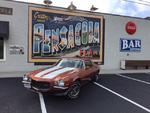
Melting Slicks


Joined: Dec 1999
Posts: 2,157
Likes: 0
From: Pensacola FLA
Originally Posted by JustinGJ
Beautiful cars, my dad has a '76 S3 in black with the red stripes. 400 and maroon swivel bucket interior. I never appreciated the car back in the day, but now I wish I could find one, the front ends are really nice.
