




steering column options
Thread Starter
Melting Slicks

Joined: Jan 2006
Posts: 3,028
Likes: 2
From: North NJ
 steering column options
1.) what year steering columns will work in my 68? i have the original but want tilt/tele. I'll end up with an aftermarket wheel anyway.
2.) what other options are there? will a c4, c5, c6 work? i would get rid of all electronics but blinkers. It would be neat to reroute my wipers to the column.
Would like to limit mounting modifications to a minimum.
ideas?
2.) what other options are there? will a c4, c5, c6 work? i would get rid of all electronics but blinkers. It would be neat to reroute my wipers to the column.
Would like to limit mounting modifications to a minimum.
ideas?
Thread Starter
Melting Slicks
Joined: Jan 2006
Posts: 3,028
Likes: 2
From: North NJ
Originally Posted by 68RATVT
Two words, Flaming River.....
gotta be an alternative out there, flaming river has nice columns but mucho dinero
what i'm finding out is that a 69 vette column won't fit a 68. Only columns from 66 thru 68 are interchangable, this true?

Le Mans Master


Joined: Jun 2005
Posts: 5,447
Likes: 3
From: Syracuse NY
Only columns from 66 thru 68 are interchangable, this true? I'll be interested in the answer to this too.
http://www.columnsgalore.com/
http://www.corvettesteering.com/
I got these Only columns from 66 thru 68 are interchangable, this true?2 after doing a search, both had very good reveiws by those that used them.
http://www.columnsgalore.com/
http://www.corvettesteering.com/
I got these Only columns from 66 thru 68 are interchangable, this true?2 after doing a search, both had very good reveiws by those that used them.
Last edited by DZRick; Nov 10, 2006 at 02:55 AM.

Le Mans Master


Joined: Jul 2000
Posts: 6,001
Likes: 113
From: Saginaw Michigan
Only the 1967 and 1968 Corvette steering columns will interchange. The only production, collapsible, energy absorbing, steering columns available are the telescoping column and the standard (non-adjustable) columns.
The 1967-68 Corvette columns were special in that they had smaller diameter tubes than any other GM columns. So the later Corvette and GM T&T and tilt columns will not fit through the instrument panel.
I personally don't recommend other brands of steering columns because they were not designed to collapse and absorb energy (particularly in cars that are driven on public roadways.)
Jim
The 1967-68 Corvette columns were special in that they had smaller diameter tubes than any other GM columns. So the later Corvette and GM T&T and tilt columns will not fit through the instrument panel.
I personally don't recommend other brands of steering columns because they were not designed to collapse and absorb energy (particularly in cars that are driven on public roadways.)
Jim
Pro

Joined: Sep 2006
Posts: 551
Likes: 2
From: Clovis CA
Jim, no offense meant, Flaming River builds nothing but quality parts. Certainly a collapsible column is a safety feature, how be it small. We are talking about a fiberglass car with little safety, the column may be the only thing. And I have to ask, how collapsible is it when it's tele'd out and locked?
Thread Starter
Melting Slicks
Joined: Jan 2006
Posts: 3,028
Likes: 2
From: North NJ
I agree, safety should always be taken into consideration...did they make t&t columns in 67 & 68? i thought i remembered reading somewhere that the standard NON-tilt/telescoping columns were standard/stock on the 68's. I hope I'm wrong. I hope tilt/telesc was an option taken advantage of from buyers so I can find one lying around somewhere.
Flaming river also has the new columns out that are lazer cut and made specifically to colapse 2 inches under significant pressure from a colission...but that ups the anti to $599 but that gives you a general column, i'm sure its more to get a colapsable 68 vette version with tilt/telesc.
So my best bet is search for a 67 - 68 tilt/tel column right?
Anyone want to part with one? doesn't have to be complete and pretty, i'll clean it up and transfer the needed parts off my standard column. Fleebay only ever has 73 and up.
Flaming river also has the new columns out that are lazer cut and made specifically to colapse 2 inches under significant pressure from a colission...but that ups the anti to $599 but that gives you a general column, i'm sure its more to get a colapsable 68 vette version with tilt/telesc.
So my best bet is search for a 67 - 68 tilt/tel column right?
Anyone want to part with one? doesn't have to be complete and pretty, i'll clean it up and transfer the needed parts off my standard column. Fleebay only ever has 73 and up.

Drifting


Joined: Oct 2003
Posts: 1,426
Likes: 1
From: VetteMOD
St. Jude Donor '05-'07
If you change the column mounting bracket to a 69-up bracket (the big steel casting and steel plate) and make an adapter plate for the firewall mount, you can use a later C3 column in a 68. I'm not sure there was a tilt/tele in 68, think it was tele only. They are not cheap and difficult to find parts for.
Last edited by BBShark; Nov 10, 2006 at 01:53 PM.
Corvette Stories
The Best of Corvette for Corvette Enthusiasts

Top 10 Most Expensive Corvettes Ever Sold on Bring A Trailer
Brett Foote
10 Things Every Corvette Owner Needs (2026 Edition)
Michael S. Palmer
8 Most "Only Corvette Owners Understand" Quirks and Problems
Pouria Savadkouei
10 Reasons the C6 Z06 is Still A Performance Benchmark After 20 Years
Joe Kucinski
How Much Horsepower Every Corvette Engine "LOST" in 1972
Joe Kucinski
Top 10 DOs and DON'Ts for Protecting Your Convertible Top!
Michael S. Palmer
Top 10 Most Explosive Corvettes Ever Made: Power-to-Weight Ratio Ranked!
Joe Kucinski
150 hp to 1,250 hp: Every Corvette Generation Compared by the Specs That Matter
Joe Kucinski
8 Coolest Corvette Pace Cars (and Replicas) of All Time
Verdad Gallardo
Le Mans Master
Joined: Aug 2003
Posts: 7,720
Likes: 12
From: Chattanooga TN
Originally Posted by 68RATVT
Jim, no offense meant, Flaming River builds nothing but quality parts. Certainly a collapsible column is a safety feature, how be it small. We are talking about a fiberglass car with little safety, the column may be the only thing. And I have to ask, how collapsible is it when it's tele'd out and locked?
Pro
Joined: Sep 2006
Posts: 551
Likes: 2
From: Clovis CA
Agree, it is a great safety feature, but if you get in a collision bad enough to need it in a Vette, chances are thats going to be the least of your worries, right?
Mustangs are great cars, sturdy and steel. Understandably collapsible could make a big difference.
Mustangs are great cars, sturdy and steel. Understandably collapsible could make a big difference.
Drifting
Joined: Oct 2003
Posts: 1,426
Likes: 1
From: VetteMOD
St. Jude Donor '05-'07
Originally Posted by 68RATVT
Agree, it is a great safety feature, but if you get in a collision bad enough to need it in a Vette, chances are thats going to be the least of your worries, right?
Mustangs are great cars, sturdy and steel. Understandably collapsible could make a big difference.
Mustangs are great cars, sturdy and steel. Understandably collapsible could make a big difference.
I does concern me that people sometimes disable this feature by collapsing the steering shaft when doing steering conversions. I hope they realize the risk they are taking.
Pro
Joined: Sep 2006
Posts: 551
Likes: 2
From: Clovis CA
Originally Posted by BBShark
I think that if you were involved in a frontal impact in a C3, the steering column going through your chest would be your greatest worry. Whatever can be done to put crush between you and the frame is good regardless of what kind of car you are driving and, next to seat belts, the most effective safety equipment in a C3.
I does concern me that people sometimes disable this feature by collapsing the steering shaft when doing steering conversions. I hope they realize the risk they are taking.
I does concern me that people sometimes disable this feature by collapsing the steering shaft when doing steering conversions. I hope they realize the risk they are taking.
Thread Starter
Melting Slicks
Joined: Jan 2006
Posts: 3,028
Likes: 2
From: North NJ
Originally Posted by BBShark
I does concern me that people sometimes disable this feature by collapsing the steering shaft when doing steering conversions. I hope they realize the risk they are taking.
Anyone have pics of a 69 or later bracket that i would need to fab up an adapter for? trying to visualize in my head.
My column is fastened to the car with a bracket/plate(A) that sits below the column that sandwiches it to a large heavy cast bracket(B)that is fastened to a metal bracket(C) that is fastened to the body/firewall. See pics below... so I need to fab a bracket from (C) to a new (B) from a 69 or later? has anyone done this yet? any pics? any pics of a 69 or later brackets?


Le Mans Master
Joined: Jul 2000
Posts: 6,001
Likes: 113
From: Saginaw Michigan
Vehicle Crash Dynamics 101
There is about 7 to 8 inches of collapse designed into the Saginaw
C2/C3 energy absorbing steering column. In a severe frontal crash the design collapse distance is used up in two ways. First, the vehicle front end crush (i.e. the frame and steering gear moving rearward toward the body) and second, the driver impacting the steering wheel and driving the upper end of the steering column into the instrument panel.
The lower steering shaft (sticking out into the engine compartment) has about 3.6 inches between the end of the strg column and the top of the detachable column flange. So in a very severe frontal collision the gear and frame could be driven back and up a couple inches causing the steering shaft to collapse from the engine side (this would take up 3.6 inches of the 7 or 8 built into the column or about half.) After the 3.6 inches is used up, the lower car floor and the steering column jacket now have to start to deform and move into the passenger compartment.
A few milliseconds later, the driver (without a shoulder belt) would slam into the steering wheel causing the upper end of the steering column to be driven into the instrument panel. (This is where the energy absorbing feature of the Saginaw column comes into play.) The upper end of the steering column moves into the instrument cluster and absorbs driver energy as it moves forward. The clearance designed into the instrument panel where the column passes through allows for that collapse distance. This could take up the remaining 3 or 4 inches of collapse.
Now when you shove the steering shaft back into the column to make room for the Jeep gear or the Steeroids R&P, you do reduce the available 7 or 8 inches by an inch or so. This would only make a difference in a very severe frontal collision.
With a rigid steering column any crash movement of the steering gear rearward causes the steering column shaft to move rearward by the same amount. This causes the steering shaft and steering hub with the wheel to begin to move rearward out of the strg column. Now the driver's body moving forward hits the steering wheel/strg shaft moving rearward. Not a pleasant thought.
Jim
There is about 7 to 8 inches of collapse designed into the Saginaw
C2/C3 energy absorbing steering column. In a severe frontal crash the design collapse distance is used up in two ways. First, the vehicle front end crush (i.e. the frame and steering gear moving rearward toward the body) and second, the driver impacting the steering wheel and driving the upper end of the steering column into the instrument panel.
The lower steering shaft (sticking out into the engine compartment) has about 3.6 inches between the end of the strg column and the top of the detachable column flange. So in a very severe frontal collision the gear and frame could be driven back and up a couple inches causing the steering shaft to collapse from the engine side (this would take up 3.6 inches of the 7 or 8 built into the column or about half.) After the 3.6 inches is used up, the lower car floor and the steering column jacket now have to start to deform and move into the passenger compartment.
A few milliseconds later, the driver (without a shoulder belt) would slam into the steering wheel causing the upper end of the steering column to be driven into the instrument panel. (This is where the energy absorbing feature of the Saginaw column comes into play.) The upper end of the steering column moves into the instrument cluster and absorbs driver energy as it moves forward. The clearance designed into the instrument panel where the column passes through allows for that collapse distance. This could take up the remaining 3 or 4 inches of collapse.
Now when you shove the steering shaft back into the column to make room for the Jeep gear or the Steeroids R&P, you do reduce the available 7 or 8 inches by an inch or so. This would only make a difference in a very severe frontal collision.
With a rigid steering column any crash movement of the steering gear rearward causes the steering column shaft to move rearward by the same amount. This causes the steering shaft and steering hub with the wheel to begin to move rearward out of the strg column. Now the driver's body moving forward hits the steering wheel/strg shaft moving rearward. Not a pleasant thought.
Jim
Thread Starter
Melting Slicks
Joined: Jan 2006
Posts: 3,028
Likes: 2
From: North NJ
Originally Posted by Jim Shea
Not a pleasant thought.Jim
Jim, if you had a 68 with a non-tilt column and really wanted to convert to a tilt/telescoping column what would you do?
and no, buying a car with one is not an option

1.)Convert the mounting brackets to a later C3 colapsable tilt/tele column? or 2.)go with an aftermarket colapsable such as flaming river?($600)
I'm leaning towards fabing up some mounting brackets for a later C3 column b/c I feel more comfortable that these were specifically designed for the C3 engineering but I also don't want to diminish the actual design engineering geometry by changing the original mounting design. By changing the mounting it may affect the overal safety and how the column would react in an unfortunate event.
Why did they change the column designs in 69? are they safer than a 67/68?
Drifting
Joined: Oct 2003
Posts: 1,426
Likes: 1
From: VetteMOD
St. Jude Donor '05-'07
The brackets "A" and "B" in your pictures could be replaced with 69-up brackets. It is a bolt in swap, no modifications. The firewall bracket could be replaced also. This bracket is available from junkyards.
If you are doing the Jeep box conversion, you will find that you have to push the steering shaft in 2.5 inches minimum. This is if the pitman arm is to remain in the same place is the Vette arm. The Jeep gear will need to be rotated so that its input shaft is aligned with the column. The Jeep box is taller than the Vette so the input shaft is higher (unless rotated down). You will need to to use a U-joint coupler to make up for this misalignment and the couplers are longer than the rag joint. I think all in all you will have to push the shaft in at least 3 inches if not more.
A little tip for the Jeep box conversion. Use a mid 70's A body power steering pitman arm. 5 1/5 inches center to center, bolt in, no welding!
If you are doing the Jeep box conversion, you will find that you have to push the steering shaft in 2.5 inches minimum. This is if the pitman arm is to remain in the same place is the Vette arm. The Jeep gear will need to be rotated so that its input shaft is aligned with the column. The Jeep box is taller than the Vette so the input shaft is higher (unless rotated down). You will need to to use a U-joint coupler to make up for this misalignment and the couplers are longer than the rag joint. I think all in all you will have to push the shaft in at least 3 inches if not more.
A little tip for the Jeep box conversion. Use a mid 70's A body power steering pitman arm. 5 1/5 inches center to center, bolt in, no welding!
Thread Starter
Melting Slicks
Joined: Jan 2006
Posts: 3,028
Likes: 2
From: North NJ
Originally Posted by BBShark
The brackets "A" and "B" in your pictures could be replaced with 69-up brackets. It is a bolt in swap, no modifications. The firewall bracket could be replaced also. This bracket is available from junkyards. A little tip for the Jeep box conversion. Use a mid 70's A body power steering pitman arm. 5 1/5 inches center to center, bolt in, no welding!
I got the jeep box quick ratio unit from corvettesteering so its a direct bolt in. Resplined and all to accept the stock pitman arm. Kit also came with
So I can get the "A" and "B" brackets from a 69+ donor car and they should be a direct bolt-in? then I would just have to get a 69 or up tilt/tel column? any years I should stay away from or aim for? i.e. would a 73 or 78 work?
I wish I could get a column mounted highbeam switch instaed of the foot switch.
Thanks guys for the info.
Le Mans Master
Joined: Jul 2000
Posts: 6,001
Likes: 113
From: Saginaw Michigan
Energy Absorbing Steering Columns 102
The first generation energy absorbing (EA) GM steering columns (all 1967-1968 passenger cars) had an expanded mesh section in the jacket tube. The mesh convolutions were designed to bend on themselves and absorb energy as the column collapsed. Unfortunately, this type of steering column was pretty whimpy in bending. This is why you will note that most 1967-68 columns had big mounting brackets with three and four aluminum breakaway capsules to hold the column into the instrument panel. This capsule bracket "band-aid" basically kept the column from bouncing in your hands as you drove down the road.
Saginaw new that in 1969 the ignition lock cylinder was going to be added to the steering column, which added mass and complexity to the steering column head. This would make a whimpy column even worse!
So Saginaw designed a second generation energy absorbing steering column with what is called the "ball EA" design.
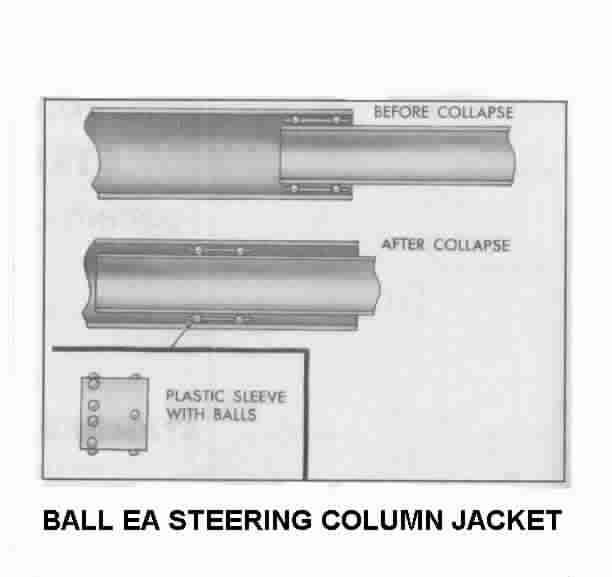
With this design, the upper jacket (driver end) telescoped over the lower jacket. As the jackets moved, the ball bearings (which filled the gap between the two jackets) plowed grooves in the two parts and absorbed energy. This 2nd design was far stiffer than the mesh jacket used the first two years. (All 1969 and later steering columns only required simple two breakaway capsule mounting brackets.)
Jim
The first generation energy absorbing (EA) GM steering columns (all 1967-1968 passenger cars) had an expanded mesh section in the jacket tube. The mesh convolutions were designed to bend on themselves and absorb energy as the column collapsed. Unfortunately, this type of steering column was pretty whimpy in bending. This is why you will note that most 1967-68 columns had big mounting brackets with three and four aluminum breakaway capsules to hold the column into the instrument panel. This capsule bracket "band-aid" basically kept the column from bouncing in your hands as you drove down the road.
Saginaw new that in 1969 the ignition lock cylinder was going to be added to the steering column, which added mass and complexity to the steering column head. This would make a whimpy column even worse!
So Saginaw designed a second generation energy absorbing steering column with what is called the "ball EA" design.
With this design, the upper jacket (driver end) telescoped over the lower jacket. As the jackets moved, the ball bearings (which filled the gap between the two jackets) plowed grooves in the two parts and absorbed energy. This 2nd design was far stiffer than the mesh jacket used the first two years. (All 1969 and later steering columns only required simple two breakaway capsule mounting brackets.)
Jim
Drifting
Joined: Oct 2003
Posts: 1,426
Likes: 1
From: VetteMOD
St. Jude Donor '05-'07
Originally Posted by 68 NJConv 454
Thanks BB,
I got the jeep box quick ratio unit from corvettesteering so its a direct bolt in. Resplined and all to accept the stock pitman arm. Kit also came with
So I can get the "A" and "B" brackets from a 69+ donor car and they should be a direct bolt-in? then I would just have to get a 69 or up tilt/tel column? any years I should stay away from or aim for? i.e. would a 73 or 78 work?
I wish I could get a column mounted highbeam switch instaed of the foot switch.
Thanks guys for the info.
I got the jeep box quick ratio unit from corvettesteering so its a direct bolt in. Resplined and all to accept the stock pitman arm. Kit also came with
So I can get the "A" and "B" brackets from a 69+ donor car and they should be a direct bolt-in? then I would just have to get a 69 or up tilt/tel column? any years I should stay away from or aim for? i.e. would a 73 or 78 work?
I wish I could get a column mounted highbeam switch instaed of the foot switch.
Thanks guys for the info.
Le Mans Master
Joined: Jul 2000
Posts: 6,001
Likes: 113
From: Saginaw Michigan
I wasn't involved with the design of the EA columns for the C2/C3 Vettes so I can't provide accurate history. However, I can provide the obvious differences.
For some reason, Corvette (and the Corvair) were the only 1967-68vehicles with small diameter jackets. (I don't know why - possibly it might have had something to do with the cutout in the carryover instrument panels to provide room for the column to collapse.) Both of these cars had standard (non-adjustable) and optional telescoping (only) steering columns. There were no tilting columns with small diameter jackets (I don't know why.) I do know that you can't just take tilting or T&T column parts and try to add them to an existing Corvette/Corvair column.
I just don't know about trying to adapt a 1969 through 1982 T&T column into a 1967-68 Vette.
I can provide the following comparison of the 1969-1976 T&T column to the 1967-68 standard column:
Overall length tip to tip of strg column shaft 67-68 36.77 inches
Overall length 1969-76 T&T (telescope shaft retracted) 38.7 in
Length from strg shaft tip (strg wheel end) to capsules 67-68 15.7 in
Length from strg shaft tip (telescope shaft retracted) to capsules 69-76 16.8 in
Length from strg shaft tip (engine end) to capsules 67-68 21.1 inches
Length from strg shaft tip (engine end) to capsules 69-76 21.9 inches
Length across column (capsule to capsule) 67-68 3.49 inches
Length across column (capsule to capsule) 69-76 4.74 inches
I would imagine that you would try and keep the threaded studs that hold the capsule brackets in the same location (they will have to be wider apart (4.74 - 3.49 = 1.25 inches). This will also mean that the steering wheel will be 16.8 - 15.7 = 1.1 inches closer to the driver (even with the T&T shaft retracted).
The engine end of the steering shaft should not be a problem. Also, the lower column brackets are spot welded in place on both steering columns. You might have to exchange brackets.
Let's try a 1977 T&T column compared to the std 1967-68.
Overall length tip to tip of strg column shaft 67-68 36.77 inches
Overall length 1977 T&T (telescope shaft retracted) 37.0 in
Length from strg shaft tip (strg wheel end) to capsules 67-68 15.7 in
Length from strg shaft tip (telescope shaft retracted) to capsules 1977 15.4 in
Length from strg shaft tip (engine end) to capsules 67-68 21.1 inches
Length from strg shaft tip (engine end) to capsules 1977 21.6 inches
Length across column (capsule to capsule) 67-68 3.49 inches
Length across column (capsule to capsule) 1977 4.74 inches
The 1977 T&T column will bring the steering wheel back to within 0.5 inch of the original column.
Don't forget, these columns have the lock cylinder on the column head and the ignition switch is mounted on the column. The 1977 column has the dimmer switch on the column. (It also has the windshield wash/wipe switch built into the column as well.)
Jim
For some reason, Corvette (and the Corvair) were the only 1967-68vehicles with small diameter jackets. (I don't know why - possibly it might have had something to do with the cutout in the carryover instrument panels to provide room for the column to collapse.) Both of these cars had standard (non-adjustable) and optional telescoping (only) steering columns. There were no tilting columns with small diameter jackets (I don't know why.) I do know that you can't just take tilting or T&T column parts and try to add them to an existing Corvette/Corvair column.
I just don't know about trying to adapt a 1969 through 1982 T&T column into a 1967-68 Vette.
I can provide the following comparison of the 1969-1976 T&T column to the 1967-68 standard column:
Overall length tip to tip of strg column shaft 67-68 36.77 inches
Overall length 1969-76 T&T (telescope shaft retracted) 38.7 in
Length from strg shaft tip (strg wheel end) to capsules 67-68 15.7 in
Length from strg shaft tip (telescope shaft retracted) to capsules 69-76 16.8 in
Length from strg shaft tip (engine end) to capsules 67-68 21.1 inches
Length from strg shaft tip (engine end) to capsules 69-76 21.9 inches
Length across column (capsule to capsule) 67-68 3.49 inches
Length across column (capsule to capsule) 69-76 4.74 inches
I would imagine that you would try and keep the threaded studs that hold the capsule brackets in the same location (they will have to be wider apart (4.74 - 3.49 = 1.25 inches). This will also mean that the steering wheel will be 16.8 - 15.7 = 1.1 inches closer to the driver (even with the T&T shaft retracted).
The engine end of the steering shaft should not be a problem. Also, the lower column brackets are spot welded in place on both steering columns. You might have to exchange brackets.
Let's try a 1977 T&T column compared to the std 1967-68.
Overall length tip to tip of strg column shaft 67-68 36.77 inches
Overall length 1977 T&T (telescope shaft retracted) 37.0 in
Length from strg shaft tip (strg wheel end) to capsules 67-68 15.7 in
Length from strg shaft tip (telescope shaft retracted) to capsules 1977 15.4 in
Length from strg shaft tip (engine end) to capsules 67-68 21.1 inches
Length from strg shaft tip (engine end) to capsules 1977 21.6 inches
Length across column (capsule to capsule) 67-68 3.49 inches
Length across column (capsule to capsule) 1977 4.74 inches
The 1977 T&T column will bring the steering wheel back to within 0.5 inch of the original column.
Don't forget, these columns have the lock cylinder on the column head and the ignition switch is mounted on the column. The 1977 column has the dimmer switch on the column. (It also has the windshield wash/wipe switch built into the column as well.)
Jim
Last edited by Jim Shea; Nov 11, 2006 at 04:17 PM.