







paint project goes on (pics)

Thread Starter
Intermediate

Joined: Jul 2007
Posts: 39
Likes: 0
From: Quebec Quebec
 paint project goes on (pics)
Hi everybody,
I'm still working on the prep of my vette and I want to share pictures for having advices on my job.
I have to final block sand with 150 grit before applying primer dp 40 and k-38. At this moment, the car is stripped with razor blades and 80 grits wheres it has been needed. I have to do some bondo job too.
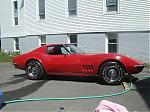
Here's the car:


And here is the proud owner:

At this moment, this is more a big restoration projet than a paint projet. Last week-end, I took off carpets and trims inside the car. I have a hole in the floor and some rust at the top of the birdcage on the passenger side :


Here's the look of the inside before:

And here's what I done this week-end: drifting on ice (What a feeling to spin around in security and to hear the thunder of side-pipes:


And here is where my baby sleeps this winter. Look at the snow. We might beat some record of precipitation this year in the province of Quebec in Canada. But I've been working every week-end on the car.
My next step is to wait for hot temperature to spray the paint bc/cc.

The technique of painting I will to use is simple: Doing exactly what the Lars paper says to do.
Btw, the engine runs as a new one even at -20 celcius. The carb as been rebuilt by a local pro.
I'm still working on the prep of my vette and I want to share pictures for having advices on my job.
I have to final block sand with 150 grit before applying primer dp 40 and k-38. At this moment, the car is stripped with razor blades and 80 grits wheres it has been needed. I have to do some bondo job too.
Here's the car:
And here is the proud owner:
At this moment, this is more a big restoration projet than a paint projet. Last week-end, I took off carpets and trims inside the car. I have a hole in the floor and some rust at the top of the birdcage on the passenger side :
Here's the look of the inside before:
And here's what I done this week-end: drifting on ice (What a feeling to spin around in security and to hear the thunder of side-pipes:
And here is where my baby sleeps this winter. Look at the snow. We might beat some record of precipitation this year in the province of Quebec in Canada. But I've been working every week-end on the car.
My next step is to wait for hot temperature to spray the paint bc/cc.
The technique of painting I will to use is simple: Doing exactly what the Lars paper says to do.
Btw, the engine runs as a new one even at -20 celcius. The carb as been rebuilt by a local pro.
Instructor
Joined: Oct 2007
Posts: 183
Likes: 1
From: Philmont NY
Lot of work....good start. I am going to be doing mine with the citrus strip I saw in another thread. I will save that for next winter or maybe the one after that. I wont be able to afford to paint it for some time so I would have to run it bare for a couple of years.
Good luck.......
Good luck.......

Le Mans Master


Joined: Jan 2006
Posts: 8,246
Likes: 114
From: Watkins Glen NY
I thought that by looking at the wheels in the third pic we might see another one of a little fun on the snow
Nice to see you got it stripped.
I can't imagine doing that amount of work outside...in Quebec...in the winter (especially the lower halves of the body panels)
Nice to see you got it stripped.
I can't imagine doing that amount of work outside...in Quebec...in the winter (especially the lower halves of the body panels)
Racer
Joined: Feb 2008
Posts: 497
Likes: 0
From: Streator Illinois
Bondo/
You said you have some bondo to do? Do you mean to use that term loosely or are you planning to actually use Bondo. If so, Here is something from Corvette Paint and Body Basics by Lars and Butch Roberts? you should read:
General 'Vette Info
Two different construction techniques have been used to manufacture Corvette body panels over the years. When the 'Vette made its debut, the new "FRP" body was a major innovation. "Fiberglass Reinforced Plastic" was a construction method that could be used to make lightweight panels with curves and design features that could not be easily duplicated in stamped steel. The body was basically built just like a fiberglass swimming pool or a boat hull: A "chopgun" was used to blow fiberglass strands and resin into a mold that was first coated with resin to produce a smooth surface finish on the body parts. This technique was used through the 1981 model year.
1982 was a unique transition year in many respects. Fuel injection was added to the 'Vette, and a computer was installed to manage all major engine functions. '82 also saw the advent of a revised body panel construction. "Structural Matted Components," or SMC panels, were thinner and lighter due to a laminate construction using more plastic and less 'glass. This panel type is used on all of our C4 'Vettes, and partially on the groundbreaking '82.
The composite materials on all 'Vettes require use of specific techniques and materials. Treating a 'Vette like a steel car can cause irreparable damage to the body: metal paint stripping techniques cannot be used, and fillers designed for use on steel will not adhere properly to the FRP or SMC panels. So read on to get the real scoop on the right stuff to use….
I don't have the rest of the article but if I remember correctly, working on something earlier than 1982, you might want to get body filler that can specifically used on FRP material.
Terry
General 'Vette Info
Two different construction techniques have been used to manufacture Corvette body panels over the years. When the 'Vette made its debut, the new "FRP" body was a major innovation. "Fiberglass Reinforced Plastic" was a construction method that could be used to make lightweight panels with curves and design features that could not be easily duplicated in stamped steel. The body was basically built just like a fiberglass swimming pool or a boat hull: A "chopgun" was used to blow fiberglass strands and resin into a mold that was first coated with resin to produce a smooth surface finish on the body parts. This technique was used through the 1981 model year.
1982 was a unique transition year in many respects. Fuel injection was added to the 'Vette, and a computer was installed to manage all major engine functions. '82 also saw the advent of a revised body panel construction. "Structural Matted Components," or SMC panels, were thinner and lighter due to a laminate construction using more plastic and less 'glass. This panel type is used on all of our C4 'Vettes, and partially on the groundbreaking '82.
The composite materials on all 'Vettes require use of specific techniques and materials. Treating a 'Vette like a steel car can cause irreparable damage to the body: metal paint stripping techniques cannot be used, and fillers designed for use on steel will not adhere properly to the FRP or SMC panels. So read on to get the real scoop on the right stuff to use….
I don't have the rest of the article but if I remember correctly, working on something earlier than 1982, you might want to get body filler that can specifically used on FRP material.
Terry
Thread Starter
Intermediate
Joined: Jul 2007
Posts: 39
Likes: 0
From: Quebec Quebec
Hi everybody,
Champ85 say:
I can't imagine doing that amount of work outside...in Quebec...in the winter (especially the lower halves of the body panels)
This is easy to strip lower halves because I can lay down myself in the clean snow. It's easy too to work work under the car behind the rear wheels. I've been cleaning and painting this spot. I wear googles for that.


alan 71 say :
You're proving that "Nothing is more fun than playing around with an old car".
That why I bought this 1979 car. I paid it 6,000$ (american and canadian dollars are currently about the same). I knew there was a lot of job to do but I love to work on the car. It was a gamble when I bought it. Luckily, the car is in good shape. The frame is in great shape and engine had been rebuilt. My money pit was the direction. I spent about 4,000$, including the rebuilt of the diff. I have to pay attention at the birdcage. It's not a catastrophy, but needs some touch up :


tnovot say:
You said you have some bondo to do? Do you mean to use that term loosely or are you planning to actually use Bondo.
Good observation. I'm going to use only specialized products for fiberglass recommended by my local PPG store. I know them and I can trust them.
At this moment my project goes well. The main reason is that the forum gives me enough confidence to go thru. All infos are here and some pros like Lars know what they say. I will send more pictures as my project goes on. I invite you all to do the same. This is the best way to learn.
Tank you all,
Claude
PS: Soryy for mistakes, I'm a french Canadian.
Champ85 say:
I can't imagine doing that amount of work outside...in Quebec...in the winter (especially the lower halves of the body panels)
This is easy to strip lower halves because I can lay down myself in the clean snow. It's easy too to work work under the car behind the rear wheels. I've been cleaning and painting this spot. I wear googles for that.
alan 71 say :
You're proving that "Nothing is more fun than playing around with an old car".
That why I bought this 1979 car. I paid it 6,000$ (american and canadian dollars are currently about the same). I knew there was a lot of job to do but I love to work on the car. It was a gamble when I bought it. Luckily, the car is in good shape. The frame is in great shape and engine had been rebuilt. My money pit was the direction. I spent about 4,000$, including the rebuilt of the diff. I have to pay attention at the birdcage. It's not a catastrophy, but needs some touch up :
tnovot say:
You said you have some bondo to do? Do you mean to use that term loosely or are you planning to actually use Bondo.
Good observation. I'm going to use only specialized products for fiberglass recommended by my local PPG store. I know them and I can trust them.
At this moment my project goes well. The main reason is that the forum gives me enough confidence to go thru. All infos are here and some pros like Lars know what they say. I will send more pictures as my project goes on. I invite you all to do the same. This is the best way to learn.
Tank you all,
Claude
PS: Soryy for mistakes, I'm a french Canadian.
Corvette Stories
The Best of Corvette for Corvette Enthusiasts

Top 10 Most Expensive Corvettes Ever Sold on Bring A Trailer
Brett Foote
10 Things Every Corvette Owner Needs (2026 Edition)
Michael S. Palmer
8 Most "Only Corvette Owners Understand" Quirks and Problems
Pouria Savadkouei
10 Reasons the C6 Z06 is Still A Performance Benchmark After 20 Years
Joe Kucinski
How Much Horsepower Every Corvette Engine "LOST" in 1972
Joe Kucinski
Top 10 DOs and DON'Ts for Protecting Your Convertible Top!
Michael S. Palmer
Top 10 Most Explosive Corvettes Ever Made: Power-to-Weight Ratio Ranked!
Joe Kucinski
150 hp to 1,250 hp: Every Corvette Generation Compared by the Specs That Matter
Joe Kucinski
8 Coolest Corvette Pace Cars (and Replicas) of All Time
Verdad Gallardo

Thread Starter
Intermediate
Joined: Jul 2007
Posts: 39
Likes: 0
From: Quebec Quebec
Casper,
Do I have to weld only the plate I'm going to place to do a new floor or do I have to do to some weld in the birdcage?
Also, I have heard that a special glue is existing to replace weld. Anybobody know something about?
Tank you,
Claude
Do I have to weld only the plate I'm going to place to do a new floor or do I have to do to some weld in the birdcage?
Also, I have heard that a special glue is existing to replace weld. Anybobody know something about?
Tank you,
Claude

Racer
Joined: Aug 2006
Posts: 493
Likes: 1
From: yarmouth ma
you most likely have some rust holes at the bottom of the windshield in each corner. thats why you are seeing some water on the floor and thats why there is rust in those body mount areas. Take a light and crawl in your foot well areas and shine it up as high as you can, you will most likely see the rust holes. vary hard area to get to. allot of guys cut the tops of the fenders to get to them to repair it. i did mine like this and it came out fine, but you have to know what you are doing.
you have to stop the source of the water entry 1st.
keep up the good work and stay warm.
you have to stop the source of the water entry 1st.
keep up the good work and stay warm.

Instructor
Joined: May 2006
Posts: 206
Likes: 0
From: Barrie Ontario
Bonjour...C'est bon, mon francaise est petite pus! Just a little humour for you...Anyway, working in the cold is part of living in Canada, I'm in Barrie, Ontario...same weather here too, just as much snow as well. Looks like you're well on your way to perfection...lots of welding and replacement of floor boards for sure, if you have a sand blaster available, this would help, especially in the pillar area, you need to get to bare fresh metal to correct your rusting problems. With regard to the fusing issue, go to your local "auto body supply house", (Not Canadian Tire for sure,) they may have something for you to review. The fibreglass issue, go to another supply house that deals in repairs to boats, same type of fibreglass issues there. Some bondo will not work, wrong consistency of chemicals, you need the correct type.
Good luck and love the snow burning....or should I say...melting under your tires, lol.
Domer.
Good Luck
Domer
Good luck and love the snow burning....or should I say...melting under your tires, lol.
Domer.
Good Luck
Domer
