






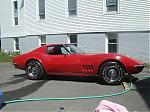
one TA done....
Thread Starter
Instructor

Joined: Oct 2007
Posts: 183
Likes: 1
From: Philmont NY
 one TA done....
I am hesitant to post...just looking at stinger12's progress I feel inadequate.....rookies first attempt???? That guy is good. 


Just waiting to pick up one more outer bearring, because I ruined one trying to get it on the spindle. The bearring plus rear shocks will be at the parts store tommorow.......hopefully driving next week (possibly weekend if I can find the time).
Just waiting to pick up one more outer bearring, because I ruined one trying to get it on the spindle. The bearring plus rear shocks will be at the parts store tommorow.......hopefully driving next week (possibly weekend if I can find the time).

Safety Car


Joined: Oct 2006
Posts: 3,930
Likes: 15
From: Calgary Alberta
Thanks for the compliment
Those arms look great Just a quick question regarding the "star wheels" on the parking brakes. Did you make them point in the same direction on both arms, or did you make one side point forward and one side point backwards? My assembly manual said to point one forward and one backwards, I'm not sure why though. Keep up the good work
Those arms look great
Just a quick question regarding the "star wheels" on the parking brakes. Did you make them point in the same direction on both arms, or did you make one side point forward and one side point backwards? My assembly manual said to point one forward and one backwards, I'm not sure why though. Keep up the good work
Safety Car
Joined: Oct 2006
Posts: 3,930
Likes: 15
From: Calgary Alberta
You need to bend these tabs up (the red ones). Be careful when you do this though, because if you break these, the only way to replace them is if you pull the entire assembly apart again - GM's engineers weren't very intelligent .
.

.

Race Director


Joined: Aug 2004
Posts: 10,628
Likes: 132
From: Duvall, WA
I think it's so that the parking brakes will be adjusted the same way on either side. For example, if you rotate the star downward, the parking brakes will expand, regardless of what side of the car you are on. Otherwise, one side of the car will expand if the star wheel is adjusted up, and the other side will expand if it's adjusted down. Who wants to remember that?
Thread Starter
Instructor
Joined: Oct 2007
Posts: 183
Likes: 1
From: Philmont NY
Stinger12...my 16 year old son has been helping me alot. We are both learning together. Why do the tabs have to be bent?
Thread Starter
Instructor
Joined: Oct 2007
Posts: 183
Likes: 1
From: Philmont NY
I also thought about shipping them out, but mine were so far gone...not even good for a core. I got bothe arms themselves off of a guy on e - bay for 180. Total cost was probably under 500 when everything was done.
Safety Car
Joined: Oct 2006
Posts: 3,930
Likes: 15
From: Calgary Alberta
I believe it acts as a locking device to prevent the 2" bolt anchor from coming loose. I'm sure someone else will chime in with more experience than me. In regards to you replacing one of the bearings due to a mistake, you might be okay with the endplay that you setup previously, but it could also bind up on you. The reason being is because, unfortunately, bearings are similar, but not dead on identical - 0.001 in one bearing will affect your readings. So, the endplay might change when you buy and install a new one. The reason they make a spindle setup tool with an undersized shaft is for this very exact reason - using two brand new "slip fit" bearings as a setup tool instead of an undersized shaft will not be accurate (because they aren't all dead on identical), you need to use the same bearings that you will be installing in the final assembly. I'm just giving you a heads up that your endplay might change. You may be alright though. It all depends on the tolerances you set your bearings too - were they set to GM spec or in the range of 0.0015-0.002? If they were set to 0.0015-0.002, you might be risking the chance of havign your bearings bind on you.
Corvette Stories
The Best of Corvette for Corvette Enthusiasts

Every 2027 Corvette Engine Explained
Joe Kucinski
Designer Imagines A Corvette That Looks More Like a Corvette Than the Corvette
Verdad Gallardo
10 Ugly Corvettes That We Still Kinda Love
Joe Kucinski
Top 10 Most Expensive Corvettes Ever Sold on Bring A Trailer
Brett Foote
10 Things Every Corvette Owner Needs (2026 Edition)
Michael S. Palmer
8 Most "Only Corvette Owners Understand" Quirks and Problems
Pouria Savadkouei
10 Reasons the C6 Z06 is Still A Performance Benchmark After 20 Years
Joe Kucinski
How Much Horsepower Every Corvette Engine "LOST" in 1972
Joe Kucinski
Top 10 DOs and DON'Ts for Protecting Your Convertible Top!
Michael S. Palmer
Safety Car
Joined: Oct 2006
Posts: 3,930
Likes: 15
From: Calgary Alberta
Read this thread over and it'll explain what I am saying a little better...
http://forums.corvetteforum.com/show...t=spindle+tool
http://forums.corvetteforum.com/show...t=spindle+tool
Safety Car
Joined: Oct 2006
Posts: 3,930
Likes: 15
From: Calgary Alberta
Yes, those are the GM tolerances. That is too much. When you factor in rotor runout and everthing, you will be pumping air into the brake system. FOR THE BEST JOB, you want to keep the endplay between 0.0015-0.002. The shims in the kits out there won't get you that close...you need to figure out which shim size you need and have a machineshop parallel grind it for you to the correct thickness. Now, because the tolerances are so close, you also need to make sure your spacer is dead on parallel, or else your readings will be off and all over the place, nto to mention that the bearings might bind in some areas. A machineshop with a surface grinder can dress the spacer for yyou to make dead certain that it is parallel. I'll refer Gary to this thread to see what he has to say.
Last edited by stinger12; Apr 17, 2008 at 02:32 PM.