



 [/IMG]

visible bonding strips?

Thread Starter
Racer

Joined: Jun 2008
Posts: 269
Likes: 0
 visible bonding strips?
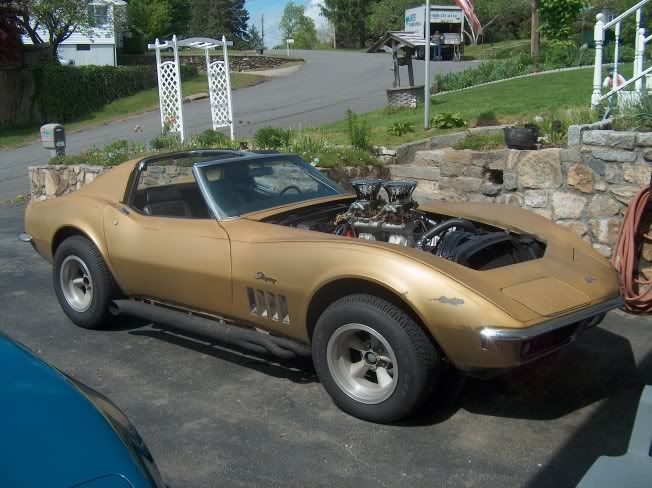
This may sound like a really dumb question, but I'll ask it anyway. I have read on several posts that one should be able to see the bonding strips through the paint if the paint is original. Why is this and was this true even when the car was new?
The reason I ask is that I would like to paint my car soon and the bonding strips are visible now. Is it more desirable to see the strips? Right now I am planning on painting the car the original color but expect the bonding strips to disappear with the new paint.
I read Lar's paper on painting basics and plan to follow his directions carefully (except that I have a spray booth at work instead of having to paint in the garage...)
I will be painting the car the original color (Dark Brown Metallic).
Sorry for the goofy question, but I am new to non-steel bodied cars and have a lot to learn...
Thanks for the help.
The reason I ask is that I would like to paint my car soon and the bonding strips are visible now. Is it more desirable to see the strips? Right now I am planning on painting the car the original color but expect the bonding strips to disappear with the new paint.
I read Lar's paper on painting basics and plan to follow his directions carefully (except that I have a spray booth at work instead of having to paint in the garage...)
I will be painting the car the original color (Dark Brown Metallic).
Sorry for the goofy question, but I am new to non-steel bodied cars and have a lot to learn...
Thanks for the help.

Le Mans Master


Joined: Apr 2005
Posts: 6,347
Likes: 418
From: Seattle Area WA
I think you must mean the seams because the actual strip is behind the panel. One can not see the bonding strips though paint, in some cases you may see a crack in the original bonding material, and in some cars you may see a tell tale seam because the bonding agent shrunk.
In your case it sounds like some of your seams are visible. If I were doing the car, I would fill and block it smooth which may be called "over restored" by NCRS folks, but that is how I would do it. I prefer a smooth, wave free car to the original look. Unless you are building the car to NCRS judging criteria its what you prefer.
In your case it sounds like some of your seams are visible. If I were doing the car, I would fill and block it smooth which may be called "over restored" by NCRS folks, but that is how I would do it. I prefer a smooth, wave free car to the original look. Unless you are building the car to NCRS judging criteria its what you prefer.

Drifting

Joined: Jan 2004
Posts: 1,991
Likes: 3
From: Piscataway NJ
I think you must mean the seams because the actual strip is behind the panel. One can not see the bonding strips though paint, in some cases you may see a crack in the original bonding material, and in some cars you may see a tell tale seam because the bonding agent shrunk.
In your case it sounds like some of your seams are visible. If I were doing the car, I would fill and block it smooth which may be called "over restored" by NCRS folks, but that is how I would do it. I prefer a smooth, wave free car to the original look. Unless you are building the car to NCRS judging criteria its what you prefer.
In your case it sounds like some of your seams are visible. If I were doing the car, I would fill and block it smooth which may be called "over restored" by NCRS folks, but that is how I would do it. I prefer a smooth, wave free car to the original look. Unless you are building the car to NCRS judging criteria its what you prefer.

Thread Starter
Racer
Joined: Jun 2008
Posts: 269
Likes: 0
Thank you for the replies. I am still a bit confused. (I wonder if I can post some pics...)
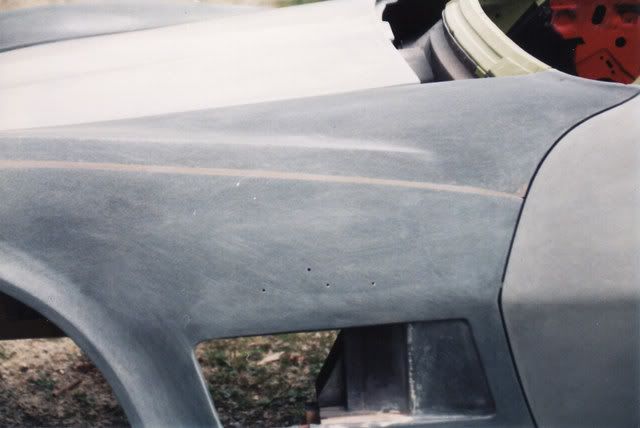
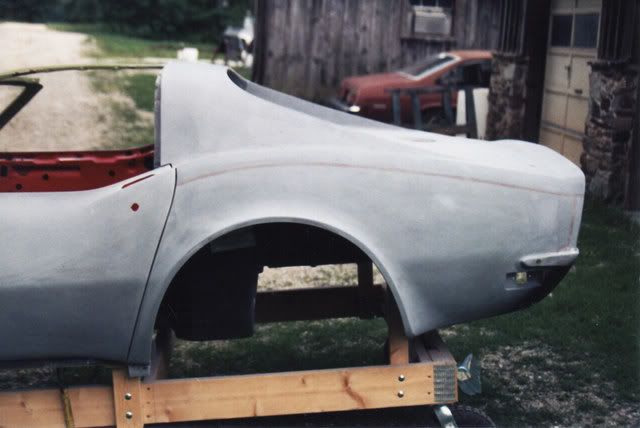
I see what looks like a 1" wide band in the paint. It pretty much follows the curve of the front fender and picks up on the rear fender as well. It does not continue through the door. It doesn't look or feel like something that needs to be filled, just a visual "band" in the paint. I have it on both sides of the car.
I will try and get some pics tomorrow......
I see what looks like a 1" wide band in the paint. It pretty much follows the curve of the front fender and picks up on the rear fender as well. It does not continue through the door. It doesn't look or feel like something that needs to be filled, just a visual "band" in the paint. I have it on both sides of the car.
I will try and get some pics tomorrow......

Team Owner


Joined: Sep 2006
Posts: 31,200
Likes: 4,287
From: Westminster Maryland
These are the seams that you can see. They became visible as the years went by because the panel adhesive would shrink at a different rate than the fiberglass. Also on some cars the seam will start to fail a little and you see that through the paint. You see the seams more in certain colors and in certain light.
I couldn't see the seams when my 71 was new but could start to see them in a year or two. The seams on the rear quarters started to fail and crack the paint a tiny bit after about 10 years.
I don't think you should see them in a newly painted car. I believe that the NCRS is referring to other things than the seams when it looks at whether an exterior is over restored.
Regards,
Alan
I couldn't see the seams when my 71 was new but could start to see them in a year or two. The seams on the rear quarters started to fail and crack the paint a tiny bit after about 10 years.
I don't think you should see them in a newly painted car. I believe that the NCRS is referring to other things than the seams when it looks at whether an exterior is over restored.
Regards,
Alan
Thread Starter
Racer
Joined: Jun 2008
Posts: 269
Likes: 0
Thanks for the help everyone. At least I understand what I am looking at now. Per Scott's comment, I looked a bit closer and the rear fender seam is starting to show a very tiny crack line. I will make sure I take care of this before I repaint the car.
Thanks again for all the replies!
Thanks again for all the replies!
Corvette Stories
The Best of Corvette for Corvette Enthusiasts

150 hp to 1,250 hp: Every Corvette Generation Compared by the Specs That Matter
Joe Kucinski
8 Coolest Corvette Pace Cars (and Replicas) of All Time
Verdad Gallardo
Top 10 Corvette Engines RANKED by Peak Torque (70+ Years of Muscle!)
Joe Kucinski
Corvette ZR1X Will Be Pacing the Indy 500, And Could Probably Race, Too!
Verdad Gallardo
Top 10 Corvettes Coming to Mecum Indy 2026!
Brett Foote
Top 10 C9 Corvette MUST-HAVES to Fix These C8 Generation Flaws!
Michael S. Palmer
10 Revolutionary 'Corvette Firsts' Most People Don't Know
Joe Kucinski
5 Reasons to Upgrade to an LS6-Powered Corvette; 5 Reasons to Stay LT2
Michael S. Palmer
2027 Corvette vs The World: Every C8 vs Its Closest Competitor
Joe Kucinski
Thread Starter
Racer
Joined: Jun 2008
Posts: 269
Likes: 0
Sound hard to do, is the process complicated? I plan on sticking with the original color in case I decide to restore the car later. In my eyes, the actual color of the car isn't as important as the quality of the work. So, I will want to spend extra time and effort to prepare the body so the paint job looks perfect. I am totally cool with the fact that I may get docked some points if the car gets judged at some event in the future.