






What is Cowl Induction???

Thread Starter
Pro


Joined: Jun 2008
Posts: 673
Likes: 2
From: Melbourne Victoria
 What is Cowl Induction???
Greetings from Downunder,
I'm looking at purchasing hood insulation (for my '74 coupe L-82 350)from feebay.
http://cgi.ebay.com/ebaymotors/ws/eB...3AIT&viewitem=
The description says
"NEW reproduction under Hood Insulation for 68-75 Chevrolet Vette models with Cowl Induction".
Dumb question time,
What is Cowl Induction???
Is it the air intake at the rear of the hood????
Also has anyone bought one of these ??
If so how do they look ???
MANY THANX for your time and patience.

GAV
I'm looking at purchasing hood insulation (for my '74 coupe L-82 350)from feebay.
http://cgi.ebay.com/ebaymotors/ws/eB...3AIT&viewitem=
The description says
"NEW reproduction under Hood Insulation for 68-75 Chevrolet Vette models with Cowl Induction".
Dumb question time,
What is Cowl Induction???
Is it the air intake at the rear of the hood????
Also has anyone bought one of these ??
If so how do they look ???
MANY THANX for your time and patience.
GAV
Le Mans Master


Joined: Sep 2002
Posts: 5,236
Likes: 898
From: Myrtle Beach SC
Not sure if you're looking for the short answer or its history. The air cleaner assembly consisted of a base and a top using an A348C air filter. A single snorkel extends from the base toward the front on the driver’s side for smallblocks while the snorkel for big blocks flips to the passenger’s side. The basic notion of forcing cold air into a carburetor was used to improve performance compromised by fuel economy requirements and emission standards.
Cold Air Induction was introduced in 1967 with the L88 and saw service through 1969 with both the L88 and ZL1. Briefly retired from 1970-72, cold air induction was resurrected in 1973 to improve performance while emission control and fuel economy measures had begun to glut those measures used in the past to boost performance. Once introduced in 1973, cold air induction would find its way into all future air intake applications, eventually modulated by Mass Air Flow.
In 1973, the air intake used a new design for cold air induction but without the obvious indication (hood bulge) of what lie under the hood as in 1968-69. As a result, the “carb-air induction” required a new hood, featuring a functional grille centered at the base of the windshield. Inside, the air cleaner used a round rubber seal, which fits into a flange that surrounds the dual snorkel air cleaner assembly. Once the hood is closed, it mates to the hood creating a seal that draws cold air in through the grille at the back of the hood. Upon hard acceleration, a vacuum operated solenoid opens a flap that covers the hood grille from the underside, drawing cold air from cowl area. When the vent opens, the rush of forced air sends an adrenaline message to occupants to hang on, especially for LS4 passengers.
Cold Air Induction was introduced in 1967 with the L88 and saw service through 1969 with both the L88 and ZL1. Briefly retired from 1970-72, cold air induction was resurrected in 1973 to improve performance while emission control and fuel economy measures had begun to glut those measures used in the past to boost performance. Once introduced in 1973, cold air induction would find its way into all future air intake applications, eventually modulated by Mass Air Flow.
In 1973, the air intake used a new design for cold air induction but without the obvious indication (hood bulge) of what lie under the hood as in 1968-69. As a result, the “carb-air induction” required a new hood, featuring a functional grille centered at the base of the windshield. Inside, the air cleaner used a round rubber seal, which fits into a flange that surrounds the dual snorkel air cleaner assembly. Once the hood is closed, it mates to the hood creating a seal that draws cold air in through the grille at the back of the hood. Upon hard acceleration, a vacuum operated solenoid opens a flap that covers the hood grille from the underside, drawing cold air from cowl area. When the vent opens, the rush of forced air sends an adrenaline message to occupants to hang on, especially for LS4 passengers.

Melting Slicks


Joined: Sep 2004
Posts: 3,227
Likes: 671
From: Northeast
He says it will fit 68-75 hoods and even the 4dr corvette 
If I were you go to one of the vendors and purchase from them. Docrebuild, Ecklers, etc. Its only about $10 more. They specifically state 73-75 not a large range like the one you mention.
I suspect you would be disappointed with the ebay one. He does not state size, thickness, etc.
Like a glove where the seller says "fits all". Sometimes they dont.
If I were you go to one of the vendors and purchase from them. Docrebuild, Ecklers, etc. Its only about $10 more. They specifically state 73-75 not a large range like the one you mention.
I suspect you would be disappointed with the ebay one. He does not state size, thickness, etc.
Like a glove where the seller says "fits all". Sometimes they dont.

Race Director

Joined: Jul 2001
Posts: 15,892
Likes: 42

Team Owner


Joined: Aug 1999
Posts: 30,995
Likes: 99
From: Ontario
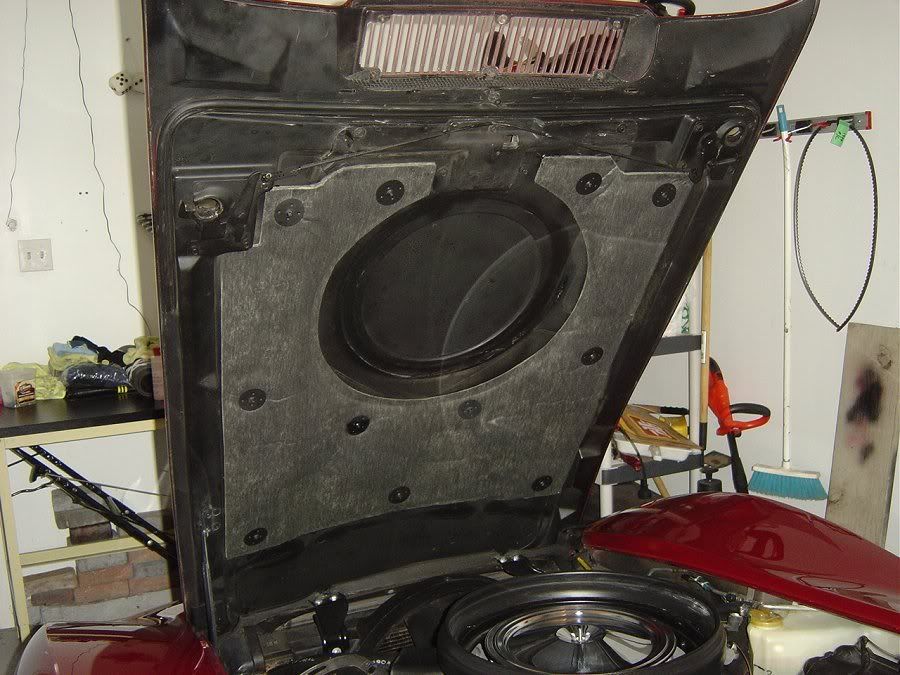
I would suggest that you get the proper insulator mat for 1973-75. They vary in quality and fit. I opted for the more expensive molded/contoured version. Others are not molded and basically do not hang very nicely.

Race Director


Joined: Apr 1999
Posts: 15,154
Likes: 477
From: NM
Corvette Stories
The Best of Corvette for Corvette Enthusiasts

Every 2027 Corvette Engine Explained
Joe Kucinski
Designer Imagines A Corvette That Looks More Like a Corvette Than the Corvette
Verdad Gallardo
10 Ugly Corvettes That We Still Kinda Love
Joe Kucinski
Top 10 Most Expensive Corvettes Ever Sold on Bring A Trailer
Brett Foote
10 Things Every Corvette Owner Needs (2026 Edition)
Michael S. Palmer
8 Most "Only Corvette Owners Understand" Quirks and Problems
Pouria Savadkouei
10 Reasons the C6 Z06 is Still A Performance Benchmark After 20 Years
Joe Kucinski
How Much Horsepower Every Corvette Engine "LOST" in 1972
Joe Kucinski
Top 10 DOs and DON'Ts for Protecting Your Convertible Top!
Michael S. Palmer
Melting Slicks
Joined: Sep 2007
Posts: 2,429
Likes: 0
From: Tucson AZ
Paul, can you save me many hours of searching, tell me where you got that insulator in a PM?
I have made my own air box, and yours looks like it would fit my 69 hood perfectly. TIA, Tank
Team Owner
Joined: Aug 1999
Posts: 30,995
Likes: 99
From: Ontario
Le Mans Master
Joined: Sep 2002
Posts: 5,236
Likes: 898
From: Myrtle Beach SC

Team Owner
Joined: Aug 1999
Posts: 30,995
Likes: 99
From: Ontario
Safety Car

Joined: Nov 2006
Posts: 4,449
Likes: 0
Miles
Team Owner
Joined: Aug 1999
Posts: 30,995
Likes: 99
From: Ontario
About five minutes. Just tuck away the wiring for the solenoid neatly in case you want to use it again. The parts are hard to find so do not discard.
Last edited by Paul L; Nov 17, 2008 at 07:52 PM.
Race Director
Joined: Jul 2001
Posts: 15,892
Likes: 42


Burning Brakes

Joined: Apr 2008
Posts: 945
Likes: 1
Upon hard acceleration, a vacuum operated solenoid opens a flap that covers the hood grille from the underside, drawing cold air from cowl area.
I have a '73 with this cowl induction hood. Can anyone show a pic of where this vacuum operated solenoid is? I see nothing that operates anyting on my car. Also on the forward driver's side of the hood is a hole about 3/4" dia that has a hole plug in it. Is this a drain hole? Why is it plugged?
Also to Paul67. I purchased the hood blanket and received it yesterday along with a retainer kit. The retainers get glued to the inside of the hood. If you glued your retainers to the hood what adhesive did you use? The adhesive has to withstand the temperatures of the engine compartment.
I have a '73 with this cowl induction hood. Can anyone show a pic of where this vacuum operated solenoid is? I see nothing that operates anyting on my car. Also on the forward driver's side of the hood is a hole about 3/4" dia that has a hole plug in it. Is this a drain hole? Why is it plugged?
Also to Paul67. I purchased the hood blanket and received it yesterday along with a retainer kit. The retainers get glued to the inside of the hood. If you glued your retainers to the hood what adhesive did you use? The adhesive has to withstand the temperatures of the engine compartment.
Race Director
Joined: Jul 2001
Posts: 15,892
Likes: 42
There isn't one. It's electrically operated. That's part of the note I sent to Tom. It should be at the rear of the duct under a black plastic cover.
Team Owner
Joined: Aug 1999
Posts: 30,995
Likes: 99
From: Ontario
Upon hard acceleration, a vacuum operated solenoid opens a flap that covers the hood grille from the underside, drawing cold air from cowl area.
I have a '73 with this cowl induction hood. Can anyone show a pic of where this vacuum operated solenoid is? I see nothing that operates anyting on my car. Also on the forward driver's side of the hood is a hole about 3/4" dia that has a hole plug in it. Is this a drain hole? Why is it plugged?
Also to Paul67. I purchased the hood blanket and received it yesterday along with a retainer kit. The retainers get glued to the inside of the hood. If you glued your retainers to the hood what adhesive did you use? The adhesive has to withstand the temperatures of the engine compartment.
I have a '73 with this cowl induction hood. Can anyone show a pic of where this vacuum operated solenoid is? I see nothing that operates anyting on my car. Also on the forward driver's side of the hood is a hole about 3/4" dia that has a hole plug in it. Is this a drain hole? Why is it plugged?
Also to Paul67. I purchased the hood blanket and received it yesterday along with a retainer kit. The retainers get glued to the inside of the hood. If you glued your retainers to the hood what adhesive did you use? The adhesive has to withstand the temperatures of the engine compartment.
On the adhesive, surely some product line like BullDog would have what you need. But I will check the AIM later today. Sometimes it specifies fasteners/adhesives/etc.


Burning Brakes
Joined: Apr 2008
Posts: 945
Likes: 1
Thanks for the response Paul. I'll check into that Bulldog thing. Somehow I don't think I have an operating cowl vent. I don't see any wires going from the carb, throttle cable or anywhere else that snakes over to the hood. If it's electrically operated or vacuum operated there must be a wire/hose to the hood somewhere. I wonder if water intrusion is an issue if the flap is missing and it's open all the time. That's why I'm wondering if the hole in the underside of the hood at the front driver side with a plug in it is a drain.