






 Not enough restriction at the t-stat can cause more problems than it will solve.If you are running hot,have a good look at the rest of your system.

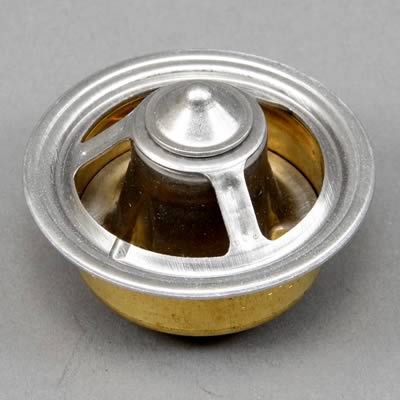

question on thermostats

Thread Starter
Drifting


Joined: Jul 2008
Posts: 1,873
Likes: 27
From: Sonora CA
 question on thermostats
Does anyone make a "high-flow" thermostat, as compared to a standard off-the-rack one? Generally speaking, I don't have any problems with my cooling system, but it seems like the opening (in the thermostat) is really small. I'm wondering if there is a special thermostat that will flow more water.
Thanks for any thoughts........... Steve
Thanks for any thoughts........... Steve

Team Owner


Joined: Jul 1999
Posts: 65,492
Likes: 230
From: Orange Park Florida
I don't remember the specific dimensions, but over the years I have noticed the various makers of replacement stats have reduced the diameter of the hole in the middle.....this limits the flow to make the engine run warmer...so if you have say a 195 stat, it opens at say 198 and stays open in summer the engine will never run colder than 195 so they make the same opening with a 180 stat, it opens at 183, and the flow is still at the 195 flow rate because of the small hole...the thing will never get below the 195 and the stat is stuck open.....
what you want to do is take about 2-3 1/8 inch holes through the apron of the stat, that allows more water flow, and the engine can run cooler in a given ambient....
you can prove this really easy...remove the stat entirely and go for a drive....you have a cold engine even in 100f+ weather...ASSUMING of course you have a good operational fan and a decent cooling system....
what you want to do is take about 2-3 1/8 inch holes through the apron of the stat, that allows more water flow, and the engine can run cooler in a given ambient....
you can prove this really easy...remove the stat entirely and go for a drive....you have a cold engine even in 100f+ weather...ASSUMING of course you have a good operational fan and a decent cooling system....

Team Owner


Joined: Jan 2006
Posts: 37,637
Likes: 3,118
From: Crossville TN
Well, I'm not totally disagreeing with you, but if you remove the stat altogether, it will run cooler than with it...but you can't predict by how much. The entire cooling system has an equilibrium temperature where it will stabilize [with some respect to ambient temperature]. Most base-engine small block C3's will stabilize somewhere between 160-180F if there is no stat in the system [during summer]. If the radiator is crudded up, that temp will be higher. The stat really does nothing to the system except allow the engine to warm up faster and set the minimum temperature at which the engine will run. Just because the stat opens is no guarantee that your system will hold that temperature, however.

Melting Slicks


Joined: Jan 2003
Posts: 2,877
Likes: 13
From: Doha
St. Jude Donor '08
I have a big block, big aluminum radiator with dual spal fans from Dewitt's, and a stage 2 water pump from Stewart, I used the normal stock thermostat and everything was fine, then I decided to go with a high-flow thermostat as its the recommended one with a high-volume water pump but I got higher enigine temp., then I replaced it with another brand, same thing! , and now I returned back to the stock thermostat, engine temp. is back to normal. I know that may sounds sense-less, but that what happened to me.
Corvette Stories
The Best of Corvette for Corvette Enthusiasts

Top 10 Most Expensive Corvettes Ever Sold on Bring A Trailer
Brett Foote
10 Things Every Corvette Owner Needs (2026 Edition)
Michael S. Palmer
8 Most "Only Corvette Owners Understand" Quirks and Problems
Pouria Savadkouei
10 Reasons the C6 Z06 is Still A Performance Benchmark After 20 Years
Joe Kucinski
How Much Horsepower Every Corvette Engine "LOST" in 1972
Joe Kucinski
Top 10 DOs and DON'Ts for Protecting Your Convertible Top!
Michael S. Palmer
Top 10 Most Explosive Corvettes Ever Made: Power-to-Weight Ratio Ranked!
Joe Kucinski
150 hp to 1,250 hp: Every Corvette Generation Compared by the Specs That Matter
Joe Kucinski
8 Coolest Corvette Pace Cars (and Replicas) of All Time
Verdad Gallardo
Team Owner
Joined: Jan 2006
Posts: 37,637
Likes: 3,118
From: Crossville TN
Changing the type/brand of stat [alone] should not make it run hotter...unless it is installed wrong or there is an air lock in the system--keeping the hot water from reaching the stat. Either of those last two items could have been your problem. Did the 'standard' stat have a bleed hole in the flange?

Melting Slicks
Joined: Jul 2004
Posts: 2,577
Likes: 2
From: Long Island New York
I run a Robert Shaw 180* t-stat with a Stewart Stage 2 water pump. I have a stock replacement radiator with all new seals in place and my car runs steady at 185*. Only on the very hottest day if I'm sitting in some stop and go traffic has it climbed as high as 200*, but it goes right back down and stays there as soon as I get moving again.

Le Mans Master


Joined: Aug 2003
Posts: 7,720
Likes: 12
From: Chattanooga TN
Melting Slicks
Joined: Jan 2003
Posts: 2,877
Likes: 13
From: Doha
St. Jude Donor '08
Changing the type/brand of stat [alone] should not make it run hotter...unless it is installed wrong or there is an air lock in the system--keeping the hot water from reaching the stat. Either of those last two items could have been your problem. Did the 'standard' stat have a bleed hole in the flange?
Team Owner
Joined: Jan 2006
Posts: 37,637
Likes: 3,118
From: Crossville TN
I believe your results....just can't come up with a logical reason for that kind of occurence. Logically, there must be some other 'factor' involved [i.e. too much flow with the hi-flo stat, so that the fluid in the radiator has less time to cool down, etc.]. {By the way, that example doesn't even make sense unless that elevated flow causes turbulence/cavitation around the radiator fins.}
Given the results of your testing and having no explanation for them, you did the right thing....go with what works!
Given the results of your testing and having no explanation for them, you did the right thing....go with what works!
Safety Car

Joined: Oct 2007
Posts: 3,729
Likes: 267
From: Austin Texas
Corvette of the Year Winner 2017
2016 C3 of Year Finalist
let me offer this info. on cooling without a thermostat,
I ran a jetboat with no Thermostat, it uses the lake water to cool with,
figured why run a stat? I had plenty of cooling so I ran without 1, the short story,
We completely fried the motor, the only explanation I, and the pro's could come up with, is without the thermostat, the water was moving so quickly thru the Engine, it did not have enough time to absorb the Heat from the Engine, ever since then I have ran Thermostats with no further problems.
Coincidence ? ...maybe ? maybe the same seniero with a high volume pump ? 69VETT
I ran a jetboat with no Thermostat, it uses the lake water to cool with,
figured why run a stat? I had plenty of cooling so I ran without 1, the short story,
We completely fried the motor, the only explanation I, and the pro's could come up with, is without the thermostat, the water was moving so quickly thru the Engine, it did not have enough time to absorb the Heat from the Engine, ever since then I have ran Thermostats with no further problems.
Coincidence ? ...maybe ? maybe the same seniero with a high volume pump ? 69VETT
Team Owner
Joined: Jan 2006
Posts: 37,637
Likes: 3,118
From: Crossville TN
If you have a 'hot' body with a constant temperature fluid flowing over it, the more flow you have, the cooler the body. That's theory. Your real-world data says that with no stat [higher flow] you burned up the engine. That's fact. As I mentioned above, the highly elevated flow rate probably cavitated the fluid so the liquid was no longer in contact with the surface of the 'body' [engine]. There are reasons why too much flow is not a good thing.
Melting Slicks
Joined: Jan 2003
Posts: 2,877
Likes: 13
From: Doha
St. Jude Donor '08
I believe your results....just can't come up with a logical reason for that kind of occurence. Logically, there must be some other 'factor' involved [i.e. too much flow with the hi-flo stat, so that the fluid in the radiator has less time to cool down, etc.]. {By the way, that example doesn't even make sense unless that elevated flow causes turbulence/cavitation around the radiator fins.}
Given the results of your testing and having no explanation for them, you did the right thing....go with what works!
Given the results of your testing and having no explanation for them, you did the right thing....go with what works!
Melting Slicks
Joined: Jan 2003
Posts: 2,877
Likes: 13
From: Doha
St. Jude Donor '08
let me offer this info. on cooling without a thermostat,
I ran a jetboat with no Thermostat, it uses the lake water to cool with,
figured why run a stat? I had plenty of cooling so I ran without 1, the short story,
We completely fried the motor, the only explanation I, and the pro's could come up with, is without the thermostat, the water was moving so quickly thru the Engine, it did not have enough time to absorb the Heat from the Engine, ever since then I have ran Thermostats with no further problems.
Coincidence ? ...maybe ? maybe the same seniero with a high volume pump ? 69VETT
I ran a jetboat with no Thermostat, it uses the lake water to cool with,
figured why run a stat? I had plenty of cooling so I ran without 1, the short story,
We completely fried the motor, the only explanation I, and the pro's could come up with, is without the thermostat, the water was moving so quickly thru the Engine, it did not have enough time to absorb the Heat from the Engine, ever since then I have ran Thermostats with no further problems.
Coincidence ? ...maybe ? maybe the same seniero with a high volume pump ? 69VETT

Race Director

Joined: Mar 2006
Posts: 14,112
Likes: 28
From: Florida
If you have a 'hot' body with a constant temperature fluid flowing over it, the more flow you have, the cooler the body. That's theory. Your real-world data says that with no stat [higher flow] you burned up the engine. That's fact. As I mentioned above, the highly elevated flow rate probably cavitated the fluid so the liquid was no longer in contact with the surface of the 'body' [engine]. There are reasons why too much flow is not a good thing.
Exactly, thats what I think is happening, iit seems the stock thermostat some how "prevents" the cavitation one way or another, I believe more in that theory because I tried once to run without a thermostat and the engine temp. was 190-200 constantly, which is less that te hi-flow thermostat, which was 200-210.
There is a lot more going on in there than just higher flow.
Without a tstat there might be high flow but less pressure. In a properly designed system, the pressure side of the cooling system might run as high as 40psi while the suction side runs at the rating of the radiator cap around 16#. Note the the rad cap is on the low pressure side.
Pressurized coolant has a very, very hard time cavitating and removes more heat because more coolant is in contact with the hottest sufaces and vapor is less likely to form.
When the tstat was put back in, then the increased pressure was again created in the engine and it cooled properly. Too much flow really isn't the problem, it's the reduced pressure. So the theory is also real world as it should be.
Same reasons a pressure cooker works better than an open pot.
I have the opposite problem, well maybe, if it's really a problem at all.
I run a stock brass rad, with a Shaw tstat (195°), stage 2 higher flow water pump, and barley gets to 185° with outside temps of over 95°.
Now I see a lot of posts that insist that all C3's will overheat if the coresupport foam and chin spoiler is not there. This car has neither the foam nor the spoiler and yes, the gauge has been verified with a pyrometer.
So obviously the high flow pump is not a problem.
BTW, smaller boat engines (with V8s) almost always come with 140° tstats.
Thread Starter
Drifting
Joined: Jul 2008
Posts: 1,873
Likes: 27
From: Sonora CA
Ok, so a lot of good information here and a lot to think about.
I have a brand new 4-row radiator, a new sending unit, new water pump, new hoses and a 185 degree t-stat that does have a bleed hole. I did do the string test on the t-stat and it dropped off the string at 166 degrees and it was fully open at 189 degrees, (using a digital thermometer)
I have removed most of the air conditioning components except for the condencer in front of the radiator. All of the water passeges, (that I have been able to see)................. look clean with no rust. And water is still flowing through the heater coil. I also have temperature senitive lables on the t-stat housing and the inlet to the radiator. the lables are in 10 degree incerments.
The gauge and the lables indicate the same temperature, around 190/200, around town on a 85 /90 degree day. This is what I have been observing for a couple of months now.
On one of the hottest days here in SO CA I desided to go for broke and drove from Huntington Beach to Onatrio. Sustained speeds of 70/75 mph with lots of long gradual up-hill grades. Both gauge and lables indicate that the water temp. was running around 220degrees.
Ok, so I would at least like to get these temps. down a little........... hense my question about a high-flow t-stat.
Any more thoughts on this? And BTW, thanks for all the replies.
Steve
I have a brand new 4-row radiator, a new sending unit, new water pump, new hoses and a 185 degree t-stat that does have a bleed hole. I did do the string test on the t-stat and it dropped off the string at 166 degrees and it was fully open at 189 degrees, (using a digital thermometer)
I have removed most of the air conditioning components except for the condencer in front of the radiator. All of the water passeges, (that I have been able to see)................. look clean with no rust. And water is still flowing through the heater coil. I also have temperature senitive lables on the t-stat housing and the inlet to the radiator. the lables are in 10 degree incerments.
The gauge and the lables indicate the same temperature, around 190/200, around town on a 85 /90 degree day. This is what I have been observing for a couple of months now.
On one of the hottest days here in SO CA I desided to go for broke and drove from Huntington Beach to Onatrio. Sustained speeds of 70/75 mph with lots of long gradual up-hill grades. Both gauge and lables indicate that the water temp. was running around 220degrees.
Ok, so I would at least like to get these temps. down a little........... hense my question about a high-flow t-stat.
Any more thoughts on this? And BTW, thanks for all the replies.
Steve

Team Owner
Joined: Jul 2008
Posts: 23,419
Likes: 22
From: In limbo
St. Jude Donor '13-'15, '17 thru '22
Thoughts? I have a few, but they never seem to get anywhere.
The "turbulence" idea is backwards. Turbulent flow through a pipe will increase heat transfer relative to laminar flow, so anyone using this argument to say that runninng without a t-stat is bad has their physics backwards.
The "cavitation" thing is just wrong. You don't get cavitation on the high pressure side of a pump, you get it on the suction side, so again, anyone using this as an explanation for a motor going bad with no t-stat needs to spend a little more time at the drawing board. When people are talking about "vapor" in the system, as opposed to cavitation, I am assuming that they mean that the coolant is boiling in the engine. While it is true that reducing the pressure in the system will make the boiling point lower, you would still have to get the coolant above its boiling point at the (lower) pressure of the system. If you are running a 50/50 water/ethylene glycol mixture, the boiling point at atmospheric pressure is somewhere around 230, so you would have to be well in excess of that temperature to get any boiling in your cooling loop. For all but the most dorked up systems, boiling coolant creating vapor space at the heat transfer area really isn't a concern.
I don't know why the fella with the burned up boat engine burned up his engine. There are lots of ways to ruin engines and I don't have nearly enough information to even take a wild guess which ones might or might not be to blame. While I accept it as fact that his engine got ruined at a time that he wasn't running a t-stat, we don't have any evidence at all of causality. In this case, where he was cooling with cold lake water, any "cavitation" arguments will be completely sensless unless the condtion of the water pump were so poor, that insufficient flow caused an overtemperature situation, a problem that would only be exacerbated by the addition of a t-stat.
The "turbulence" idea is backwards. Turbulent flow through a pipe will increase heat transfer relative to laminar flow, so anyone using this argument to say that runninng without a t-stat is bad has their physics backwards.
The "cavitation" thing is just wrong. You don't get cavitation on the high pressure side of a pump, you get it on the suction side, so again, anyone using this as an explanation for a motor going bad with no t-stat needs to spend a little more time at the drawing board. When people are talking about "vapor" in the system, as opposed to cavitation, I am assuming that they mean that the coolant is boiling in the engine. While it is true that reducing the pressure in the system will make the boiling point lower, you would still have to get the coolant above its boiling point at the (lower) pressure of the system. If you are running a 50/50 water/ethylene glycol mixture, the boiling point at atmospheric pressure is somewhere around 230, so you would have to be well in excess of that temperature to get any boiling in your cooling loop. For all but the most dorked up systems, boiling coolant creating vapor space at the heat transfer area really isn't a concern.
I don't know why the fella with the burned up boat engine burned up his engine. There are lots of ways to ruin engines and I don't have nearly enough information to even take a wild guess which ones might or might not be to blame. While I accept it as fact that his engine got ruined at a time that he wasn't running a t-stat, we don't have any evidence at all of causality. In this case, where he was cooling with cold lake water, any "cavitation" arguments will be completely sensless unless the condtion of the water pump were so poor, that insufficient flow caused an overtemperature situation, a problem that would only be exacerbated by the addition of a t-stat.