L86 vs LT1
Melting Slicks

Joined: Mar 2007
Posts: 2,100
Likes: 12
From: Frederick Maryland

That can depend on a lot of things...what year LT-1? Three years of production and three different horsepower ratings. Rear axle ratios can be different as well.
Let's say 1970 LT-1...370hp and against a '69 L68...400hp. Not a whole lot of difference at gross hp ratings. The LT-1 weighs less, the 427 will put out more torque, so it's quickness against pure torque...which one?
The LT-1 is a solid lifter engine...the L68 is hydraulic so the small block should wind out higher...maybe higher top ends.
The LT-1 is a high revver and lives for high rpm's. The L68 is more low end and mid-range and drivability. The LT-1 is a better balanced car so it would likely handle somewhat better.
Everything else being equal...I say the difference is in the drivers...the better driver will win, regardless of the two cars.
Let's say 1970 LT-1...370hp and against a '69 L68...400hp. Not a whole lot of difference at gross hp ratings. The LT-1 weighs less, the 427 will put out more torque, so it's quickness against pure torque...which one?
The LT-1 is a solid lifter engine...the L68 is hydraulic so the small block should wind out higher...maybe higher top ends.
The LT-1 is a high revver and lives for high rpm's. The L68 is more low end and mid-range and drivability. The LT-1 is a better balanced car so it would likely handle somewhat better.
Everything else being equal...I say the difference is in the drivers...the better driver will win, regardless of the two cars.

Thread Starter
Racer


Joined: Mar 2009
Posts: 331
Likes: 1
From: Brooklin Ontario
The LT-1 is a solid lifter engine...the L68 is hydraulic so the small block should wind out higher...maybe higher top ends.
The LT-1 is a high revver and lives for high rpm's. The L68 is more low end and mid-range and drivability. The LT-1 is a better balanced car so it would likely handle somewhat better.
Everything else being equal...I say the difference is in the drivers...the better driver will win, regardless of the two cars.
The LT-1 is a high revver and lives for high rpm's. The L68 is more low end and mid-range and drivability. The LT-1 is a better balanced car so it would likely handle somewhat better.
Everything else being equal...I say the difference is in the drivers...the better driver will win, regardless of the two cars.
Later, Rog.
Melting Slicks
Joined: Mar 2007
Posts: 2,100
Likes: 12
From: Frederick Maryland
Hydraulic valve lifters can "float" at high rpm's where solid lifters won't. Everything else being equal, a solid lifter engine can rev higher than a hydraulic one. The downside...solid lifter engines require more maintenance to keep the lifters adjusted. Hydraulic lifters are self-regulating in comparison and quieter...no "clack-clack" that solids have, though to many that's music to their ears.
Thread Starter
Racer
Joined: Mar 2009
Posts: 331
Likes: 1
From: Brooklin Ontario
That's my quesion, what about the hydraulic lifter limits the rotation of the engine. They ride on the cam the same as a solid lifter.
Corvette Stories
The Best of Corvette for Corvette Enthusiasts

Top 10 Most Expensive Corvettes Ever Sold on Bring A Trailer
Brett Foote
10 Things Every Corvette Owner Needs (2026 Edition)
Michael S. Palmer
8 Most "Only Corvette Owners Understand" Quirks and Problems
Pouria Savadkouei
10 Reasons the C6 Z06 is Still A Performance Benchmark After 20 Years
Joe Kucinski
How Much Horsepower Every Corvette Engine "LOST" in 1972
Joe Kucinski
Top 10 DOs and DON'Ts for Protecting Your Convertible Top!
Michael S. Palmer
Top 10 Most Explosive Corvettes Ever Made: Power-to-Weight Ratio Ranked!
Joe Kucinski
150 hp to 1,250 hp: Every Corvette Generation Compared by the Specs That Matter
Joe Kucinski
8 Coolest Corvette Pace Cars (and Replicas) of All Time
Verdad Gallardo
Race Director


Joined: Dec 1999
Posts: 11,096
Likes: 990
From: Sierra Foothills CA
I poked around a little bit and found a reference giving 1/4 mile stats for the 70 Corvette LT1 at 14.17 at 102+ MPH. I actually remember that test but can't remember which mag did it. Another source gave 1/4 mile stats for the 68 Corvette L68 at 14.1 at 102 MPH. That test was done by Car and Driver mag. Looks like a driver's race. 

Le Mans Master


Joined: Jan 2006
Posts: 6,506
Likes: 139
From: Butler Pa
Thread Starter
Racer
Joined: Mar 2009
Posts: 331
Likes: 1
From: Brooklin Ontario
Le Mans Master
Joined: Jan 2006
Posts: 6,506
Likes: 139
From: Butler Pa
Thread Starter
Racer
Joined: Mar 2009
Posts: 331
Likes: 1
From: Brooklin Ontario
Thanks for the info. On a stock LT1, what are the ideal shift points on a 1/4 mile run?
Le Mans Master
Joined: Jan 2006
Posts: 6,506
Likes: 139
From: Butler Pa
I've never seen any horsepower charts so I can't say for sure, but back in the early '80's when I was racing mine, I was shifting it between 7000 and 7200 rpm. I later put a bigger cam in and was shifting at 7800rpm.


Le Mans Master
Joined: Dec 2003
Posts: 5,727
Likes: 38
From: Fremont CA
My $$$ would be on the L86 until the first corner or engine compartment fire (whichever occured first.)

Le Mans Master
Joined: Jan 2006
Posts: 6,506
Likes: 139
From: Butler Pa
Racer
Joined: Nov 2008
Posts: 364
Likes: 0
From: Anaheim California
I have had mine to 7000 rpm with no ill effects. I think shifting at 6200 is probably about right unless you can run out the finish with out shifting and them go for the overrive. Sure makes beautiful noise at 7000 though. Ed
Le Mans Master
Joined: Dec 2003
Posts: 5,727
Likes: 38
From: Fremont CA
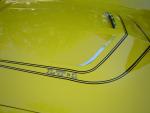
First I thought, man what a bad carb fire this Vette must have went through, then after further study, I realized HEY! some EFFING idiot cut this hood to put a tunnel ram on the motor way back in the day (another reason why I know the Vette is a true 70 LT-1)