





How rare is my 1981 ?

Thread Starter
Le Mans Master


Joined: Jul 2004
Posts: 5,865
Likes: 6
From: Saraland Alabama
St. Jude Donor '11-'12-'13-'14-'15-'16
 How rare is my 1981 ?
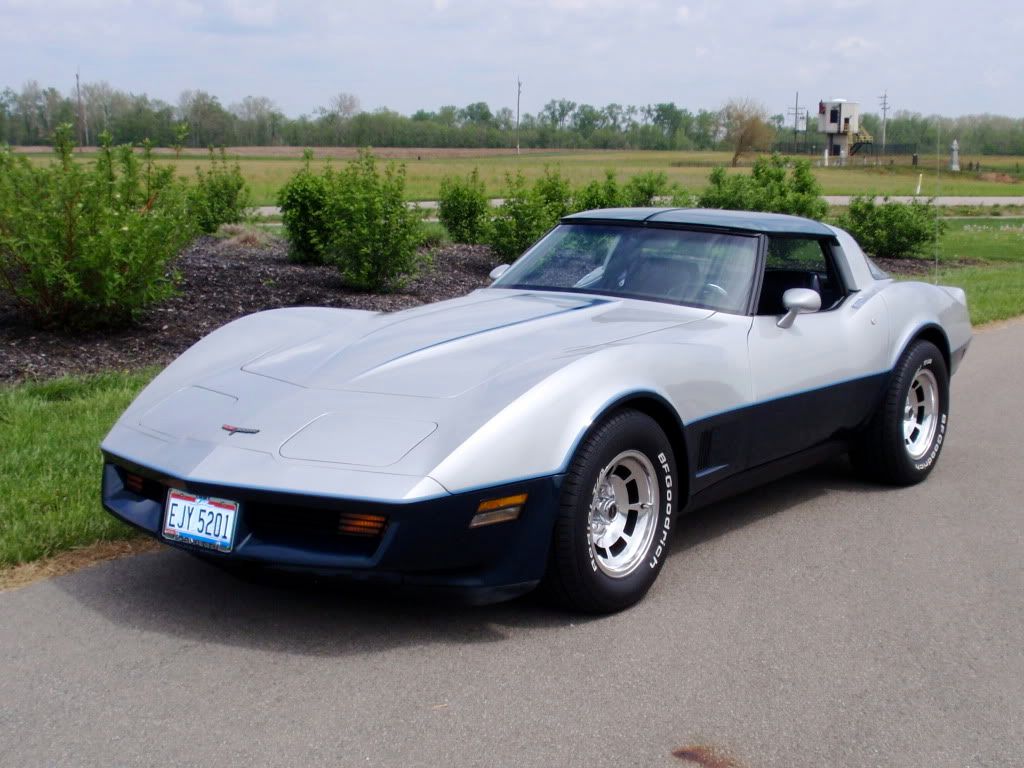
I just bought a completely stock 1981 last week with two tone , silver over dark blue, paint. I have been told it is rare. The car is NCRS Top Flight from Oct 2003 but has been garaged and only used as a show car since that time.
Does anyone on here know how many '81s had this two tone paint scheme with factory applied blue pin stripes on border between the silver and blue paint and also on the hood. It has glass t-tops and automatic transmission. Also has factory a/c, power ant.,pw, power mirrors, cloth seats. A beautiful car with only 44k miles on it.
This car was supposedly built right near the end of the St Louis run and was transported to BG for painting since it got a special paint job.
Is there any way to verify the above?
I am the fourth owner. The third owner died and I bought the car from his wife. They bought the car from his brother-in-law who was the second owner. I haven't had a chance to contact the BIL and find out more info about the car but intend to do so. At this time I don't know who the original owner was and if he is still alive.
Any help would be appreciated.
Does anyone on here know how many '81s had this two tone paint scheme with factory applied blue pin stripes on border between the silver and blue paint and also on the hood. It has glass t-tops and automatic transmission. Also has factory a/c, power ant.,pw, power mirrors, cloth seats. A beautiful car with only 44k miles on it.
This car was supposedly built right near the end of the St Louis run and was transported to BG for painting since it got a special paint job.
Is there any way to verify the above?
I am the fourth owner. The third owner died and I bought the car from his wife. They bought the car from his brother-in-law who was the second owner. I haven't had a chance to contact the BIL and find out more info about the car but intend to do so. At this time I don't know who the original owner was and if he is still alive.
Any help would be appreciated.

Pro


Joined: Sep 2010
Posts: 745
Likes: 66
From: Hutto Texas
There are several sites that can help answer your questions.
VIN decoder - http://www.corvettec3.ca/vin.htm#1981_Options
Paint Codes - http://www.corvettec3.ca/colors.htm#1981_Options
It does not give a qty. for the number of cars with the silver over blue paint job but it is rare. If you Google 1981 Corvette paint codes you might find someone who knows the qty.
Congrats on your new purchase, would love to see some pics of it when you can post them up.
VIN decoder - http://www.corvettec3.ca/vin.htm#1981_Options
Paint Codes - http://www.corvettec3.ca/colors.htm#1981_Options
It does not give a qty. for the number of cars with the silver over blue paint job but it is rare. If you Google 1981 Corvette paint codes you might find someone who knows the qty.
Congrats on your new purchase, would love to see some pics of it when you can post them up.

Team Owner


Joined: Jun 2000
Posts: 38,923
Likes: 1,482
From: Southbound
Cruise-In II Veteran
The silver/blue paint combination was a factory option; your tape stripes were included with the two tone scheme. I am not certain specific two tone color combination numbers are available.
Two tone cars were assembled at St. Louis and at Bowling Green. I have not heard of any St. Louis 81s being shipped to Bowling Green for paint. That is likely to be an old Corvette myth left over from the time when it was thought all of the two tone cars were done at Bowling Green and none were assembled at St. Louis.
Check your VIN; if the car was assembled in St. Louis, there will be an S following the B; if it's a Bowling Green car, a 5 will follow the B.
Your glass tops and power mirrors were options. Leather was standard seating but the cloth was a no charge choice for the buyer. If you have aluminum wheels, they were optional.
If the car was NCRS Top Flight, I am certain there is/was original documentation with the car. You might want to check with the previous owners and see if the documentation is available.

Two tone cars were assembled at St. Louis and at Bowling Green. I have not heard of any St. Louis 81s being shipped to Bowling Green for paint. That is likely to be an old Corvette myth left over from the time when it was thought all of the two tone cars were done at Bowling Green and none were assembled at St. Louis.
Check your VIN; if the car was assembled in St. Louis, there will be an S following the B; if it's a Bowling Green car, a 5 will follow the B.
Your glass tops and power mirrors were options. Leather was standard seating but the cloth was a no charge choice for the buyer. If you have aluminum wheels, they were optional.
If the car was NCRS Top Flight, I am certain there is/was original documentation with the car. You might want to check with the previous owners and see if the documentation is available.
Last edited by Easy Mike; Oct 1, 2010 at 02:14 PM.
Drifting

Joined: Apr 2008
Posts: 1,992
Likes: 56
From: Antioch IL
The silver/blue paint combination was a factory option; your tape stripes were included with the two tone scheme. I am not certain specific two tone color combination numbers are available.
Two tone cars were assembled at St. Louis and at Bowling Green. I have not heard of any St. Louis 81s being shipped to Bowling Green for paint. That is likely to be an old Corvette myth left over from the time when it was thought all of the two tone cars were done at Bowling Green and none were assembled at St. Louis.
Check your VIN; if the car was assembled in St. Louis, there will be an S following the B; if it's a Bowling Green car, a 5 will follow the B.
Two tone cars were assembled at St. Louis and at Bowling Green. I have not heard of any St. Louis 81s being shipped to Bowling Green for paint. That is likely to be an old Corvette myth left over from the time when it was thought all of the two tone cars were done at Bowling Green and none were assembled at St. Louis.
Check your VIN; if the car was assembled in St. Louis, there will be an S following the B; if it's a Bowling Green car, a 5 will follow the B.

Thread Starter
Le Mans Master
Joined: Jul 2004
Posts: 5,865
Likes: 6
From: Saraland Alabama
St. Jude Donor '11-'12-'13-'14-'15-'16
The VIN is 1G1AY8767B5107423
There is a metal plate riveted to the door jamb near the driver door hinge that has the following info:
B 09D 107423
131 33L 33U 38M E
CHEVROLET
Thanks for the info.
There is a metal plate riveted to the door jamb near the driver door hinge that has the following info:
B 09D 107423
131 33L 33U 38M E
CHEVROLET
Thanks for the info.
Drifting
Joined: Apr 2008
Posts: 1,992
Likes: 56
From: Antioch IL
from the looks of it you have a Bowling green car. Mine is also a BG car birthday Aug. 4th.
according to an app i have on my phone your car was built on Oct. 6, 1981.
I cannot wait to see pics of your car.
according to an app i have on my phone your car was built on Oct. 6, 1981.
I cannot wait to see pics of your car.
Team Owner
Joined: Jun 2000
Posts: 38,923
Likes: 1,482
From: Southbound
Cruise-In II Veteran
The VIN is 1G1AY8767B5107423
There is a metal plate riveted to the door jamb near the driver door hinge that has the following info:
B 09D 107423
131 33L 33U 38M E
CHEVROLET
Thanks for the info.
There is a metal plate riveted to the door jamb near the driver door hinge that has the following info:
B 09D 107423
131 33L 33U 38M E
CHEVROLET
Thanks for the info.
B is the code for the model year (1981). 80s had an A; C for the 82s
09 September
D fourth week of September
107423 consecutive unit number; 8995 was the last BG 81; about 1500 cars from yours. The first 1 is a code for the car line series. All BG 81s had the 1.
131 interior trim code for silver gray cloth
33 paint code for silver
38 paint code for dark blue metallic
The two tone silver/blue with gray cloth has to be sweet. Post some pics.
Last edited by Easy Mike; Oct 1, 2010 at 03:07 PM.
Corvette Stories
The Best of Corvette for Corvette Enthusiasts

5 Best & 5 Worst Corvette Daily Drivers
Joe Kucinski
The Headlights of Every Corvette Generation Explained
Joe Kucinski
5 Best & 5 Most Overrated Corvette Track Packages of All Time!
Joe Kucinski
Every 2027 Corvette Engine Explained
Joe Kucinski
Designer Imagines A Corvette That Looks More Like a Corvette Than the Corvette
Verdad Gallardo
10 Ugly Corvettes That We Still Kinda Love
Joe Kucinski
Top 10 Most Expensive Corvettes Ever Sold on Bring A Trailer
Brett Foote
10 Things Every Corvette Owner Needs (2026 Edition)
Michael S. Palmer
8 Most "Only Corvette Owners Understand" Quirks and Problems
Pouria Savadkouei
Le Mans Master


Joined: Nov 2001
Posts: 8,852
Likes: 1,965
From: LONG ISLAND
2025 C3 ('68-'73) of the Year Finalist - Unmodified
2024 C3 of the Year Finalist - Unmodified
2023 C3 of the Year Finalist - Unmodified
The silver/blue paint combination was a factory option; your tape stripes were included with the two tone scheme. I am not certain specific two tone color combination numbers are available.
Two tone cars were assembled at St. Louis and at Bowling Green. I have not heard of any St. Louis 81s being shipped to Bowling Green for paint. That is likely to be an old Corvette myth left over from the time when it was thought all of the two tone cars were done at Bowling Green and none were assembled at St. Louis.
Check your VIN; if the car was assembled in St. Louis, there will be an S following the B; if it's a Bowling Green car, a 5 will follow the B.
Your glass tops and power mirrors were options. Leather was standard seating but the cloth was a no charge choice for the buyer. If you have aluminum wheels, they were optional.
If the car was NCRS Top Flight, I am certain there is/was original documentation with the car. You might want to check with the previous owners and see if the documentation is available.
Two tone cars were assembled at St. Louis and at Bowling Green. I have not heard of any St. Louis 81s being shipped to Bowling Green for paint. That is likely to be an old Corvette myth left over from the time when it was thought all of the two tone cars were done at Bowling Green and none were assembled at St. Louis.
Check your VIN; if the car was assembled in St. Louis, there will be an S following the B; if it's a Bowling Green car, a 5 will follow the B.
Your glass tops and power mirrors were options. Leather was standard seating but the cloth was a no charge choice for the buyer. If you have aluminum wheels, they were optional.
If the car was NCRS Top Flight, I am certain there is/was original documentation with the car. You might want to check with the previous owners and see if the documentation is available.

Melting Slicks


Joined: Nov 1999
Posts: 2,461
Likes: 354
From: Madison Alabama
I'm partcial to the two-tones as well. The Corvette Black Book shows a total of 5,352 of the 40,606 Corvettes produced in 1981 had the two-tone paint option; $399 option!
For some reason the breakdown of colors is not listed - must have not been recorded by GM. In 1982 (the only other year the two-tone color options were available on a C3 - excluding the 78 PC and SA) there were four color options as well but the breakdown on number of cars and color options is listed. My car is silver blue over dark blue and is one of 1,667 cars painted this color. GM painted 4,871 cars two-tone in 1982 out of 25,407 produced.
Take care of your paint - these stripes are hard to come by and a re-paint is twice the cost for a two-tone!
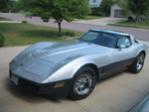
This picture is the closest to what my colors (silver blue over dark blue) look like in person.

And the hood stripe...

For some reason the breakdown of colors is not listed - must have not been recorded by GM. In 1982 (the only other year the two-tone color options were available on a C3 - excluding the 78 PC and SA) there were four color options as well but the breakdown on number of cars and color options is listed. My car is silver blue over dark blue and is one of 1,667 cars painted this color. GM painted 4,871 cars two-tone in 1982 out of 25,407 produced.
Take care of your paint - these stripes are hard to come by and a re-paint is twice the cost for a two-tone!
This picture is the closest to what my colors (silver blue over dark blue) look like in person.
And the hood stripe...

Race Director


Joined: Jul 2001
Posts: 15,892
Likes: 42
Much cheaper, more educational and lots more fun simple having it re-judged now in your own name.




Thread Starter
Le Mans Master
Joined: Jul 2004
Posts: 5,865
Likes: 6
From: Saraland Alabama
St. Jude Donor '11-'12-'13-'14-'15-'16
Hi Z28... That is a beautiful car you have.
I was just looking at my build sheet and it has the "ZO5" option. That is the build sheet code for two tone paint on my '81.
Also according to my build sheet, the shipping weight of my car was 1653 lbs front and 1572 lbs rear. Adding those two weights comes to 3225 lbs for total weight of the car. I am shocked that it is actually lighter than my C5 and my C6. I don't remember what my C4 weighed. IIRC both my C5 & C6 were listed at 3400 plus pounds.
I took the '81 to a Cruiz-in last nite and it really got alot of attention. It seems as though everyone loves the two tone paint.
I drove my C6 to church this morning and the first time I touched to brakes to slow from about 40-45 mph I almost gave myself whiplash as I had not driven the C6 in the last week. The brake pedal on the C3 is low and mushey compared to the C6. As soon as I get a chance I plan to bleed and replace the brake fluid in the C3. Hopefully, that will give it a higher pedal. I don't like a brake pedal that goes way down before starting to brake.
I was just looking at my build sheet and it has the "ZO5" option. That is the build sheet code for two tone paint on my '81.
Also according to my build sheet, the shipping weight of my car was 1653 lbs front and 1572 lbs rear. Adding those two weights comes to 3225 lbs for total weight of the car. I am shocked that it is actually lighter than my C5 and my C6. I don't remember what my C4 weighed. IIRC both my C5 & C6 were listed at 3400 plus pounds.
I took the '81 to a Cruiz-in last nite and it really got alot of attention. It seems as though everyone loves the two tone paint.
I drove my C6 to church this morning and the first time I touched to brakes to slow from about 40-45 mph I almost gave myself whiplash as I had not driven the C6 in the last week. The brake pedal on the C3 is low and mushey compared to the C6. As soon as I get a chance I plan to bleed and replace the brake fluid in the C3. Hopefully, that will give it a higher pedal. I don't like a brake pedal that goes way down before starting to brake.



Team Owner

Joined: Jan 2006
Posts: 37,637
Likes: 3,118
From: Crossville TN
Just a thought....but those rubber flex hoses that connect each caliper to the solid brake line are only good for so many years. If those are originals, they are probably deteriorated on the inside and could be dangerous to operate (you apply the brakes...but the crud inside the flex line won't let all the pressure release when you let up on the pedal). I suggest you call the seller and ask if those have been replaced recently [or not]. {just tryin' to keep you safe...}
Thread Starter
Le Mans Master
Joined: Jul 2004
Posts: 5,865
Likes: 6
From: Saraland Alabama
St. Jude Donor '11-'12-'13-'14-'15-'16
That could be difficult contacting the previous owner since he was buried about two weeks ago. I bought the car from his widow and she knew nothing about it other than how to drive it..
I'll check the hoses when I pull the wheels.
Thanks for the tip though!
I'll check the hoses when I pull the wheels.
Thanks for the tip though!

Race Director
Joined: Oct 2000
Posts: 12,703
Likes: 3,153
From: Shamong, NJ
Flachusnret, first off, congrats on your purchase!
In response to some of your questions, there doesn't appear to be any numbers available for how many of each Bowling Green solid or two-tone paint cars were built. There were more two-tone Bowling Green 81's built than solid colored cars though. There were 8,995 Bowling Green 81's, of which, 5,352 were two-tones. It seems that GM was treating the two-tone option sort of like a special edition. The Bowling Green sales brochure says "four new optional two-tone paint treatments celebrate the opening of the new plant". Apparently very few solid colored cars (if any) were built the first month or two of BG production.
Take another look at your trim tag. The 13"1" is probably actually an "I", and not a 1. Bowling Green 81 (and 82) trim tags usually show both cloth and leather interiors as 13I, even though the actual trim codes are 132 for leather and 13C for cloth. This means that the only true way to tell if a BG car had cloth or leather, is from the build sheet. If you look at box #77 on your build sheet, it will list either 13I132 (leather) or 13I13C (for cloth). Additionally, in the last column of the large box (#107), your trim and paint colors will be listed. They probably read something like this:
13I SLATE INT TRM
132 SLATE LEATHER
33L SILVER MET
33U SILVER MET
33M DK BLUE MET
Strangely, Chevrolet calls the interior color "Silver Gray" in the sales brochure and ordering guide, but refers to it as "Slate" on the build sheet.
It's funny that the two-tone shows up on your build sheet as "ZO5", as the actual RPO (regular production option), or ordering code for two-tone in 81 was "D84". "D" codes are usually exterior features, while "Z" codes were usually special packages.
With the opening of the Bowling Green plant, Chevrolet provided dealers with 2 "Quick-Spec" ordering codes. The Quick-Specs were made up of popular, commonly ordered options. By using the Quick-Spec, a dealer could easily order a car, without having to specify all the individual order codes. When the Quick-Spec was specified, the individual RPOs appeared on the window sticker and build sheets, not the Quick-Spec code. Because of the Quick-Spec, most BG 81's have the same, or very similar options.
Quick-Spec 615B included rear defogger, power mirrors, 8 track radio, cruise (with auto trans), white lettered 225/70's and aluminum wheels. The radio and tires could be upgraded. Quick-Spec 616B added power mirrors, power antenna, glass roof panels and power seat to 615Bs equipment, and replaced the radio and tires with a cassette radio and 255/60s. Any regular options could be added to either Quick-Spec.
As far as your brakes go, remember that they are 1965 technology. Having owned Vettes for 35 years, I can say that I've never liked the pedal feel of the 82 and earlier brakes, especially when power assisted. If your use to the feel of 97 up brakes, I doubt you'll ever get that feel in your 81.
By the way, my 81 has both yours and Z28's beat in the weight department at 1661 front and 1579 rear. My 81 was also built the day after yours, October 7th, and is 48 behind yours. My VIN is 7471.
In response to some of your questions, there doesn't appear to be any numbers available for how many of each Bowling Green solid or two-tone paint cars were built. There were more two-tone Bowling Green 81's built than solid colored cars though. There were 8,995 Bowling Green 81's, of which, 5,352 were two-tones. It seems that GM was treating the two-tone option sort of like a special edition. The Bowling Green sales brochure says "four new optional two-tone paint treatments celebrate the opening of the new plant". Apparently very few solid colored cars (if any) were built the first month or two of BG production.
Take another look at your trim tag. The 13"1" is probably actually an "I", and not a 1. Bowling Green 81 (and 82) trim tags usually show both cloth and leather interiors as 13I, even though the actual trim codes are 132 for leather and 13C for cloth. This means that the only true way to tell if a BG car had cloth or leather, is from the build sheet. If you look at box #77 on your build sheet, it will list either 13I132 (leather) or 13I13C (for cloth). Additionally, in the last column of the large box (#107), your trim and paint colors will be listed. They probably read something like this:
13I SLATE INT TRM
132 SLATE LEATHER
33L SILVER MET
33U SILVER MET
33M DK BLUE MET
Strangely, Chevrolet calls the interior color "Silver Gray" in the sales brochure and ordering guide, but refers to it as "Slate" on the build sheet.
It's funny that the two-tone shows up on your build sheet as "ZO5", as the actual RPO (regular production option), or ordering code for two-tone in 81 was "D84". "D" codes are usually exterior features, while "Z" codes were usually special packages.
With the opening of the Bowling Green plant, Chevrolet provided dealers with 2 "Quick-Spec" ordering codes. The Quick-Specs were made up of popular, commonly ordered options. By using the Quick-Spec, a dealer could easily order a car, without having to specify all the individual order codes. When the Quick-Spec was specified, the individual RPOs appeared on the window sticker and build sheets, not the Quick-Spec code. Because of the Quick-Spec, most BG 81's have the same, or very similar options.
Quick-Spec 615B included rear defogger, power mirrors, 8 track radio, cruise (with auto trans), white lettered 225/70's and aluminum wheels. The radio and tires could be upgraded. Quick-Spec 616B added power mirrors, power antenna, glass roof panels and power seat to 615Bs equipment, and replaced the radio and tires with a cassette radio and 255/60s. Any regular options could be added to either Quick-Spec.
As far as your brakes go, remember that they are 1965 technology. Having owned Vettes for 35 years, I can say that I've never liked the pedal feel of the 82 and earlier brakes, especially when power assisted. If your use to the feel of 97 up brakes, I doubt you'll ever get that feel in your 81.
By the way, my 81 has both yours and Z28's beat in the weight department at 1661 front and 1579 rear.
My 81 was also built the day after yours, October 7th, and is 48 behind yours. My VIN is 7471.