



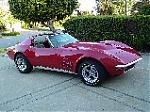






How much can the original engine be worth?

Thread Starter
Melting Slicks

Joined: May 2009
Posts: 3,079
Likes: 315
2024 C3 of the Year Finalist - Unmodified
 How much can the original engine be worth?
Check out this '69 L88 that just sold for $210,000 with a correct replacement engine. Either the economy is really down or collectors are placing much more importance on original engine L88s than I previously thought.
http://www.mecum.com/auctions/lot_de...=SC0511-107380
Previous high sale for a '69 L88 coupe at Mecum was for $446,250 in October of 2007. Low mileage, original engine.
http://www.mecum.com/auctions/lot_de...=SC0511-107380
Previous high sale for a '69 L88 coupe at Mecum was for $446,250 in October of 2007. Low mileage, original engine.
Thread Starter
Melting Slicks
Joined: May 2009
Posts: 3,079
Likes: 315
2024 C3 of the Year Finalist - Unmodified
Doesn't make much difference with the '67 L88s...those that still exist and have been positively identified. Most are NOM. They are all serious collector cars. Every one of them.

Melting Slicks


Joined: Apr 2007
Posts: 3,189
Likes: 111
From: Tolland CT

If there's a demand and a very limited number of 'originals' available buyers may opt for a NOM with a configuration identical to the original.
Thread Starter
Melting Slicks
Joined: May 2009
Posts: 3,079
Likes: 315
2024 C3 of the Year Finalist - Unmodified
Here is a '68 L88 coupe scheduled to cross the auction block at Bloomington. Correct date coded parts EXCEPT for the engine and transmission. Even been in the movies. We'll see.
http://www.mecum.com/auctions/lot_de...=BG0611-111969
http://www.mecum.com/auctions/lot_de...=BG0611-111969

Team Owner


Joined: Jan 2006
Posts: 37,637
Likes: 3,118
From: Crossville TN
An 'original' L88 vehicle without the original engine (now has a clone L88 block, etc.) should not be worth nearly as much as the complete car. Of course, there are always 'idiots with money' hanging out at all these auctions, so all bets are off on that one.
Corvette Stories
The Best of Corvette for Corvette Enthusiasts

Top 10 Most Expensive Corvettes Ever Sold on Bring A Trailer
Brett Foote
10 Things Every Corvette Owner Needs (2026 Edition)
Michael S. Palmer
8 Most "Only Corvette Owners Understand" Quirks and Problems
Pouria Savadkouei
10 Reasons the C6 Z06 is Still A Performance Benchmark After 20 Years
Joe Kucinski
How Much Horsepower Every Corvette Engine "LOST" in 1972
Joe Kucinski
Top 10 DOs and DON'Ts for Protecting Your Convertible Top!
Michael S. Palmer
Top 10 Most Explosive Corvettes Ever Made: Power-to-Weight Ratio Ranked!
Joe Kucinski
150 hp to 1,250 hp: Every Corvette Generation Compared by the Specs That Matter
Joe Kucinski
8 Coolest Corvette Pace Cars (and Replicas) of All Time
Verdad Gallardo


Safety Car

Joined: Sep 2007
Posts: 4,458
Likes: 331
From: Indy Indiana
to those that say that a L88 without its original engine is just another corvette, here is just another corvette worth 210,000$.
i really does pay to clone these cars. Get you all the right date coded parts, employ the services of one of the best VIN stamp guys in the nation, and get you the right group of ' aged' documentation and a repro POP, then disclose everything, then sell it for 6 figures. People will buy it.
i really does pay to clone these cars. Get you all the right date coded parts, employ the services of one of the best VIN stamp guys in the nation, and get you the right group of ' aged' documentation and a repro POP, then disclose everything, then sell it for 6 figures. People will buy it.
Melting Slicks
Joined: May 2006
Posts: 3,438
Likes: 41
From: Raleigh NC
St. Jude Donor '13-'14
I've always felt that if it doesn't have the original engine, its only worth the base model plus the cost for you to put on all the options (or in the case of the L88, to delete them).

Administrator

Joined: Jul 2000
Posts: 53,988
Likes: 6,212
From: About 1100 miles from where I call home.
Check out this '69 L88 that just sold for $210,000 with a correct replacement engine. Either the economy is really down or collectors are placing much more importance on original engine L88s than I previously thought.
http://www.mecum.com/auctions/lot_de...=SC0511-107380
Previous high sale for a '69 L88 coupe at Mecum was for $446,250 in October of 2007. Low mileage, original engine.
http://www.mecum.com/auctions/lot_de...=SC0511-107380
Previous high sale for a '69 L88 coupe at Mecum was for $446,250 in October of 2007. Low mileage, original engine.
Original motor= $446k+.
"Correct replacement engine" = (otherwise know as "NOM" or "wrong engine") = less than half. I think the selling price was too high, not too low.
Administrator
Joined: Jul 2000
Posts: 53,988
Likes: 6,212
From: About 1100 miles from where I call home.
to those that say that a L88 without its original engine is just another corvette, here is just another corvette worth 210,000$.
i really does pay to clone these cars. Get you all the right date coded parts, employ the services of one of the best VIN stamp guys in the nation, and get you the right group of ' aged' documentation and a repro POP, then disclose everything, then sell it for 6 figures. People will buy it.
i really does pay to clone these cars. Get you all the right date coded parts, employ the services of one of the best VIN stamp guys in the nation, and get you the right group of ' aged' documentation and a repro POP, then disclose everything, then sell it for 6 figures. People will buy it.
Thread Starter
Melting Slicks
Joined: May 2009
Posts: 3,079
Likes: 315
2024 C3 of the Year Finalist - Unmodified
I'm talking about a real, documented, C3 L88 with KNOWN history that happens to be NOM...not a clone or tribute car. According to doubting Joe though, any high value car could be a fake...and probably is. Be that as it may.
If we were talking about one of the real C2 L88s KNOWN to exist, do you think the value of a NOM car would be less than half? Think you could pick a real one up for a half to three quarter million? I don't think so.

Burning Brakes


Joined: Oct 2007
Posts: 813
Likes: 0
From: N E area of state Kansas
If it had the original engine, it would sell for a lot more. However, still very valuable with correct replacment if it was originally an L88.
NOM is not as important as it used to be on base models, as resto-rods have taking off, and many people want cars to drive not collect dust. However, on rare engine options L88, the big blocks, etc, it makes a big diffrence to have the original engine.
NOM is not as important as it used to be on base models, as resto-rods have taking off, and many people want cars to drive not collect dust. However, on rare engine options L88, the big blocks, etc, it makes a big diffrence to have the original engine.

Safety Car

Joined: Dec 1999
Posts: 3,606
Likes: 839
From: PA
Urban legend is always a lot more interesting than reality. 
Dyno cell readings of 480-500 horsepower for a closed chamber L-88 and 525-535 horsepower for an open chamber L-88/ZL-1 according to the engineers who actually worked on these engines for GM "back in the day." Figure even less as installed in the car with exhaust manifolds, full exhaust, air filter assembly, etc. If the owner of this car assembled the engine in a manner similar to what the folks in Tonawanda did in 1968, 502 horsepower is just about right for a closed chamber L-88 engine.
Not as exciting as the 600+ horsepower that we're used to hearing about in magazines, but it is reality.
Regards,
Stan Falenski
Dyno cell readings of 480-500 horsepower for a closed chamber L-88 and 525-535 horsepower for an open chamber L-88/ZL-1 according to the engineers who actually worked on these engines for GM "back in the day." Figure even less as installed in the car with exhaust manifolds, full exhaust, air filter assembly, etc. If the owner of this car assembled the engine in a manner similar to what the folks in Tonawanda did in 1968, 502 horsepower is just about right for a closed chamber L-88 engine.
Not as exciting as the 600+ horsepower that we're used to hearing about in magazines, but it is reality.
Regards,
Stan Falenski