


Any suggestions for saving the paint?


Thread Starter
Instructor

Joined: Sep 2011
Posts: 139
Likes: 0
From: Phoenix AZ
 Any suggestions for saving the paint?
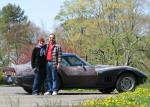
As I have mentioned in other threads, I have had my C3 for about a month. Two owners ago it was in the hands of a pretty good mechanic however when he got ready to sell it he got a horrible paint job for it. The next owner bought the car in 1997 and put it in a garage driving it less than 1000 miles over the 14 years. I bought the car and within a month huge chips of paint are flying off. I am out of money and probably won't have the ability to paint for the next couple years, especially if get a quality paint job. Any chance I can prolong the paint job? Any ideas? What about this Polycoat Detailing--is it just snake oil?


Pro

Joined: May 2011
Posts: 581
Likes: 5
From: BC
There isn't anything that you're going to put on the paint that will stall the deterioration because the problem is not with the paint, it's with the prep of the surface it was put on. Geez, they even painted right over an old oil change sticker.
If having it painted isn't in the cards I would suggest spot repairing it yourself. In fact, even if you were going to have it professionally painted I would suggest that you do some of the repair/prep yourself.
In particular what needs to happen to the door jambs and door edges is that the paint will have to be stripped off (actually, when the time comes the entire car will have to be stripped). You can remove the doors yourself and work away at it with proper paint stripper and sandpaper and get it all cleaned up. This is a labour intensive job that a shop will have no special tools for and that you are quite capable of doing yourself rather than paying a shop $100/hr to do it. With that part done it wouldn't cost a lot to have a shop shoot the door edges and jambs if you don't have access to the tools to do it properly yourself.
This provides a way of doing it properly, economically and in pieces as the budget allows. Unlike when it comes to doing the exterior when you aren't going to take it in to have the hood done, then the doors another time etc. Jambs are almost always done seperate from the exterior then masked with transition tape at the meeting edge anyways.
The exterior chips I would feather sand, shoot some rattle can primer, block sand and rattle can the matching color. Blend out as best you can and it will look better than the existing scars until you are ready for complete paint.
Steve g
If having it painted isn't in the cards I would suggest spot repairing it yourself. In fact, even if you were going to have it professionally painted I would suggest that you do some of the repair/prep yourself.
In particular what needs to happen to the door jambs and door edges is that the paint will have to be stripped off (actually, when the time comes the entire car will have to be stripped). You can remove the doors yourself and work away at it with proper paint stripper and sandpaper and get it all cleaned up. This is a labour intensive job that a shop will have no special tools for and that you are quite capable of doing yourself rather than paying a shop $100/hr to do it. With that part done it wouldn't cost a lot to have a shop shoot the door edges and jambs if you don't have access to the tools to do it properly yourself.
This provides a way of doing it properly, economically and in pieces as the budget allows. Unlike when it comes to doing the exterior when you aren't going to take it in to have the hood done, then the doors another time etc.
Jambs are almost always done seperate from the exterior then masked with transition tape at the meeting edge anyways.The exterior chips I would feather sand, shoot some rattle can primer, block sand and rattle can the matching color. Blend out as best you can and it will look better than the existing scars until you are ready for complete paint.
Steve g
Melting Slicks


Joined: Aug 2005
Posts: 2,683
Likes: 34
From: Working on the car NY
My .02 is this about your chip repair. Chip repair normally does not turn out the way you want it. Why? Because it is very difficult - it is for me at least. Colors fade, don't match, overlap decent paint etc. What I would do, is get a color match bottle. Get a fine artist's brush and "dab"' you chip area and then (what I've said in the past) turn around and walk away immediately. Leave then AS IS. Cause what I've found out ( over years of experience in this
 ) is that you only then make it worse. When later you have either the time or money, the car has to be stripped to the bone and prepared/painted by someone who knows what they are doing - are even then, hopefully it will turn out to your likeing.
over years of experience in this) is that you only then make it worse. When later you have either the time or money, the car has to be stripped to the bone and prepared/painted by someone who knows what they are doing - are even then, hopefully it will turn out to your likeing.

Melting Slicks
Joined: Jun 2009
Posts: 2,709
Likes: 3
From: Savannah GA
Until you can afford a complete paint job the only thing to do is spot repair. Dab some color in the scabs and save up. Have you considered painting it yourself? I applied color to the hood, tees, gas door, headlight doors and bumpers of my '77 project this afternoon... right in my backyard. I added up the total paint material bill just for kicks and even if you include the cost of all the razor blades, sandpaper, tape and the $15.00 Harbor Freight spray gun I applied all the materials with it's just north of $500.00 which includes the epoxy and body filler used to fill the cracks in the body. I do of course already own an adequate compressor, DA sander, 4 inch air powered grinder, manual 12 inch longboard and a die grinder which were the only "specialty" tools used besides some sanding blocks (OK add $65 to the total... I bought those special for this project too).
If you have a detached garage, some time, a bit of bravery and some basic tools, you can turn out a better first paint job than the one which is on the car now, and if you are a quick study possibly a much better finish! Mine has some flaws (and a few Georgia gnats) but it looks much better than when I got it, and good enough for now.
If you have a detached garage, some time, a bit of bravery and some basic tools, you can turn out a better first paint job than the one which is on the car now, and if you are a quick study possibly a much better finish! Mine has some flaws (and a few Georgia gnats) but it looks much better than when I got it, and good enough for now.

Team Owner


Joined: Jan 2006
Posts: 37,637
Likes: 3,118
From: Crossville TN
You have a solid color paint that should be pretty easy to match. Go to any auto body paint supply store; they should be able to come up with a very close match to your color...and adjust it a bit, if necessary.
Then, it is all technique. You need to clean the touch-up area well, and you need to fill any significant 'pits', holes, gouges with some polyester spot-putty first. Once you have a level surface, you need to lay on very thin coats of paint--one layer at a time, with time between for the paint to dry well (at least one day). This takes time to do properly. You need to prep ALL of the areas needing to be done, then put a coat down for ALL of them and let dry. Then do it again. And again. Any time there is some surface roughness that develops, you need to sand the area smooth with fine sandpaper (working down to about 1500 grit), then do another coat. When the area is filled and recolored satisfactorily, wet sand with 1500 grit and feather the area into the existing paint. Then get to work with the buffing/polishing pads and finer & finer polish until you get the same gloss as the rest of the paint.
Nothing to it. Or, you can take it to a pro and get him/her to do it right for a few hundred bucks.
Then, it is all technique. You need to clean the touch-up area well, and you need to fill any significant 'pits', holes, gouges with some polyester spot-putty first. Once you have a level surface, you need to lay on very thin coats of paint--one layer at a time, with time between for the paint to dry well (at least one day). This takes time to do properly. You need to prep ALL of the areas needing to be done, then put a coat down for ALL of them and let dry. Then do it again. And again. Any time there is some surface roughness that develops, you need to sand the area smooth with fine sandpaper (working down to about 1500 grit), then do another coat. When the area is filled and recolored satisfactorily, wet sand with 1500 grit and feather the area into the existing paint. Then get to work with the buffing/polishing pads and finer & finer polish until you get the same gloss as the rest of the paint.
Nothing to it.
Or, you can take it to a pro and get him/her to do it right for a few hundred bucks.







