




[LS Swap] Air Intake Help

Thread Starter
Race Director


Joined: Dec 2005
Posts: 13,515
Likes: 12
From: Fisher, IL
 [LS Swap] Air Intake Help
Sorry, I hate bugging you guys with so many questions but....
I need an intake setup and am trying my best to avoid the common 90degree type.
I've seen a few that have a dual intake or the one in a C2 with a wide one.
Just wondering how to they go about not having the MAF sensor and isn't it supposed to be something like 4" away from the throttle body?
Anyone have any input or suggestions that might help?


I need an intake setup and am trying my best to avoid the common 90degree type.
I've seen a few that have a dual intake or the one in a C2 with a wide one.
Just wondering how to they go about not having the MAF sensor and isn't it supposed to be something like 4" away from the throttle body?
Anyone have any input or suggestions that might help?
Last edited by PUNISHER VETTE; Nov 6, 2012 at 09:09 PM.
Thread Starter
Race Director
Joined: Dec 2005
Posts: 13,515
Likes: 12
From: Fisher, IL
ugh. I guess I can try hooking the MAF up right to the throttle body then seeing if I have enough room for a T intake...
stupid setup having a 4" throttle body and a 3" MAF...
stupid setup having a 4" throttle body and a 3" MAF...

Team Owner


Joined: Feb 1999
Posts: 34,454
Likes: 665
From: Republic of Texas
Thread Starter
Race Director
Joined: Dec 2005
Posts: 13,515
Likes: 12
From: Fisher, IL
Thread Starter
Race Director
Joined: Dec 2005
Posts: 13,515
Likes: 12
From: Fisher, IL
Well. I just took some measurements and basically i'm stuck with the 90degree single cone setup unless I do a SpeedDensity tune.
I'm not saying that is out of the question as from what I read they're good...although I have never tuned before so I'll have to do a lot of research to see if I could do it myself or not. Maybe in the future.
I'm not saying that is out of the question as from what I read they're good...although I have never tuned before so I'll have to do a lot of research to see if I could do it myself or not. Maybe in the future.
Thread Starter
Race Director
Joined: Dec 2005
Posts: 13,515
Likes: 12
From: Fisher, IL
Just ordered the parts to build this...so at least if i'm doing a 90 elbow it'll be a BIG elbow.... except I ordered a red filter.
My only question now is the small 1" round IAT sensor that was in the stock intake that I assume I need to install in the new one? Just curious if there is a special place it needs to be.

My only question now is the small 1" round IAT sensor that was in the stock intake that I assume I need to install in the new one? Just curious if there is a special place it needs to be.
Last edited by PUNISHER VETTE; Nov 7, 2012 at 06:58 PM.
Corvette Stories
The Best of Corvette for Corvette Enthusiasts

Top 10 Most Expensive Corvettes Ever Sold on Bring A Trailer
Brett Foote
10 Things Every Corvette Owner Needs (2026 Edition)
Michael S. Palmer
8 Most "Only Corvette Owners Understand" Quirks and Problems
Pouria Savadkouei
10 Reasons the C6 Z06 is Still A Performance Benchmark After 20 Years
Joe Kucinski
How Much Horsepower Every Corvette Engine "LOST" in 1972
Joe Kucinski
Top 10 DOs and DON'Ts for Protecting Your Convertible Top!
Michael S. Palmer
Top 10 Most Explosive Corvettes Ever Made: Power-to-Weight Ratio Ranked!
Joe Kucinski
150 hp to 1,250 hp: Every Corvette Generation Compared by the Specs That Matter
Joe Kucinski
8 Coolest Corvette Pace Cars (and Replicas) of All Time
Verdad Gallardo
Instructor


Joined: Oct 2011
Posts: 245
Likes: 34
From: Detroit Michigan
for the IAT sensor This is what I made so it was able to be screwed in. Just put it in a location that wasnt right in your face. Doesnt matter where it is on the intake tube.
I used a brass fitting, opened up the inside of it to fit the sensor, and then used 2 ton epoxy to seal it in. being very careful not to get any on the actual sensor tip.


I used a brass fitting, opened up the inside of it to fit the sensor, and then used 2 ton epoxy to seal it in. being very careful not to get any on the actual sensor tip.
Race Director


Joined: Jan 2000
Posts: 12,399
Likes: 247
From: San Jose CA
Not sure if that's a great bend for that MAF. You need a certain amount of straight before and after the MAF and that looks like it'll be turbulent air on both sides.
The reason MAF and MAP are used in unison has to do with the accuracy of the sensors. MAFs work really well at high speed and are a true measure of air-flow. MAPs work really well at low air speed but are based on equations (PV=nRT). If you have a correct MAF curve(transfer function) in a MAF system, you'll never have to re-tune your MAF.
When the engine is modified, then the vacuum signal the MAP sees has a completely different meaning thus the lookup function (VE (volumetric efficiency) table) needs to be modified to accurately reflect the combination.
FWIW.
FYI
http://www.chevroletperformance.com/...44807E-ROD.pdf
The reason MAF and MAP are used in unison has to do with the accuracy of the sensors. MAFs work really well at high speed and are a true measure of air-flow. MAPs work really well at low air speed but are based on equations (PV=nRT). If you have a correct MAF curve(transfer function) in a MAF system, you'll never have to re-tune your MAF.
When the engine is modified, then the vacuum signal the MAP sees has a completely different meaning thus the lookup function (VE (volumetric efficiency) table) needs to be modified to accurately reflect the combination.
FWIW.
FYI
http://www.chevroletperformance.com/...44807E-ROD.pdf
Originally Posted by GM E-Rod manual
Ensure the MAF Sensor is mounted in the middle of a minimum 6 inch length of 4 inch diameter tube, and is a minimum of 10 inches from the throttle body.
Last edited by Shark Racer; Nov 8, 2012 at 06:36 PM.
Thread Starter
Race Director
Joined: Dec 2005
Posts: 13,515
Likes: 12
From: Fisher, IL
Not sure if that's a great bend for that MAF. You need a certain amount of straight before and after the MAF and that looks like it'll be turbulent air on both sides.
The reason MAF and MAP are used in unison has to do with the accuracy of the sensors. MAFs work really well at high speed and are a true measure of air-flow. MAPs work really well at low air speed but are based on equations (PV=nRT). If you have a correct MAF curve(transfer function) in a MAF system, you'll never have to re-tune your MAF.
When the engine is modified, then the vacuum signal the MAP sees has a completely different meaning thus the lookup function (VE (volumetric efficiency) table) needs to be modified to accurately reflect the combination.
FWIW.
FYI
http://www.chevroletperformance.com/...44807E-ROD.pdf
The reason MAF and MAP are used in unison has to do with the accuracy of the sensors. MAFs work really well at high speed and are a true measure of air-flow. MAPs work really well at low air speed but are based on equations (PV=nRT). If you have a correct MAF curve(transfer function) in a MAF system, you'll never have to re-tune your MAF.
When the engine is modified, then the vacuum signal the MAP sees has a completely different meaning thus the lookup function (VE (volumetric efficiency) table) needs to be modified to accurately reflect the combination.
FWIW.
FYI
http://www.chevroletperformance.com/...44807E-ROD.pdf
I havent looked yet but is the stock trans am IAT removable and reusable?
Race Director
Joined: Jan 2000
Posts: 12,399
Likes: 247
From: San Jose CA
Typically IATs on the LS cars are integrated with the MAF.
Turbulent MAFs would have inconsistent readings, especially at lower speeds, and not run particularly well because they're getting incorrect readings. If you're running a MAP as well it will probably mask this behavior.
Turbulent MAFs would have inconsistent readings, especially at lower speeds, and not run particularly well because they're getting incorrect readings. If you're running a MAP as well it will probably mask this behavior.



Burning Brakes


Joined: Mar 2012
Posts: 871
Likes: 73
From: Memphis Tennessee
Not an LS, but same idea. I rigged this up today using bits of a Camaro air induction kit. I'm going to need to get a tune before startup anyway, so I'm going to have them convert it to run on Speed Density. I'll keep the MAF connector intact in case I ever decide to change.
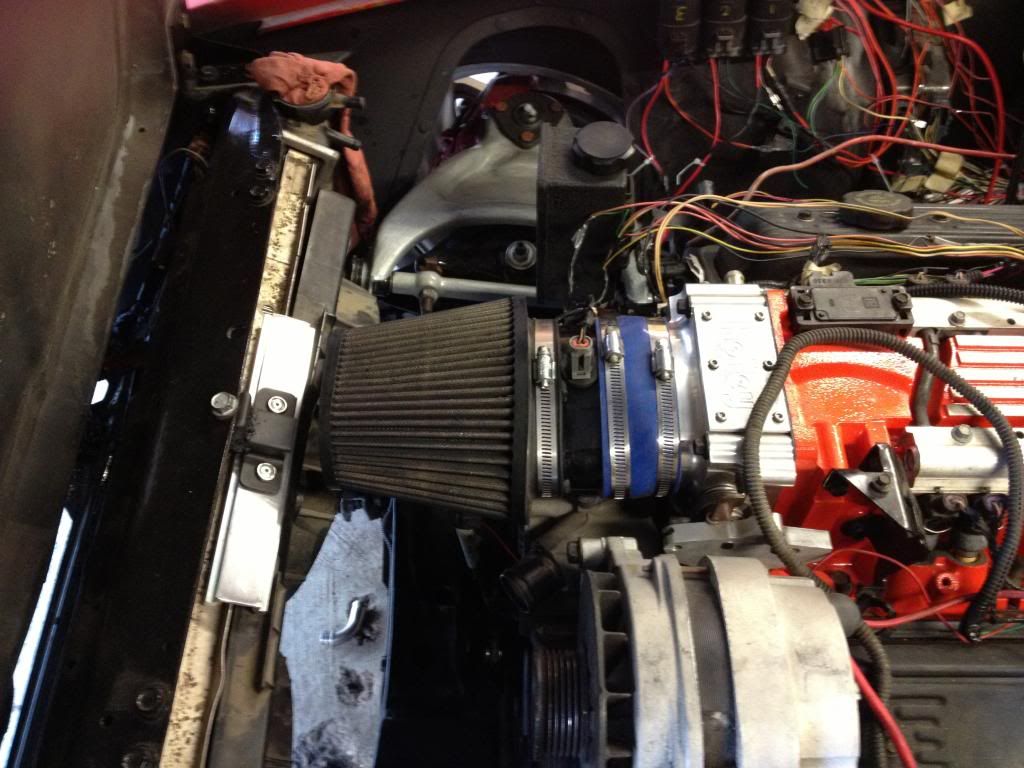
I tried to mount the filter directly on the throttle body but it would not clear the thermastat housing. Since the cold air kit was just sitting around, I cut the mounting plate from the piece that connects the intake tube to the filter to give me my added length. It also gave me a place to mount the IAT sensor. You can see what it looked like before in this pic.

Now to get cold air I would like to put a tray below the filter and run it to the top of the radiator. I would like extend the sides of the tray up to seal to the hood, and do this for good measure.

1980 hood modified to create a scoop.
I tried to mount the filter directly on the throttle body but it would not clear the thermastat housing. Since the cold air kit was just sitting around, I cut the mounting plate from the piece that connects the intake tube to the filter to give me my added length. It also gave me a place to mount the IAT sensor. You can see what it looked like before in this pic.
Now to get cold air I would like to put a tray below the filter and run it to the top of the radiator. I would like extend the sides of the tray up to seal to the hood, and do this for good measure.
1980 hood modified to create a scoop.