







Brake bleeding...No fluid through any bleeder
Thread Starter
Intermediate

Joined: Aug 2013
Posts: 45
Likes: 0
 Brake bleeding...No fluid through any bleeder
My first time bleeding GM brakes.
I have all 4 calipers replaced and the master cylinder and SS brake lines.
I get no fluid through any of the lines either gravity bleeding or with a Mighty Vac pulling up to 20 inHg.
Ideas?
I have all 4 calipers replaced and the master cylinder and SS brake lines.
I get no fluid through any of the lines either gravity bleeding or with a Mighty Vac pulling up to 20 inHg.
Ideas?

Team Owner


Joined: Jul 1999
Posts: 65,492
Likes: 230
From: Orange Park Florida
IF you have OEM style lip seals on the caliper pistons, you can not use a vacuum system very effectively, but if you had the foresight to install a O ring caliper setup....presumable stainless like any thing today....you can still push fluid down the system....the cheap way to do this is, note the stock stamp steel like and the rubber seal up top of the m/cyl....
fill the thing with fluid, and drill a hole into each cyl section....1/16th is fine....this obviously has to be above the rubber seal.....
so put the lid on, and hit it with your air hose, not the small tip but the large blaster tip into that small hole, we not trying to blow the damn lid off, but put pressure on the m/cyl to fill the lines....and brakes, one end of the car at a time....keep a check on the amount of fluid in the m/cyl, so not to blow air too much at a time.....and empty the m/cyl and push air into the lines.....
I assume you know about the bleeder valves on the calipers.....

fill the thing with fluid, and drill a hole into each cyl section....1/16th is fine....this obviously has to be above the rubber seal.....
so put the lid on, and hit it with your air hose, not the small tip but the large blaster tip into that small hole, we not trying to blow the damn lid off, but put pressure on the m/cyl to fill the lines....and brakes, one end of the car at a time....keep a check on the amount of fluid in the m/cyl, so not to blow air too much at a time.....and empty the m/cyl and push air into the lines.....
I assume you know about the bleeder valves on the calipers.....

Team Owner


Joined: Jan 2006
Posts: 37,637
Likes: 3,118
From: Crossville TN
If your flex hoses (between each hard line and caliper) have many years on them, they could have deteriorated at the inside of each hose, making it difficult to pass fluid. Since you are doing a brake system refurb, you really need to change those out, unless you have done so recently.
Thread Starter
Intermediate
Joined: Aug 2013
Posts: 45
Likes: 0
These are new Wilwood brake calipers to answer the question about the calipers.
Mighty Vac all 4 corners.
Yeah, I did install a new master cylinder and did bench bleed it, however, it is possible it lost some of the bleed when I installed it and didn't have the lines tight enough and could have sucked in air when I pumped the brake pedal as the connections leaked a little until I realized they were loose.
There are still rubber lines on both fronts and rear on 1 side, I put full stainless steel on 1 rear, but on the other rear I left the rubber line because I was tired of fooling with it and didn't want to round off the connector (it was being real stubborn). The fronts are pretty stubborn too so I just left the rubber lines between the hard lines and the new SS lines that connect to the calipers.
CORRECTION: The fronts are stainless steel lines directly from the hard lines to the calipers, so there is only 1 rubber line remaining in the whole system at one rear corner.
I'm thinking rebleed the master, but also the possibility of something having to do with the proportioning valve.
How do I reset the proportioning valve?
Mighty Vac all 4 corners.
Yeah, I did install a new master cylinder and did bench bleed it, however, it is possible it lost some of the bleed when I installed it and didn't have the lines tight enough and could have sucked in air when I pumped the brake pedal as the connections leaked a little until I realized they were loose.
There are still rubber lines on both fronts and rear on 1 side, I put full stainless steel on 1 rear, but on the other rear I left the rubber line because I was tired of fooling with it and didn't want to round off the connector (it was being real stubborn). The fronts are pretty stubborn too so I just left the rubber lines between the hard lines and the new SS lines that connect to the calipers.
CORRECTION: The fronts are stainless steel lines directly from the hard lines to the calipers, so there is only 1 rubber line remaining in the whole system at one rear corner.
I'm thinking rebleed the master, but also the possibility of something having to do with the proportioning valve.
How do I reset the proportioning valve?
Last edited by runningstart; Sep 23, 2013 at 12:12 AM.

Le Mans Master


Joined: Mar 2001
Posts: 5,738
Likes: 644
From: Lincoln, CA
Typically on Wilwoods there are two screws.
The larger one is an adapter and the small one the bleed screw. Make sure you are just turning the bleed screw.
In this shot the black screw not the brass one.
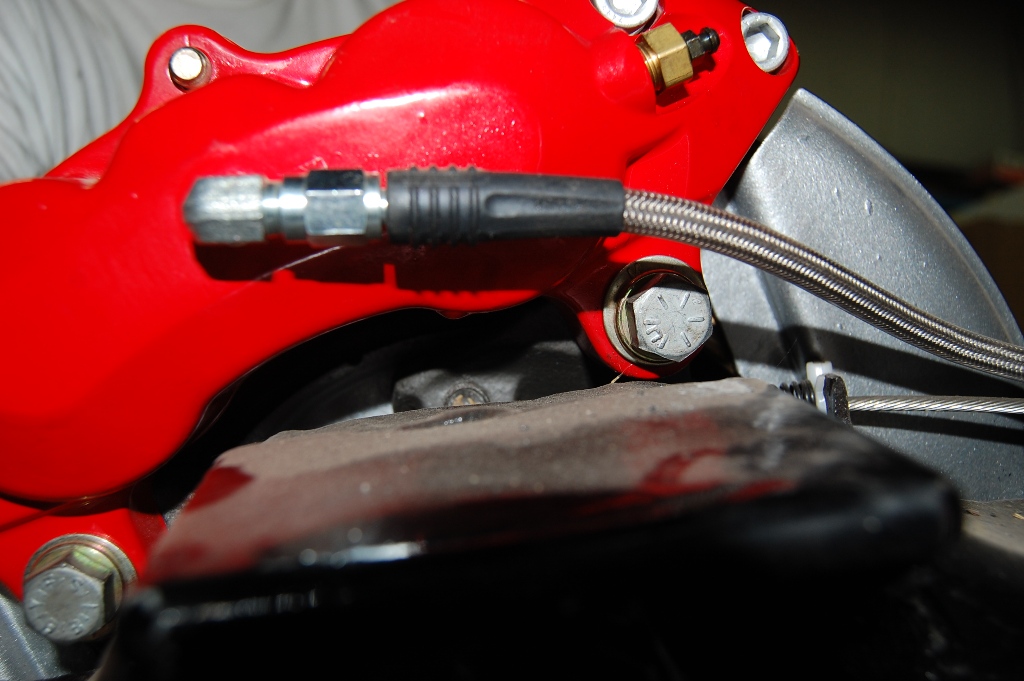
The larger one is an adapter and the small one the bleed screw. Make sure you are just turning the bleed screw.
In this shot the black screw not the brass one.
Corvette Stories
The Best of Corvette for Corvette Enthusiasts

Top 10 Most Expensive Corvettes Ever Sold on Bring A Trailer
Brett Foote
10 Things Every Corvette Owner Needs (2026 Edition)
Michael S. Palmer
8 Most "Only Corvette Owners Understand" Quirks and Problems
Pouria Savadkouei
10 Reasons the C6 Z06 is Still A Performance Benchmark After 20 Years
Joe Kucinski
How Much Horsepower Every Corvette Engine "LOST" in 1972
Joe Kucinski
Top 10 DOs and DON'Ts for Protecting Your Convertible Top!
Michael S. Palmer
Top 10 Most Explosive Corvettes Ever Made: Power-to-Weight Ratio Ranked!
Joe Kucinski
150 hp to 1,250 hp: Every Corvette Generation Compared by the Specs That Matter
Joe Kucinski
8 Coolest Corvette Pace Cars (and Replicas) of All Time
Verdad Gallardo
Supporting Vendor
Joined: Jun 2008
Posts: 2,199
Likes: 119
From: tempe Arizona
Good tips above. However ideally the calipers should be in a vertical manner for bleeding. Using the vac or any other tool will not guarantee the crowns of the pistons are fully purged. Only having the nipple at the top will as the air will rise to the highest spot.
Le Mans Master
Joined: Mar 2001
Posts: 5,738
Likes: 644
From: Lincoln, CA
I finally figured it out when I used a cheap vacuum bleeder and had vacuum with one pump.
I felt like the V8 commercial were you smack your head.
Thread Starter
Intermediate
Joined: Aug 2013
Posts: 45
Likes: 0
Good point! Easy enough to remove a mounting bolt and rotate the caliper to vertical, but thanks for the reminder.
Melting Slicks

Joined: Feb 2007
Posts: 2,136
Likes: 62
From: West Kingston RI
I have never had to remove a mounting bolt to bleed brakes. Just make sure on the back calipers you do both inside and outside bleeder screws. I believe sequence is inside first and then outside.
Supporting Vendor
Joined: Jun 2008
Posts: 2,199
Likes: 119
From: tempe Arizona
Air being air...will become trapped at the high point. Bleeders are at 9 and 3 whereas the crown of the piston is at 12. Obviously this is all because the calipers are laid over and not vertical.
Last edited by Todd TCE; Sep 23, 2013 at 06:21 PM.
Melting Slicks
Joined: Feb 2007
Posts: 2,136
Likes: 62
From: West Kingston RI
If the stock calipers have bleeders on the tops of the piston crowns (as I think they do) that's why you didn't have too. These don't have that option. You did look at the picture above right?
Air being air...will become trapped at the high point. Bleeders are at 9 and 3 whereas the crown of the piston is at 12. Obviously this is all because the calipers are laid over and not vertical.
Air being air...will become trapped at the high point. Bleeders are at 9 and 3 whereas the crown of the piston is at 12. Obviously this is all because the calipers are laid over and not vertical.