




Trim rings
Thread Starter
Racer


Joined: Oct 2008
Posts: 475
Likes: 3
From: Windham NH
 Trim rings
I have a question on original equipment trim rings for a 71. I'm still learning more about all there is to trim rings. From what I have learned the original production line trim rings had 4 clips, one clip over the valve stem, and spot welded into place.
So, I wanted to know if they were flashed chromed or just polished stainless. I thought they were from what I have read. When I talked with Rick Miller who restores them, he said they came only polished from the factory. I know Rick advertises through Driveline on the NCRS site.
I'm just not sure what is correct...
So, I wanted to know if they were flashed chromed or just polished stainless. I thought they were from what I have read. When I talked with Rick Miller who restores them, he said they came only polished from the factory. I know Rick advertises through Driveline on the NCRS site.
I'm just not sure what is correct...
Last edited by 63vette427; Dec 22, 2013 at 07:02 PM.

Team Owner


Joined: Sep 2006
Posts: 31,172
Likes: 4,250
From: Westminster Maryland
Hi 63,
The rings used in production in 71 were stainless steel and flash chromed. The plating is referred to as 'flash' chrome because it consists of just the chrome plating not the copper and nickel that's under the chrome plating on parts like bumpers and is often referred to as triple chrome plating, (even though it's still just one layer of chrome.)
Polishing original rings to restore them quickly removes the chrome plating because by nature chrome plating is extremely thin.
Polished rings that haven't been re-chromed have a subtle, but very noticeable, yellowish hue to them.
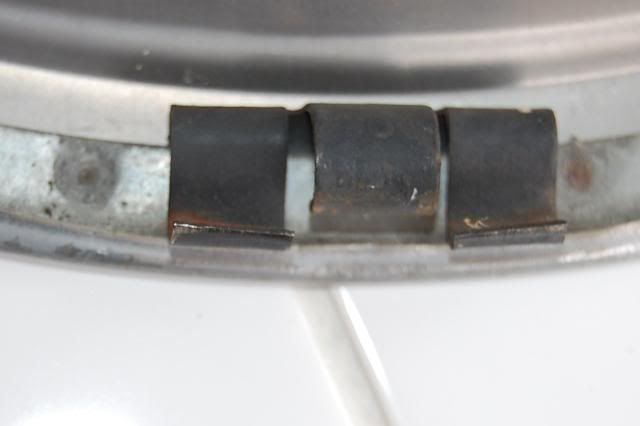
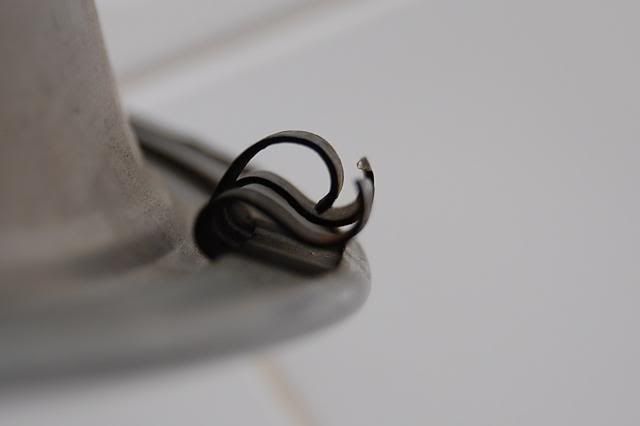
The production rings had 4 clips (one at the stem hole) spot welded to a flat ring. The ring was crimped into place around the outer edge of the trim ring. The crimp was continuous and smooth around the ring's circumference.
The rings available as service replacements even in 1971 were different than the rings used in production. The clips were turned 45 degrees.
Many rings now being sold as nos are in fact nos but are different from the production rings in that they've had the clips turned. It's very difficult to re crimp the perimeter to look like a trim ring that hasn't had the clip ring turned.
Regards,
Alan
Bluish chrome hue

Spot welded clip, flat ring (not L shaped in profile)
Smooth crimp
The rings used in production in 71 were stainless steel and flash chromed. The plating is referred to as 'flash' chrome because it consists of just the chrome plating not the copper and nickel that's under the chrome plating on parts like bumpers and is often referred to as triple chrome plating, (even though it's still just one layer of chrome.)
Polishing original rings to restore them quickly removes the chrome plating because by nature chrome plating is extremely thin.
Polished rings that haven't been re-chromed have a subtle, but very noticeable, yellowish hue to them.
The production rings had 4 clips (one at the stem hole) spot welded to a flat ring. The ring was crimped into place around the outer edge of the trim ring. The crimp was continuous and smooth around the ring's circumference.
The rings available as service replacements even in 1971 were different than the rings used in production. The clips were turned 45 degrees.
Many rings now being sold as nos are in fact nos but are different from the production rings in that they've had the clips turned. It's very difficult to re crimp the perimeter to look like a trim ring that hasn't had the clip ring turned.
Regards,
Alan
Bluish chrome hue

Spot welded clip, flat ring (not L shaped in profile)

Smooth crimp

Last edited by Alan 71; Dec 22, 2013 at 08:35 PM.
Thread Starter
Racer
Joined: Oct 2008
Posts: 475
Likes: 3
From: Windham NH
Hi 63,
The rings used in production in 71 were stainless steel and flash chromed. The plating is referred to as 'flash' chrome because it consists of just the chrome plating not the copper and nickel that's under the chrome plating on parts like bumpers and is often referred to as triple chrome plating, (even though it's still just one layer of chrome.)
Polishing original rings to restore them quickly removes the chrome plating because by nature chrome plating is extremely thin.
Polished rings that haven't been re-chromed have a subtle, but very noticeable, yellowish hue to them.
The production rings had 4 clips (one at the stem hole) spot welded to a flat ring. The ring was crimped into place around the outer edge of the trim ring. The crimp was continuous and smooth around the ring's circumference.
The rings available as service replacements even in 1971 were different than the rings used in production. The clips were turned 45 degrees.
Many rings now being sold as nos are in fact nos but are different from the production rings in that they've had the clips turned. It's very difficult to re crimp the perimeter to look like a trim ring that hasn't had the clip ring turned.
Regards,
Alan
Bluish chrome hue
Spot welded clip, flat ring (not L shaped in profile)
Smooth crimp
The rings used in production in 71 were stainless steel and flash chromed. The plating is referred to as 'flash' chrome because it consists of just the chrome plating not the copper and nickel that's under the chrome plating on parts like bumpers and is often referred to as triple chrome plating, (even though it's still just one layer of chrome.)
Polishing original rings to restore them quickly removes the chrome plating because by nature chrome plating is extremely thin.
Polished rings that haven't been re-chromed have a subtle, but very noticeable, yellowish hue to them.
The production rings had 4 clips (one at the stem hole) spot welded to a flat ring. The ring was crimped into place around the outer edge of the trim ring. The crimp was continuous and smooth around the ring's circumference.
The rings available as service replacements even in 1971 were different than the rings used in production. The clips were turned 45 degrees.
Many rings now being sold as nos are in fact nos but are different from the production rings in that they've had the clips turned. It's very difficult to re crimp the perimeter to look like a trim ring that hasn't had the clip ring turned.
Regards,
Alan
Bluish chrome hue
Spot welded clip, flat ring (not L shaped in profile)
Smooth crimp
That's great information as always Alan..
Team Owner
Joined: Sep 2006
Posts: 31,172
Likes: 4,250
From: Westminster Maryland
Hi 63,
I guess that's why production line rings in excellent condition have become so very expensive.
I'm afraid that some owners are paying pretty outrageous prices for trim rings that are mutations that are 'kinda' like production rings.
A person really needs to know just what to look for.... if that sort of thing matters.
It's really become a situation that's similar to the rocker panel trim for 70-72 cars.
Regards,
Alan
I guess that's why production line rings in excellent condition have become so very expensive.
I'm afraid that some owners are paying pretty outrageous prices for trim rings that are mutations that are 'kinda' like production rings.
A person really needs to know just what to look for.... if that sort of thing matters.
It's really become a situation that's similar to the rocker panel trim for 70-72 cars.
Regards,
Alan

Burning Brakes


Joined: Jan 2006
Posts: 1,072
Likes: 331
From: Clear Lake Shores Texas
2016 C3 of Year Finalist
Hi 63,
I guess that's why production line rings in excellent condition have become so very expensive.
I'm afraid that some owners are paying pretty outrageous prices for trim rings that are mutations that are 'kinda' like production rings.
A person really needs to know just what to look for.... if that sort of thing matters.
It's really become a situation that's similar to the rocker panel trim for 70-72 cars.
Regards,
Alan
I guess that's why production line rings in excellent condition have become so very expensive.
I'm afraid that some owners are paying pretty outrageous prices for trim rings that are mutations that are 'kinda' like production rings.
A person really needs to know just what to look for.... if that sort of thing matters.
It's really become a situation that's similar to the rocker panel trim for 70-72 cars.
Regards,
Alan
What is the best way to remove these original type trim rings to avoid damaging them?
Thanks
Thread Starter
Racer
Joined: Oct 2008
Posts: 475
Likes: 3
From: Windham NH
Corvette Stories
The Best of Corvette for Corvette Enthusiasts

8 Coolest Corvette Pace Cars (and Replicas) of All Time
Verdad Gallardo
Top 10 Corvette Engines RANKED by Peak Torque (70+ Years of Muscle!)
Joe Kucinski
Corvette ZR1X Will Be Pacing the Indy 500, And Could Probably Race, Too!
Verdad Gallardo
Top 10 Corvettes Coming to Mecum Indy 2026!
Brett Foote
Top 10 C9 Corvette MUST-HAVES to Fix These C8 Generation Flaws!
Michael S. Palmer
10 Revolutionary 'Corvette Firsts' Most People Don't Know
Joe Kucinski
5 Reasons to Upgrade to an LS6-Powered Corvette; 5 Reasons to Stay LT2
Michael S. Palmer
2027 Corvette vs The World: Every C8 vs Its Closest Competitor
Joe Kucinski