



Rotor removal?

Thread Starter
Melting Slicks

Joined: Jun 2011
Posts: 2,096
Likes: 15
 Rotor removal?
Well I'm replacing the calipers on my 82 and the driver's rear was already drilled out but the right rear is not. I have drilled out the rivets but still can not remove the rotor. There are two larger holes for the "E" brake adjustment that is still closed up, do those have to be drilled out too? On the other 5 holes I used up to a 23/64 drill bit which I think is large enough. If I go bigger I'll be drilling into the rotor. So what is the secret?
Also the reason I'm removing the rotor is to check the "E" brake pads, on the drivers it's about a 1/8" thick. Is that about right? I know they don't put much pad on there but have never seen one before to compare to.
Thanks
Also the reason I'm removing the rotor is to check the "E" brake pads, on the drivers it's about a 1/8" thick. Is that about right? I know they don't put much pad on there but have never seen one before to compare to.
Thanks

Melting Slicks

Joined: May 2012
Posts: 2,192
Likes: 344
From: Allenton Wisconsin
normally when removing the rivots you drill off the peened over end down to the rotor, take a punch and drive out the rivot. rotor due to age is most likely stuck, whack it with a hammer, adding penetrating oils as you go.T
Thread Starter
Melting Slicks
Joined: Jun 2011
Posts: 2,096
Likes: 15

Melting Slicks


Joined: Mar 2009
Posts: 3,126
Likes: 15
The e-brake holes should not be sealed up. I only had to drill the five rivets between the studs. One rotor was stuck to the hub and was difficult to remove. The inner hole of the rotor sticks to the outer diameter of the hub. Can you get us a picture? mike...
Last edited by mds3013; Apr 5, 2014 at 12:59 PM.

Le Mans Master


Joined: Apr 1999
Posts: 6,134
Likes: 46
From: Raleigh North Carolina
No. The larger e-brake hole has nothing to do with rotor removal. And as noted... you should be able to see through the rotor and the spindle to the inside of the assembly. This is how the e-brake is adjusted... through the large hole. It doesn't make sense that you cannot see through it. Possibly, somebody already replaced the rotor and installed new rivets, and didn't line up the e-brake hole properly. At one point, somebody was manufacturing spindles without the brake adjusting hole. This is also a possibility.

Racer


Joined: Oct 2013
Posts: 362
Likes: 11
From: MARSHALLVILLE OHIO
Corvette Stories
The Best of Corvette for Corvette Enthusiasts

Every 2027 Corvette Engine Explained
Joe Kucinski
Designer Imagines A Corvette That Looks More Like a Corvette Than the Corvette
Verdad Gallardo
10 Ugly Corvettes That We Still Kinda Love
Joe Kucinski
Top 10 Most Expensive Corvettes Ever Sold on Bring A Trailer
Brett Foote
10 Things Every Corvette Owner Needs (2026 Edition)
Michael S. Palmer
8 Most "Only Corvette Owners Understand" Quirks and Problems
Pouria Savadkouei
10 Reasons the C6 Z06 is Still A Performance Benchmark After 20 Years
Joe Kucinski
How Much Horsepower Every Corvette Engine "LOST" in 1972
Joe Kucinski
Top 10 DOs and DON'Ts for Protecting Your Convertible Top!
Michael S. Palmer
2026 Loser of the Year


Joined: Sep 2013
Posts: 36,607
Likes: 7,053
From: New Or-leens Loo-z-anna
And use a "dead-blow" hammer.......or place a block of wood against the back side of the rotor to hit-on when hitting with a hammer to keep from damaging the rotor......rotate the rotor 1/4 turn at a time as you hit the backside of it.
Sometimes it can take a while to get a stuck rotor aloose.
Sometimes it can take a while to get a stuck rotor aloose.
Thread Starter
Melting Slicks
Joined: Jun 2011
Posts: 2,096
Likes: 15
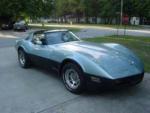
Well here is the hub and still can't get it off, I've tried heat and the beating but nothing. See how the larger holes are covered.http://s929.photobucket.com/user/alc...g.html?filters[user]=99198616&filters[recent]=1&sort=1&o=1


Last edited by alconk; Apr 5, 2014 at 05:50 PM. Reason: No picture

Melting Slicks
Joined: Mar 2009
Posts: 3,126
Likes: 15
Looks like Tom454 has it correct. The large holes are not holding the rotor on. As far as I can see the rotor should be free to come off. I have been wrong a couple of times. E-brake shoes look good on that side. Good luck with it. mike...
Burning Brakes

Joined: Mar 2010
Posts: 943
Likes: 15
From: Valdosta Georgia
I had to get mine off after a bearing failure a couple of years ago. I used a lot of penetrating oil and the block of wood to beat on trick. Took some time but I got them off (they were both stuck).
Thread Starter
Melting Slicks
Joined: Jun 2011
Posts: 2,096
Likes: 15
Ok finally was able to remove it. For some reason the rotor was offset from the e-brake holes. Now any input of the condition of the pads? Passenger side looks the same as the driver's, about a 1/8" thickness. The e-brake grips going in reverse but only a slight drag forwards, maybe just needs adjusting?? I was also going to lube the backside of the rotors with anti-seize so this doesn't happen again.
Melting Slicks
Joined: Mar 2009
Posts: 3,126
Likes: 15
It is really only a parking brake. Most C3 engines can overcome the E/P-brake during a full on engine test like they do during an inspection. Shoes look good to me and are close to mine. Happy see you got her off. Clean off as much rust as possible on the inner rotor hole, outer spindle and lug studs. Press On! mike...
Last edited by mds3013; Apr 5, 2014 at 06:47 PM.

Le Mans Master
Joined: Apr 1999
Posts: 6,134
Likes: 46
From: Raleigh North Carolina
When I lived in NJ (1980-1996) the State Inspection included a test of the parking brake. They would apply the brake and then either put the car in drive or let the clutch out. If the brake did not hold, they would fail the car. It was impossible for me to use the factory adjustment procedure to adjust the parking brake so that the car would pass the NJ test. It always held great in reverse, but failed in forward. I had to over-adjust (tight), drive to the nearest inspection station, pass the test, and then loosen up the drag on the shoes when I got back home. The rotors would get super hot but there was no other way to pass the inspection. Both of my Corvette's behaved the same way plus a neighbors 76. I've never been able to get a C2/C3 parking brake to hold when the trans was put in drive (let out the clutch) and the technician stepped on the gas. Especially with the 454. The aftermarket pads with stainless shoes are less "sticky" than OM GM pads... they do not hold as well and tend to glaze. But the GM shoe pads wear faster.