



Average Bird Cage Condition

Thread Starter
Cruising

Joined: Jul 2014
Posts: 13
Likes: 0
 Average Bird Cage Condition
In your experience, what has been the average bird cage condition of the cars 68-72'ish that you've looked at?
I'm not talking about the cars that are known to have sat outside in the rain. I mean the ones that have at least been garaged, not necessarily restored at any time.
I'm trying to determine if this is an area that always seems to require repair after this many years or if there are plenty that are still good to go out there.
After reading the "Top Ten" list of things to look out for I have a handle on what to walk away from, but what about the gray area? What would be the lowest level of condition that you'd purchase but not have to dig in and repair? Is there such a thing?
Thanks in advance for your wisdom!
I'm not talking about the cars that are known to have sat outside in the rain. I mean the ones that have at least been garaged, not necessarily restored at any time.
I'm trying to determine if this is an area that always seems to require repair after this many years or if there are plenty that are still good to go out there.
After reading the "Top Ten" list of things to look out for I have a handle on what to walk away from, but what about the gray area? What would be the lowest level of condition that you'd purchase but not have to dig in and repair? Is there such a thing?
Thanks in advance for your wisdom!
Last edited by Scott from Akron; Jul 15, 2014 at 08:00 AM.

Team Owner


Joined: Sep 2006
Posts: 31,316
Likes: 4,421
From: Westminster Maryland
Hi SfA,
I don't think there's an 'average'. Each car is what it is for various reasons…. good and bad.
There are certainly many rusty cars and we hear about and see the examples of really rusted cars that people find or end up with all the time. But I believe there there are still lots of 68-72 cars with little or no rust.
Some people are willing (and have the skill and determination) to deal with a rusty car. While other people continue the search for a rust free car.
I think you need to do your homework well so you don't end up with a rusty car after thinking you were buying an un-rusty car.
Determining if a car is rust free; was rusty and has been repaired; or is rusty; or is rusty and attempts have been made to conceal that fact; takes time and knowledge.
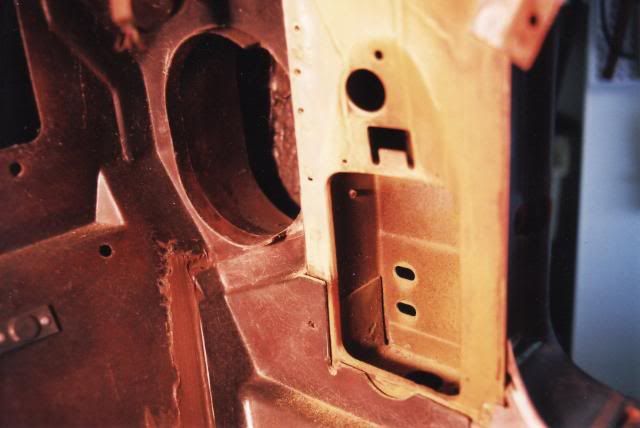
A car that shows some rust when it's completely together, or just the kick-panels have been removed, will most often have more concealed rust that can't be seen until the car is disassembled.
Regards,
Alan
I don't think there's an 'average'. Each car is what it is for various reasons…. good and bad.
There are certainly many rusty cars and we hear about and see the examples of really rusted cars that people find or end up with all the time. But I believe there there are still lots of 68-72 cars with little or no rust.
Some people are willing (and have the skill and determination) to deal with a rusty car. While other people continue the search for a rust free car.
I think you need to do your homework well so you don't end up with a rusty car after thinking you were buying an un-rusty car.
Determining if a car is rust free; was rusty and has been repaired; or is rusty; or is rusty and attempts have been made to conceal that fact; takes time and knowledge.
A car that shows some rust when it's completely together, or just the kick-panels have been removed, will most often have more concealed rust that can't be seen until the car is disassembled.
Regards,
Alan
Last edited by Alan 71; Jul 15, 2014 at 08:16 AM.
Thread Starter
Cruising
Joined: Jul 2014
Posts: 13
Likes: 0
[QUOTE=Alan 71;1587363257]Hi SfA,
I don't think there's an 'average'. Each car is what it is for various reasons…. good and bad.
There are certainly many rusty cars and we hear about and see the examples of really rusted cars that people find or end up with all the time. But I believe there there are still lots of 68-72 cars with little or no rust.
Some people are willing (and have the skill and determination) to deal with a rusty car. While other people continue the search for a rust free car.
I think you need to do your homework well so you don't end up with a rusty car after thinking you were buying an un-rusty car.
Determining if a car is rust free; was rusty and has been repaired; or is rusty; or is rusty and attempts have been made to conceal that fact; takes time and knowledge.
Regards,
Alan
QUOTE]
Thanks Alan. I agree with the homework and am not planning on purchasing for 2-3 years at least. I have 12 week old twins at home so I have time to study up on the subject when they are napping.
I don't think there's an 'average'. Each car is what it is for various reasons…. good and bad.
There are certainly many rusty cars and we hear about and see the examples of really rusted cars that people find or end up with all the time. But I believe there there are still lots of 68-72 cars with little or no rust.
Some people are willing (and have the skill and determination) to deal with a rusty car. While other people continue the search for a rust free car.
I think you need to do your homework well so you don't end up with a rusty car after thinking you were buying an un-rusty car.
Determining if a car is rust free; was rusty and has been repaired; or is rusty; or is rusty and attempts have been made to conceal that fact; takes time and knowledge.
Regards,
Alan
QUOTE]
Thanks Alan. I agree with the homework and am not planning on purchasing for 2-3 years at least. I have 12 week old twins at home so I have time to study up on the subject when they are napping.

Melting Slicks


Joined: Apr 2007
Posts: 3,189
Likes: 111
From: Tolland CT
I'll add the windshield header as another reasonably easy area to inspect. The visors and trim will need to be removed to see this area. If you find anything but surface rust here it may be an indication the windshield frame has been compromised. Repairs to this area can get expensive if rust has penetrated the lower portions of the windshield frame making removal of the front clip and firewall necessary to do a proper repair.

Burning Brakes


Joined: Dec 2003
Posts: 1,151
Likes: 154
For what it's worth I would focus my search on cars that have spent most of their lives in dry climates. Ask how long the owner has owned the car and where the previous owner was from. Shipping from one state to another is cheaper than repairing a rusty one.

Team Owner
Joined: Jul 1999
Posts: 65,492
Likes: 230
From: Orange Park Florida
I got lucky in that my car was an old show car, painted burgundy and all the w/s cage area was painted nicely and the w/s reinstalled/replaced....now I notices some problems still, since it's a convertible, I pulled off all the trim, and wrapped the header stainless with black vinyl, allowing the rag top to seal much better, upon replacing all the stainless trim, I first totally packed the gaps with black RTV, and had it oozing out from under the trim as I placed it back.....then took a nice neat bead all around to fill up any body gaps, no more water inside.....
the frame was/is fine.....

the frame was/is fine.....

Melting Slicks
Joined: Jun 2006
Posts: 2,071
Likes: 147
From: S Nevada
My 72 sat outside neglected for many years, but no frame or cage rot! How can that be? It lived its life in the desert. It had a little rust in the windshield frame corners but nothing worth fixing. Bead blasted the rust out and epoxy painted. Find a desert car.

Burning Brakes

Joined: Jan 2012
Posts: 1,106
Likes: 168
2018 C2 of Year Finalist
When looking at a potential car for sale I would look first at the windshield posts. You can look at the bottom area where it meets the dash without removing the trim. If it looks like the area is bubbled or showing signs of rust chances are good that the rest of it is in poor condition. Check the car's frame for rust also. Many sellers are not going to be willing to let someone come over and start removing all the trim etc. so it is important to know what to look for and where.
Corvette Stories
The Best of Corvette for Corvette Enthusiasts

5 Best & 5 Worst Corvette Daily Drivers
Joe Kucinski
The Headlights of Every Corvette Generation Explained
Joe Kucinski
5 Best & 5 Most Overrated Corvette Track Packages of All Time!
Joe Kucinski
Every 2027 Corvette Engine Explained
Joe Kucinski
Designer Imagines A Corvette That Looks More Like a Corvette Than the Corvette
Verdad Gallardo
10 Ugly Corvettes That We Still Kinda Love
Joe Kucinski
Top 10 Most Expensive Corvettes Ever Sold on Bring A Trailer
Brett Foote
10 Things Every Corvette Owner Needs (2026 Edition)
Michael S. Palmer
8 Most "Only Corvette Owners Understand" Quirks and Problems
Pouria Savadkouei
Drifting

Joined: Mar 2014
Posts: 1,744
Likes: 278
From: Akron OH
I agree with the some of the other posts in this thread ==> go West young man. Before I bought my '71, I looked at cars that lived their lives in the Midwest and North Carolina. I found the mid-west to have a lot of birdcage, radiator support and frame rust. The North Carolina cars were somewhat less rusty than the Midwest cars, but some still had some bad birdcage and radiator support rust. My '71 lived most of it's life in the Los Angeles area and has remarkably little frame, radiator support and birdcage rust. Good luck with your search and don't settle for a rusty one. You'll be happier in the long run.

Administrator


Joined: Jul 2000
Posts: 54,007
Likes: 6,215
From: About 1100 miles from where I call home.
I've had a number of these cars and I'm going to say the majority of them have had some sort of rot in the upper windshield and corner, to the point I find it normal. Maybe it's the locales I've lived in. I just don't find that to be the deal breaker some do.
I'm much more interested in the side rails and kickup areas on the frame. That sort of rust damage is far more telling to me than upper windshield holes that can be repaired. Obviously, that's not the lower cage damage that requires a nose removal to fix.
I'm much more interested in the side rails and kickup areas on the frame. That sort of rust damage is far more telling to me than upper windshield holes that can be repaired. Obviously, that's not the lower cage damage that requires a nose removal to fix.
Thread Starter
Cruising
Joined: Jul 2014
Posts: 13
Likes: 0
I agree with the some of the other posts in this thread ==> go West young man. Before I bought my '71, I looked at cars that lived their lives in the Midwest and North Carolina. I found the mid-west to have a lot of birdcage, radiator support and frame rust. The North Carolina cars were somewhat less rusty than the Midwest cars, but some still had some bad birdcage and radiator support rust. My '71 lived most of it's life in the Los Angeles area and has remarkably little frame, radiator support and birdcage rust. Good luck with your search and don't settle for a rusty one. You'll be happier in the long run.

Racer
Joined: Sep 2013
Posts: 284
Likes: 16
From: St Louis MO http://1972corvetterestomod.blogspot.com/

Melting Slicks
Joined: Sep 2011
Posts: 3,372
Likes: 215
From: Peoria Arizona
The interiors and rubber parts on the other hand, are a different story after time in the desert

Adam
Racer
Joined: Sep 2013
Posts: 284
Likes: 16
From: St Louis MO http://1972corvetterestomod.blogspot.com/
Drifting
Joined: Mar 2014
Posts: 1,744
Likes: 278
From: Akron OH
I did not buy my car from a California owner. My ’71 Corvette was purchased by a gentleman in Michigan in the 90’s who had it transported from California to Michigan via truck. When bought the car in April 2014, I considered hiring a truck to bring it home. Instead I opted to spend that same money to have a local mechanic in Michigan check it over and make repairs that would allow me to safely and reliably make the 250 mile drive from the Lansing area to my home in Akron. The mechanic had the car for a week and fixed the inoperable turn signals, installed a new wiper motor and replaced some power steering components that were causing excess play in the steering. I did not price the transportation cost to bring the car from Michigan to Ohio, but I did get an estimate of $900 to transport a C3 Corvette from Raleigh, NC to Akron on an open air trailer. As a side note, after a couple of conversations with the owner of this particular Corvette in Raleigh, I was convinced that it was “the one”. After seeing it in person, I walked away after discovering the car had 50K more miles than advertised as well as significant birdcage, frame and radiator support rust. This is another lesson that others on this Forum preach – never buy a C3 without first inspecting it in person! Pictures can hide a lot of warts and owners can misrepresent the condition of the car.

Racer
Joined: Mar 2009
Posts: 276
Likes: 31
From: Brant County Ontario
I'll add the windshield header as another reasonably easy area to inspect. The visors and trim will need to be removed to see this area. If you find anything but surface rust here it may be an indication the windshield frame has been compromised. Repairs to this area can get expensive if rust has penetrated the lower portions of the windshield frame making removal of the front clip and firewall necessary to do a proper repair.
