





Bead Blaster Recommendation
Thread Starter
Melting Slicks


Joined: May 2006
Posts: 3,438
Likes: 41
From: Raleigh NC
St. Jude Donor '13-'14
 Bead Blaster Recommendation
Hi All,
There are many old threads on this subject, but I was hoping the forum can help tailor my selection for my needs.
I'm looking to purchase a bead blaster for my shop. My new shop is much smaller than my previous shop, so space is a major issue. My current compressor is a 20-gallon, 1.5 HP rated for 4 SCFM @ 90 psi. The largest I could upgrade to is the 33-gallon Husky 1.7 HP rated for 5.1 SCFM @ 90 psi.
My usage will be for small parts (bolt, brackets, etc.). The largest part I would need to consider is an intake manifold.
I'm looking for a good quality unit with this minimum size needed. Thanks for the help.
There are many old threads on this subject, but I was hoping the forum can help tailor my selection for my needs.
I'm looking to purchase a bead blaster for my shop. My new shop is much smaller than my previous shop, so space is a major issue. My current compressor is a 20-gallon, 1.5 HP rated for 4 SCFM @ 90 psi. The largest I could upgrade to is the 33-gallon Husky 1.7 HP rated for 5.1 SCFM @ 90 psi.
My usage will be for small parts (bolt, brackets, etc.). The largest part I would need to consider is an intake manifold.
I'm looking for a good quality unit with this minimum size needed. Thanks for the help.
Thread Starter
Melting Slicks
Joined: May 2006
Posts: 3,438
Likes: 41
From: Raleigh NC
St. Jude Donor '13-'14
I am assuming those requirements are for continuous operation without any interruption. My hope is that doing mostly small parts that operating in bursts will be suffice and will still be able to complete them in a short amount of time. The 33-gallon compressor would give me a bit more time at 5.1 SCFM, and I can always turn the pressure down to the minimum necessary to clean the part and gain more time between compressor recharging.
Thread Starter
Melting Slicks
Joined: May 2006
Posts: 3,438
Likes: 41
From: Raleigh NC
St. Jude Donor '13-'14
Melting Slicks

Joined: Feb 2007
Posts: 2,136
Likes: 62
From: West Kingston RI
Problem you will run into is if your compressor runs to often you are going to get more condensation than your water separator can remove and you will probably keep packing your gun tip up. You may want to see if you can rent one and try it or call the manufacturer and ask their tech department before investing in one, just a thought
Thread Starter
Melting Slicks
Joined: May 2006
Posts: 3,438
Likes: 41
From: Raleigh NC
St. Jude Donor '13-'14
Problem you will run into is if your compressor runs to often you are going to get more condensation than your water separator can remove and you will probably keep packing your gun tip up. You may want to see if you can rent one and try it or call the manufacturer and ask their tech department before investing in one, just a thought
I would like to hear of a good bead blaster, and of anyone's experience operating it with a 33-gallon, or less, compressor.
Corvette Stories
The Best of Corvette for Corvette Enthusiasts

10 Most Common Corvette Problems of the Last 20 Years!
Joe Kucinski
5 MOST and 5 LEAST Popular Corvette Model Years in History!
Joe Kucinski
2027 Corvette Buyer's Guide: Everything You Need to Know!
Joe Kucinski
10 Things C8 Corvette Owners Hate (But Won't Tell You)
Joe Kucinski
10 Best Corvettes Coming to Barrett-Jackson Palm Beach 2026!
Brett Foote
Every Corvette Grand Sport Explained! (C2, C4, C6, C7, & C8)
Joe Kucinski
Grand Sport & Grand Sport X Launch Alongside All-New 535hp LS6 V8!
Michael S. Palmer
5 Reasons Bad Drivers Crash & 5 Ways to Avoid a Costly Mistake!
Joe Kucinski
7 Bolt-On Upgrades From Extreme Online Store to Level Up Your C6 Corvette
Pouria Savadkouei
Le Mans Master


Joined: Dec 2003
Posts: 5,380
Likes: 415
From: N J
I bought a Harbor freight blast cabinet 7 or 8 years ago. I would say its their medium size cabinet. Nothing special about it, but the price was right and it works fantastic for my Corvette hobby. If I had to get another one though, I would get the next size up to fit a wheel inside.
At that time I had a 20 gal compressor, but even the smallest parts took forever with it. Since then I replaced it with a 60. Obviously much better, but even the 60 gets a work out. 33 is better than nothing, just going to have to make the best of it.
At that time I had a 20 gal compressor, but even the smallest parts took forever with it. Since then I replaced it with a 60. Obviously much better, but even the 60 gets a work out. 33 is better than nothing, just going to have to make the best of it.
Thread Starter
Melting Slicks
Joined: May 2006
Posts: 3,438
Likes: 41
From: Raleigh NC
St. Jude Donor '13-'14
I bought a Harbor freight blast cabinet 7 or 8 years ago. I would say its their medium size cabinet. Nothing special about it, but the price was right and it works fantastic for my Corvette hobby. If I had to get another one though, I would get the next size up to fit a wheel inside.
At that time I had a 20 gal compressor, but even the smallest parts took forever with it. Since then I replaced it with a 60. Obviously much better, but even the 60 gets a work out. 33 is better than nothing, just going to have to make the best of it.
At that time I had a 20 gal compressor, but even the smallest parts took forever with it. Since then I replaced it with a 60. Obviously much better, but even the 60 gets a work out. 33 is better than nothing, just going to have to make the best of it.
If it is the 40-lb model, do you know the air capacity requirements on it?
I'm also considering the barrel blaster (http://www.barrelblaster.com/BarrelBlaster1.htm), it is just a little bit smaller than the 40-lb HF model.
Le Mans Master
Joined: Dec 2003
Posts: 5,380
Likes: 415
From: N J
This is the one I have, it's worked well for the $$$
Sorry I don't know any air requirements.
http://www.harborfreight.com/abrasiv...net-42202.html
Sorry I don't know any air requirements.
http://www.harborfreight.com/abrasiv...net-42202.html
Melting Slicks
Joined: Feb 2007
Posts: 2,136
Likes: 62
From: West Kingston RI
This is the one I have, it's worked well for the $$$
Sorry I don't know any air requirements.
http://www.harborfreight.com/abrasiv...net-42202.html
Sorry I don't know any air requirements.
http://www.harborfreight.com/abrasiv...net-42202.html

Safety Car

Joined: Sep 2007
Posts: 4,443
Likes: 326
From: Indy Indiana
a small capacity tank and compressor will be a nightmare.. you will blast for 1 minute and then wait 3 minutes for it to catch up before you can start again. if size is an absolute requirement, then that is what you will have to live with.
i have a 60 gallon 240 volt and it runs continuously when I blast at 90#s. if you blast a lot, you will not be happy with anything less.
i have a 60 gallon 240 volt and it runs continuously when I blast at 90#s. if you blast a lot, you will not be happy with anything less.

Burning Brakes


Joined: Aug 2004
Posts: 802
Likes: 1
I agree with the others, a 20 gal compressor will make you wait after about a minute for it to catch up. This is probably OK for small parts that have a minor amount of rust. Wire wheeling first in areas you can get to helps out.
The small cabinets ( approx 2 feet on each side) have some problems.The windows will frost up after a while since the abrasive will bang around and hit the window even if you try and shot away from the window. If the window opens up as a door, you can replace the inside with the peel and stick coverings. But this gets tedious. I have one of these smaller units. I went to Micheals crafts and bought a roll of flower film, cut it to width then roll it under the window and up, over the window. When the iniside frosts up, I just roll out a fresh spot and rip off the old. Takes a minute.
For long parts, I cut a hole in the side and placed a plastic sawdust ducting gate of about 4 inches in diameter, I can get in longer items like tie rods in, do one side, then swap out to do the other side.
Also lighting is important. The harbour freight units have poor lighting that is next to useless. The lights also frost up. I installed two LED lights in the lower and upper right corners( since I am right handed) These are the spot lights worth around $30. This makes a huge difference. The bulbs are wrapped in the same flower film.
Small cabinets and small compressor can work but the trade off is your time. The other thing is that a lot of guys on this forum restore many cars so they will invest in bigger and better equipment. But for the casual restorer, (one car per 5 or 10 yrs. or maybe just one car), the expense and space may not be worth the more elaborate equipment.
As a hobby today, you may lose interest tomorrow. Then what are you gonna do with this stuff (compressors, cabinets, welders, spray guns etc. ) I'm a casual hobbiest, and have all this stuff in a small space as well. But I like having this stuff other than just for cars since I'm a DYIer for all kinds of other things. So I will go out and get things like powder coat equipment for harbour freight if nothing then just to play with it(never intended to powder coat anything on the 73)
If you have only a small space for a cabinet, go for it. A small cabinet and a small compressor is better than nothing.
Steve L
73 coupe since new
The small cabinets ( approx 2 feet on each side) have some problems.The windows will frost up after a while since the abrasive will bang around and hit the window even if you try and shot away from the window. If the window opens up as a door, you can replace the inside with the peel and stick coverings. But this gets tedious. I have one of these smaller units. I went to Micheals crafts and bought a roll of flower film, cut it to width then roll it under the window and up, over the window. When the iniside frosts up, I just roll out a fresh spot and rip off the old. Takes a minute.
For long parts, I cut a hole in the side and placed a plastic sawdust ducting gate of about 4 inches in diameter, I can get in longer items like tie rods in, do one side, then swap out to do the other side.
Also lighting is important. The harbour freight units have poor lighting that is next to useless. The lights also frost up. I installed two LED lights in the lower and upper right corners( since I am right handed) These are the spot lights worth around $30. This makes a huge difference. The bulbs are wrapped in the same flower film.
Small cabinets and small compressor can work but the trade off is your time. The other thing is that a lot of guys on this forum restore many cars so they will invest in bigger and better equipment. But for the casual restorer, (one car per 5 or 10 yrs. or maybe just one car), the expense and space may not be worth the more elaborate equipment.
As a hobby today, you may lose interest tomorrow. Then what are you gonna do with this stuff (compressors, cabinets, welders, spray guns etc. ) I'm a casual hobbiest, and have all this stuff in a small space as well. But I like having this stuff other than just for cars since I'm a DYIer for all kinds of other things. So I will go out and get things like powder coat equipment for harbour freight if nothing then just to play with it(never intended to powder coat anything on the 73)
If you have only a small space for a cabinet, go for it. A small cabinet and a small compressor is better than nothing.
Steve L
73 coupe since new
Thread Starter
Melting Slicks
Joined: May 2006
Posts: 3,438
Likes: 41
From: Raleigh NC
St. Jude Donor '13-'14
Thanks again.
Le Mans Master


Joined: May 2003
Posts: 8,870
Likes: 3,544
From: Fernandina Beach FL
2023 Restomod of the Year finalist
2020 C3 of the Year Winner - Modified
Here's a thought-
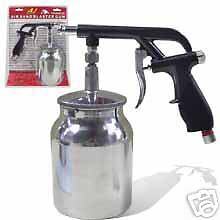
Rather than use the air hungry gun that pulls the media from the bottom of the cabinet- try one that uses a cup to store the media. On these types air consumption is a lot lower- like 5.7CFM.
I have a big compressor- and the standard cabinet gun-but when I'm doing small parts I run this type plus compressor doesn't constantly run.
I got mine at Harbor Freight- I don't think it was more than $20.
Looks something like this-
Rather than use the air hungry gun that pulls the media from the bottom of the cabinet- try one that uses a cup to store the media. On these types air consumption is a lot lower- like 5.7CFM.
I have a big compressor- and the standard cabinet gun-but when I'm doing small parts I run this type plus compressor doesn't constantly run.
I got mine at Harbor Freight- I don't think it was more than $20.
Looks something like this-
Burning Brakes
Joined: Aug 2004
Posts: 802
Likes: 1
Here's a thought-
Rather than use the air hungry gun that pulls the media from the bottom of the cabinet- try one that uses a cup to store the media. On these types air consumption is a lot lower- like 5.7CFM.
I have a big compressor- and the standard cabinet gun-but when I'm doing small parts I run this type plus compressor doesn't constantly run.
I got mine at Harbor Freight- I don't think it was more than $20.
Looks something like this-
Rather than use the air hungry gun that pulls the media from the bottom of the cabinet- try one that uses a cup to store the media. On these types air consumption is a lot lower- like 5.7CFM.
I have a big compressor- and the standard cabinet gun-but when I'm doing small parts I run this type plus compressor doesn't constantly run.
I got mine at Harbor Freight- I don't think it was more than $20.
Looks something like this-
steve l
73 coupe since new

Old Fart Pilot


Joined: Apr 2010
Posts: 1,835
Likes: 917
From: Spokane, WA
a small capacity tank and compressor will be a nightmare.. you will blast for 1 minute and then wait 3 minutes for it to catch up before you can start again. if size is an absolute requirement, then that is what you will have to live with.
i have a 60 gallon 240 volt and it runs continuously when I blast at 90#s. if you blast a lot, you will not be happy with anything less.
i have a 60 gallon 240 volt and it runs continuously when I blast at 90#s. if you blast a lot, you will not be happy with anything less.
Thanks,
Paul
Burning Brakes
Joined: Aug 2004
Posts: 802
Likes: 1
This will be my first and most likely last resto so I don't need to go overboard. I already have a 21 gal compressor and was wondering if its possible to connect a second one up to it (using some sort of a Y or T fitting) to provide more volume when media blasting?
Thanks,
Paul
Thanks,
Paul
Hooking up two compressors complete with separate motors, I think would be more complicated. It would be near impossible to synch up both motors. I would think that one of the motors would run but the second motor would kick in late. I think you would need to rewire both motors to run off of one pressure switch. The switch would need to be rated to run both motors. Each motor would probably need it's own 15amp circuit breaker. All this is probably do-able but would be a pain to set up.
Someone else might have some better ideas.
steve L
73 coupe since new
Le Mans Master
Joined: May 2003
Posts: 8,870
Likes: 3,544
From: Fernandina Beach FL
2023 Restomod of the Year finalist
2020 C3 of the Year Winner - Modified
Small parts = few sq inches

This will be my first and most likely last resto so I don't need to go overboard. I already have a 21 gal compressor and was wondering if its possible to connect a second one up to it (using some sort of a Y or T fitting) to provide more volume when media blasting?
Thanks,
Paul
Thanks,
Paul
Both compressor outputs can be T-ed into one line. Probably want to put a check valve (less than $20) in the output of each air compressor before they tee together- to stop air from flowing from the running compressor into the stopped one, and out the unloader valve.
Richard