





 mike...

Engine Pad Stamps

Thread Starter
Team Owner


Joined: Sep 2006
Posts: 31,278
Likes: 4,372
From: Westminster Maryland
 Engine Pad Stamps
Hi,
John Hinkley, (John Z), posted some interesting info on the DB.
"Flint and Tonawanda BOTH produced about 5500 engines per day…300 engines per hour".
Even if 99% of the engines leaving those plants each day had 'perfect' assembly code stamps, 55 didn't.
If you multiply that times the number of days per year the plants worked it's no wonder we see many odd stamps.
Regards,
Alan
John Hinkley, (John Z), posted some interesting info on the DB.
"Flint and Tonawanda BOTH produced about 5500 engines per day…300 engines per hour".
Even if 99% of the engines leaving those plants each day had 'perfect' assembly code stamps, 55 didn't.
If you multiply that times the number of days per year the plants worked it's no wonder we see many odd stamps.
Regards,
Alan
Thread Starter
Team Owner
Joined: Sep 2006
Posts: 31,278
Likes: 4,372
From: Westminster Maryland
Hi mds,
I hope this isn't a trick question because I'm not good at this.
V….Flint
06….June
21….21st
CLF… 1977, 350 ci, automatic, L-82, California, Corvette
How does that sound?
I like the surface on the pad.
Regards,
Alan
I hope this isn't a trick question because I'm not good at this.
V….Flint
06….June
21….21st
CLF… 1977, 350 ci, automatic, L-82, California, Corvette
How does that sound?
I like the surface on the pad.
Regards,
Alan
Last edited by Alan 71; Mar 15, 2015 at 02:01 PM.

Race Director


Joined: Oct 2000
Posts: 12,682
Likes: 3,135
From: Shamong, NJ
You have a 77 automatic, L-82 with California emission equipment.
"V" is the engine assembly plant, at Flint Michigan. "0621" is the date the engine was assembled, June 21, 1977. "CLF" is the engine suffix code, or identifier, which indicates a 77 L-82 attached to an automatic trans, and equipped with California emission equipment.
To take it further, your VIN derivative breaks down as follows.
"1" is Chevrolet Motor Division. "7" is the 1977 model year. "S" is the St. Louis assembly plant. "4" is just a GM control number and 41449 indicates that you have the 41,449th 77 Corvette built. The birthday calculator shows 41449 to have been built on aproximately July 2, 1977.

Race Director
Joined: Oct 2000
Posts: 12,682
Likes: 3,135
From: Shamong, NJ

Corvette Stories
The Best of Corvette for Corvette Enthusiasts

Top 10 Most Expensive Corvettes Ever Sold on Bring A Trailer
Brett Foote
10 Things Every Corvette Owner Needs (2026 Edition)
Michael S. Palmer
8 Most "Only Corvette Owners Understand" Quirks and Problems
Pouria Savadkouei
10 Reasons the C6 Z06 is Still A Performance Benchmark After 20 Years
Joe Kucinski
How Much Horsepower Every Corvette Engine "LOST" in 1972
Joe Kucinski
Top 10 DOs and DON'Ts for Protecting Your Convertible Top!
Michael S. Palmer
Top 10 Most Explosive Corvettes Ever Made: Power-to-Weight Ratio Ranked!
Joe Kucinski
150 hp to 1,250 hp: Every Corvette Generation Compared by the Specs That Matter
Joe Kucinski
8 Coolest Corvette Pace Cars (and Replicas) of All Time
Verdad Gallardo
Thread Starter
Team Owner
Joined: Sep 2006
Posts: 31,278
Likes: 4,372
From: Westminster Maryland
Hi,
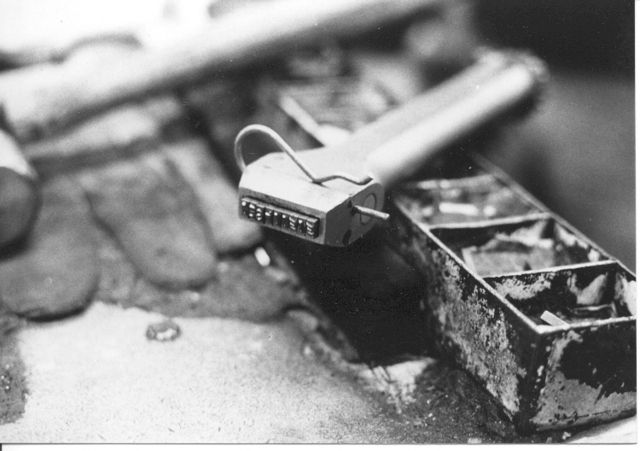
Here's another picture from John's collection!!
The infamous 'gang' holder and the box with the stamps in it.
I believe this is from the mid-years but I'm thinking the holder didn't change much for our cars.
I think our cars required 1 more digit starting in 70-71?
Notice the glove and hammer in the picture too.
Regards,
Alan
Here's another picture from John's collection!!
The infamous 'gang' holder and the box with the stamps in it.
I believe this is from the mid-years but I'm thinking the holder didn't change much for our cars.
I think our cars required 1 more digit starting in 70-71?
Notice the glove and hammer in the picture too.
Regards,
Alan
Last edited by Alan 71; Mar 15, 2015 at 02:22 PM.



Race Director
Joined: Jun 2005
Posts: 10,189
Likes: 206
2018 Corvette of Year Finalist
2017 C3 of Year
Interesting yes!
However, if you factor exactly how many of those 5500 motors per day went into Corvettes, the percentage of Corvette oddities would be quite small. One percent might be high?
Had to be hotter than hell working there!
However, if you factor exactly how many of those 5500 motors per day went into Corvettes, the percentage of Corvette oddities would be quite small. One percent might be high?
Had to be hotter than hell working there!
Thread Starter
Team Owner
Joined: Sep 2006
Posts: 31,278
Likes: 4,372
From: Westminster Maryland
Hi WB,
Yes, but the only engine stamps they screwed up were those headed for Corvettes, and then only LT-!, 427, and 454 engines.
I don't know if I've ever seen an odd pad on a base motor? You?
Regards,
Alan
I've been wondering where you've been? Hopefully either too busy or too far away!
Yes, but the only engine stamps they screwed up were those headed for Corvettes, and then only LT-!, 427, and 454 engines.
I don't know if I've ever seen an odd pad on a base motor? You?
Regards,
Alan
I've been wondering where you've been? Hopefully either too busy or too far away!
Last edited by Alan 71; Mar 15, 2015 at 06:01 PM.
Race Director
Joined: Jun 2005
Posts: 10,189
Likes: 206
2018 Corvette of Year Finalist
2017 C3 of Year
Hi WB,
Yes, but the only engine stamps they screwed up were those headed for Corvettes, and then only LT-!, 427, and 454 engines.
I don't know if I've ever seen an odd pad on a base motor? You?
Regards,
Alan
I've been wondering where you've been? Hopefully either too busy or too far away!
Yes, but the only engine stamps they screwed up were those headed for Corvettes, and then only LT-!, 427, and 454 engines.
I don't know if I've ever seen an odd pad on a base motor? You?
Regards,
Alan
I've been wondering where you've been? Hopefully either too busy or too far away!

Both busy and far away!
Melting Slicks

Joined: May 2006
Posts: 3,438
Likes: 41
From: Raleigh NC
St. Jude Donor '13-'14
It is a subject I've always found fascinating. This is one of those subjects that a little knowledge can make someone very dangerous!
I've always been relieved that the pad on my '75 is nice looking.

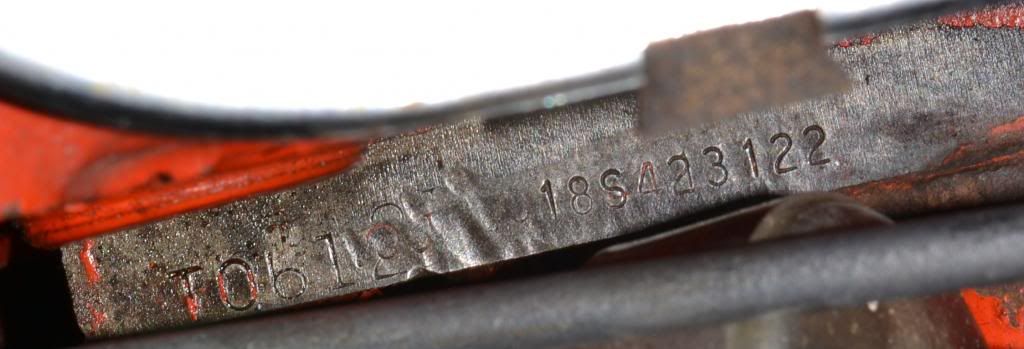
I do remember viewing this car, which will clearly raise some eyebrows:
Now trim tags - I feel that is a topic that in the large, general circle does not receive enough scrutiny as the engine pad does. Many people coming to this forum asking about their "matching numbers" and referring to the previous stamp pad, but may not even know of the trim tag existence.
I've always been relieved that the pad on my '75 is nice looking.
I do remember viewing this car, which will clearly raise some eyebrows:
Now trim tags - I feel that is a topic that in the large, general circle does not receive enough scrutiny as the engine pad does. Many people coming to this forum asking about their "matching numbers" and referring to the previous stamp pad, but may not even know of the trim tag existence.
Melting Slicks
Joined: May 2006
Posts: 3,438
Likes: 41
From: Raleigh NC
St. Jude Donor '13-'14
Alan,
You mention the assembly stamp side of the pad, it just gets even more compounded with the man whacking that gang stamp on the St. Louis/BG assembly line! In my second picture above, it appears the Tonawanda guy did a fine job, then the St. Louis guy came along and ruined nice, pretty pad stamp.
You mention the assembly stamp side of the pad, it just gets even more compounded with the man whacking that gang stamp on the St. Louis/BG assembly line! In my second picture above, it appears the Tonawanda guy did a fine job, then the St. Louis guy came along and ruined nice, pretty pad stamp.

Pro


Joined: Feb 2014
Posts: 607
Likes: 122
I was talking to the guy who built my engine the other day, and he told me he has been restamping "matching motors" at the customers request since he got into the engine building business back in the seventies. He asked me if I wanted mine stamped to match the car. I am sure there are a few real deals out there, but most are not.
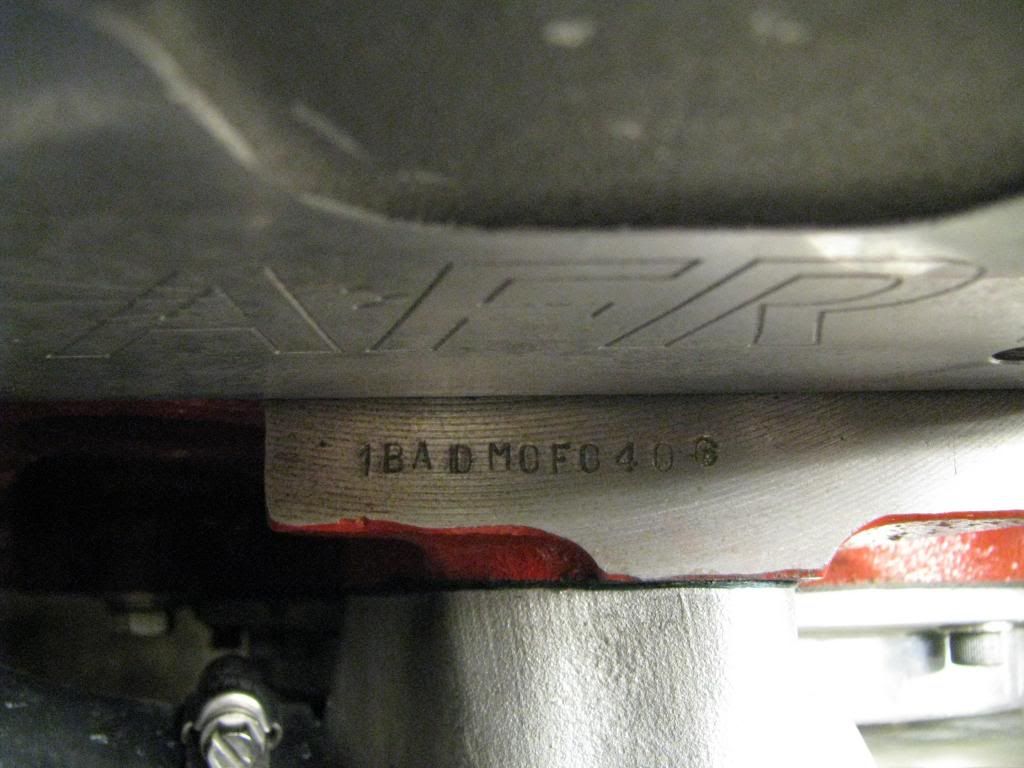
I wish I would of thought of the 1BadMofo stamp, that is pretty cool.
I wish I would of thought of the 1BadMofo stamp, that is pretty cool.

Race Director


Joined: Jul 2004
Posts: 12,706
Likes: 329
From: Scottsdale Arizona
I was talking to the guy who built my engine the other day, and he told me he has been restamping "matching motors" at the customers request since he got into the engine building business back in the seventies. He asked me if I wanted mine stamped to match the car. I am sure there are a few real deals out there, but most are not.
I wish I would of thought of the 1BadMofo stamp, that is pretty cool.
I wish I would of thought of the 1BadMofo stamp, that is pretty cool.
I need to come up with something clever on my pad. Maybe 7t2 has started a trend
Thread Starter
Team Owner
Joined: Sep 2006
Posts: 31,278
Likes: 4,372
From: Westminster Maryland
Hi Pete,
If one reads about 'heavy repair' one can pretty well understand how some pads ended up looking like they do.
It sounds like repairing engines that ended up in heavy repair without ever leaving the engine plants, or those that came back from St.Louis, was pretty low on the list of things to do.
Certainly getting a stamp back on the engine or changing the original stamp wasn't given much thought or effort.
Regards,
Alan
If one reads about 'heavy repair' one can pretty well understand how some pads ended up looking like they do.
It sounds like repairing engines that ended up in heavy repair without ever leaving the engine plants, or those that came back from St.Louis, was pretty low on the list of things to do.
Certainly getting a stamp back on the engine or changing the original stamp wasn't given much thought or effort.
Regards,
Alan