When you click on links to various merchants on this site and make a purchase, this can result in this site earning a commission. Affiliate programs and affiliations include, but are not limited to, the eBay Partner Network.
I did a search but couldn't find anything. I'm installing factory sidepipes. I did a fit and it looks like I don't have to cut anything off the front fender. Now for the covers I will, I thought I would have to for the sidepipes, is this correct? Also the sidepipes are right against the frame, is that correct? Should I paint the frame with high temp paint? One more question, on Wilcox paper on fitting it said I would need a spacer exhaust pipe. I bought them but the pipes fit fine without them, is this correct?
Thanks for the help!
Last edited by mpro71vette; Jul 2, 2016 at 12:24 PM.
My sidepipes are not against the frame. There is enough space to fit my fingers between them. If by spacers you mean the rubber disks, they should be installed between the large metal tab on the sideppes and the frame. That may help with your spacing.
Tried to get a pic but it's pretty low to the ground. If it becomes a problem, I can jack it up and get pics for you.
I did a search but couldn't find anything. I'm installing factory sidepipes. I did a fit and it looks like I don't have to cut anything off the front fender. Now for the covers I will, I thought I would have to for the sidepipes, is this correct? Also the sidepipes are right against the frame, is that correct? Should I paint the frame with high temp paint? One more question, on Wilcox paper on fitting it said I would need a spacer exhaust pipe. I bought them but the pipes fit fine without them, is this correct?
Thanks for the help!
Nothing to cut for the pipes.
If they are right against/touching the frame something is wrong/missing as there should be attaching hardware.
No paint required.
No idea what a "spacer exhaust pipe" is - pic or link helpful.
When fitting the covers it helped to raise the side of the car up (enough to remove the wheels). This gave the clearance needed to manipulate the front cover attaching point over the pipes. Took several test fits.
Hardest part is adding the attaching hardware to the car for the covers along the body.
My sidepipes are not against the frame. There is enough space to fit my fingers between them. If by spacers you mean the rubber disks, they should be installed between the large metal tab on the sideppes and the frame. That may help with your spacing.
Tried to get a pic but it's pretty low to the ground. If it becomes a problem, I can jack it up and get pics for you.
Thanks guys, by spacer I mean at the exhaust manifold end, Its like a heat riser but doesn't have the center. I just tried fitting the spacer and it didn't fit.
Thanks guys, by spacer I mean at the exhaust manifold end, Its like a heat riser but doesn't have the center. I just tried fitting the spacer and it didn't fit.
Thanks for the help, I check the mounting of sidepipe to see if I can get my fingers between.
rickscamaro redirect form that link was no help.
If you're talking about the exhaust doughnuts you'll be wanting those when you start it up. If they don't fit you may have the wrong size or might be missing the adapter.
I checked my other side pipe and it is longer connecting to the exhaust manifold, if my right side was like that it may work. Do you think they sent me the wrong size or screwed one side up?
Same thought.
If stock manifolds then passenger side has a heat riser valve.
You either use the stock heat riser OR replace it with the one you linked to which has no valve (so it's just a spacer now).
The tapered side uses a standard exhaust donut (tapered on both edges) between it and the header pipe (on both header pipes) photo courtesy Paragon Corvette Reproductions https://www.paragoncorvette.com/p-35...onut-2-12.aspx
Without the exhaust donuts the pipes will appear to fit together, but you will end up with a pretty significant exhaust leak. The exhaust donut alignment sleeve on the drivers side keeps the donut aligned as you are tightening the header to the manifold and slips into the header pipe as well as up into the manifold.
The tapered side uses a standard exhaust donut (tapered on both edges) between it and the header pipe (on both header pipes) photo courtesy Paragon Corvette Reproductions https://www.paragoncorvette.com/p-35...onut-2-12.aspx
Without the exhaust donuts the pipes will appear to fit together, but you will end up with a pretty significant exhaust leak. The exhaust donut alignment sleeve on the drivers side keeps the donut aligned as you are tightening the header to the manifold and slips into the header pipe as well as up into the manifold.
Good luck... GUSTO
Thanks! This is just what I needed! It clears a lot of things up!:
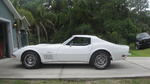
first vette, before the deal was made. checking it out.
Good morning, Happy Thanksgiving
This is my first post, first vette (got it 4 days ago) and it has some issues, exhaust to start. The above pic is a big help but brings up some questions.
Do I need the heat riser?
Why doesn't the other side have it?
After digging in to this problem, I need parts!!!! I don't have any sources for parts for this car yet------- anyone have a list of sources for parts?
1972 Corvette 350 sb/ auto and seems to have all the parts from the factory???
Hi b,
Welcome!
Happy Thanksgiving!!
Car looks like a nice one!!!
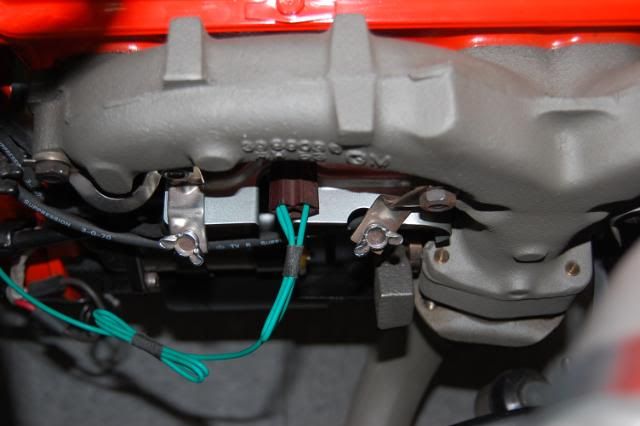
The purpose of the heat riser is to shorten the time it takes the engine to warm up enough to reach operating temperature by directing heat from the exhaust through a passage in the intake manifold below the carburetor.
An engine with a carburetor that has an operating choke and an operating hear riser will drop to normal operating rpm more quickly than one without.
The exhaust gas circulates across the manifold from the right to left side so there would be no need for a heat riser valve on the left side.
On many engines this heating process results in the orange paint on the manifold darkening in the area of the crossover because of the increased heat in that area.
A few good sources for parts are:
ZIP Products
Corvette Central
Paragon Reproduction
Willcox
Regards,
Alan
The heat riser installed.
An example of the darkened area the heat passage in the manifold causes in the engine paint.
Hi b,
Those vendors will have the manifold bolts too.
If you're talking about the bolts to fasten the manifolds to the engine notice that there are special washers and 'french locks' used on the bolts.
If you're talking about the bolts for the exhaust flanges notice the 'studs' are longer on the side with the heat riser than on the left side.
Regards,
Alan
Is the spacer they are talking about the one that goes between the transmission and the frame? I have 3 1969 with side exhaust. The bracket that the regular exhaust attaches to is under the transmission. It is somewhat of a "T" shape. That has to be removed and a small flat spacer gets installed in it's place. All of the parts suppliers sell them.
Also, yes the fender was cut out on all 1969s with side exhaust that I know of. It is a very crude cutout. I have a picture if you need it. There is also insulation between the frame rail and rocker channel, again I have pictures if needed.
Hi Ned,
I believe the 'spacer' that's talked about and shown in this thread is the one located at the right side exhaust manifold that some people choose to use in place of the heat riser. About 1" thick.
The one you mention fewer people even know about. It was used under the rear transmission mount to replace the exhaust hanger that was not installed on original N-14 cars. I believe it's purpose was to keep the angle between the engine/transmission and the driveshaft the same on an N-14 car as on an under-car exhaust equipped car.
Regards,
Alan
The heat risers main purpose was to help eliminate or reduce hydrocarbons exiting the vehicle through the exhaust pipe. Reducing the time from start up to operating temperature was one method. It also returned/slowed exhaust gases, to be "reburned" reducing the harmful outgoing hydrocarbons.
Edit: The rocker moldings were "trimmed" slightly where the pipes crossed the frame rail, on my '72 when I bought it....
Last edited by Don Rickles; Jan 4, 2017 at 08:08 AM.






 Factory Sidepipes