











Headlight Vacuum Issues: Why does the passenger side go first?

Thread Starter
Melting Slicks

Joined: Jun 2016
Posts: 2,979
Likes: 332
From: Woodinville WA
 Headlight Vacuum Issues: Why does the passenger side go first?
I'm slowly noticing that when headlight vacuum issues show up in our C3s that its' very often the passenger side that refuses to go back down first; I've seen 3 pictures of Vettes with just the passenger side that refuses to go down.
Why is this?
Adam
Why is this?
Adam

Team Owner


Joined: Sep 2006
Posts: 31,285
Likes: 4,375
From: Westminster Maryland
Hi Adam,
I don't really know if it's one side or the other that is more frequently a problem.
Of course each side has it's own actuator and on cars with two relays it's own relay.
So which side works or doesn't, or is faster or slower, depends on the operation of the relay and actuator for that side.
The small control line from the headlight switch to operate the relays has a 'T' in it so they should be receiving the same signal.
There are 2 lines to supply vacuum for the actuators so perhaps one or the other side might be biased for some reason.
????
Regards,
Alan
I don't really know if it's one side or the other that is more frequently a problem.
Of course each side has it's own actuator and on cars with two relays it's own relay.
So which side works or doesn't, or is faster or slower, depends on the operation of the relay and actuator for that side.
The small control line from the headlight switch to operate the relays has a 'T' in it so they should be receiving the same signal.
There are 2 lines to supply vacuum for the actuators so perhaps one or the other side might be biased for some reason.
????
Regards,
Alan
Last edited by Alan 71; Jan 10, 2017 at 01:20 PM.

Racer


Joined: Aug 2013
Posts: 339
Likes: 54
From: Fayetteville NC
My guess would be that the passenger side headlight is the furthest from the source causing to react slower. My system is working and the passenger side is the last to open and close. I've read where some members have removed the passenger relay and tied it into the drivers side reducing the extra relay.
Team Owner
Joined: Sep 2006
Posts: 31,285
Likes: 4,375
From: Westminster Maryland
Hi,
I believe being further from the source really doesn't enter in to the operation of the lights.
The control of the headlights are from the relays located between the lights so the hoses from the relays to the actuators are the same length.
Also the control of the relays, small hose, is from a 't' fitting, so both relays get the control signal (open/close) at the same time.
Regards,
Alan
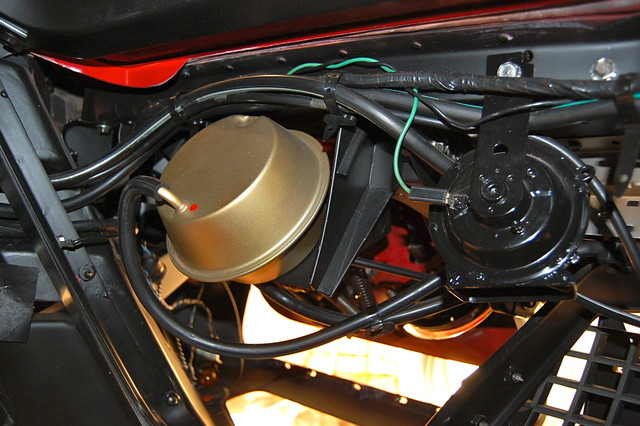

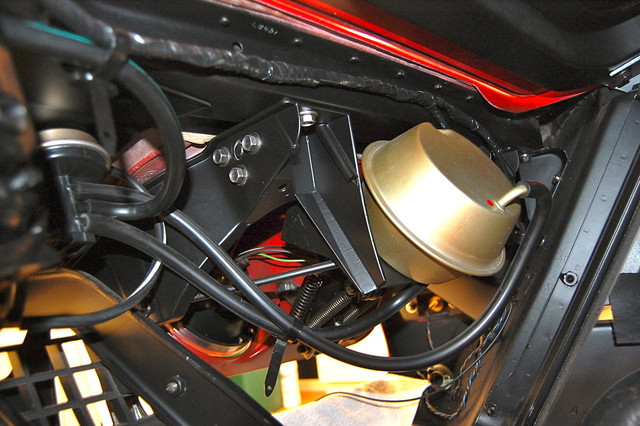
I believe being further from the source really doesn't enter in to the operation of the lights.
The control of the headlights are from the relays located between the lights so the hoses from the relays to the actuators are the same length.
Also the control of the relays, small hose, is from a 't' fitting, so both relays get the control signal (open/close) at the same time.
Regards,
Alan

Advanced
Joined: Sep 2015
Posts: 89
Likes: 9
From: Dawsonville, Ga.
My 77 did this, and it was annoying. I eventually converted my to electric and now I don't have any concerns. Goodluck

Melting Slicks
Joined: May 2015
Posts: 2,365
Likes: 428
From: Cape Girardeau Missouri
There are a number possibilities to include:
1) Presuming the '75 has a relay for each unit (I believe it does) exchange the three large hoses between the two relays and see if the driver side now lags. If so the relay is the problem. Relays can be disassembled and repaired (often just needing some silicon plumber's grease on the seals). When installing the hoses to the relay I find it best to do the center one first--otherwise it's very hard to get the center hose fully onto the connection.
2) The hose leading from the vacuum tank to the relay that feeds the slow headlight door may be leaking. Even if the hose tests leak-free the ends may be stretched allowing leaks at the connections. Sometimes there's enough hose to allow you to cut off a couple inches or so at each end, sometimes not. Doc Rebuild is a great source for vacuum hoses and you're extremely unlikely to find them in auto parts stores.
3) The main diaphragm in the slow actuator may have a leak. New OEM replacements are no longer available and the imports sold by all of the vendors have an amazingly high failure rate. I've read of people who claim a source who can repair them but I cannot confirm that such actually exists. Non-OEM replacements that don't leak upon receipt and stay working for more than 30-40 operations [seem] to stay working indefinitely. The shaft seals that function only when opening the doors are readily available from the vendors.
4) Worn/corroded, bearings/bushings, broken spring(s), etc. in the slow door may be causing a great deal of drag resulting in very slow operation.
------------------------
p.s. I found it impossible to remove the actuators in my '79 without removing the hood. When trying the first time I nicked up a spot that had been previously repaired. While it takes three people to remove/replace, I found it surprisingly easy to replace and align the hood.
p.p.s. Test ANY new vacuum component (be it OEM, NOS, repro or used) BEFORE INSTALLATION! Be certain that it holds vacuum indefinitely--there should be zero or nearly zero loss of vacuum overnight.
Last edited by SwampeastMike; Jan 10, 2017 at 05:52 PM.
Corvette Stories
The Best of Corvette for Corvette Enthusiasts

Top 10 Most Expensive Corvettes Ever Sold on Bring A Trailer
Brett Foote
10 Things Every Corvette Owner Needs (2026 Edition)
Michael S. Palmer
8 Most "Only Corvette Owners Understand" Quirks and Problems
Pouria Savadkouei
10 Reasons the C6 Z06 is Still A Performance Benchmark After 20 Years
Joe Kucinski
How Much Horsepower Every Corvette Engine "LOST" in 1972
Joe Kucinski
Top 10 DOs and DON'Ts for Protecting Your Convertible Top!
Michael S. Palmer
Top 10 Most Explosive Corvettes Ever Made: Power-to-Weight Ratio Ranked!
Joe Kucinski
150 hp to 1,250 hp: Every Corvette Generation Compared by the Specs That Matter
Joe Kucinski
8 Coolest Corvette Pace Cars (and Replicas) of All Time
Verdad Gallardo
Thread Starter
Melting Slicks
Joined: Jun 2016
Posts: 2,979
Likes: 332
From: Woodinville WA
This statement seems to be so incredibly obvious as to be unnecessary.
Of course if every component in the entire vacuum system is in perfect condition and doesn't leak the headlights will work fine.
-With a scientifically proven 13+ miles of vacuum hoses, Ts and fittings in a C3 and vacuum hoses running to the distributor, smog equipment, front headlights, transmission, windshield wiper, cruise control, heating and air condition control panel, the brake system, gas tank, T-tops, steering wheel, radio, radio antenna, tires, passenger seats and vanity mirrors, the problem is making sure that all 13+ miles don't have a leak. And actually finding the leaks when they do arise.
(Detroit's crack problem must've started with GM's engineers in the mid to late 70s... running the world off of manifold vacuum is nutty.)
Adam
Last edited by NewbVetteGuy; Jan 10, 2017 at 06:19 PM.
Melting Slicks
Joined: May 2015
Posts: 2,365
Likes: 428
From: Cape Girardeau Missouri
Huh?
This statement seems to be so incredibly obvious as to be unnecessary.
Of course if every component in the entire vacuum system is in perfect condition and doesn't leak the headlights will work fine.
-With a scientifically proven 13+ miles of vacuum hoses, Ts and fittings in a C3 and vacuum hoses running to the distributor, smog equipment, front headlights, transmission, windshield wiper, cruise control, heating and air condition control panel, the brake system, gas tank, T-tops, steering wheel, radio, radio antenna, tires, passenger seats and vanity mirrors, the problem is making sure that all 13+ miles don't have a leak. And actually finding the leaks when they do arise.
(Detroit's crack problem must've started with GM's engineers in the mid to late 70s... running the world off of manifold vacuum is nutty.)
Adam
This statement seems to be so incredibly obvious as to be unnecessary.
Of course if every component in the entire vacuum system is in perfect condition and doesn't leak the headlights will work fine.
-With a scientifically proven 13+ miles of vacuum hoses, Ts and fittings in a C3 and vacuum hoses running to the distributor, smog equipment, front headlights, transmission, windshield wiper, cruise control, heating and air condition control panel, the brake system, gas tank, T-tops, steering wheel, radio, radio antenna, tires, passenger seats and vanity mirrors, the problem is making sure that all 13+ miles don't have a leak. And actually finding the leaks when they do arise.
(Detroit's crack problem must've started with GM's engineers in the mid to late 70s... running the world off of manifold vacuum is nutty.)
Adam
While a relative newbee here I cannot overstress the importance of replacing ALL vacuum hoses of unknown age in a new-to-you C3!!! You will NOT find these hoses at PepBoys or AutoZone! Doc Rebuild sells the finest quality hoses and nearly perfect kits.
Thread Starter
Melting Slicks
Joined: Jun 2016
Posts: 2,979
Likes: 332
From: Woodinville WA
A critical system with a single point of failure is a very serious design flaw. Every hose T fitting and other component in the vacuum system and RC threes represents a possible single point of failure for multiple systems windshield wipers breaks headlights; A vacuum leak in any of them can take all of them down and make your car idle and run like crap. That's just terrible engineering.
discussions on the Corvette forum regarding rubber versus modern poly bushings always ends up discussing how rapidly rubber can deteriorate yet our entire vacuum systems run off who knows how many rubber hoses strewn about the entire car. That's an awful awful idea.
I agree that it all works really well when every component is working perfectly but when it's not it doesn't. That's MY point.
I get using vacuum advance for the distributor I get using vacuum to enable the transmission to understand when the engine is under load I don't get running accessories including critical ones like breaks headlights windshield wipers off a vacuum that's just stupid.



Le Mans Master


Joined: Dec 2006
Posts: 8,837
Likes: 1,028
Because that is the gutter side.
Melting Slicks
Joined: May 2015
Posts: 2,365
Likes: 428
From: Cape Girardeau Missouri
I agree but I don't think that means what you think it means. That's actually the argument against the vacuum system not for it.
A critical system with a single point of failure is a very serious design flaw. Every hose T fitting and other component in the vacuum system and RC threes represents a possible single point of failure for multiple systems windshield wipers breaks headlights; A vacuum leak in any of them can take all of them down and make your car idle and run like crap. That's just terrible engineering.
discussions on the Corvette forum regarding rubber versus modern poly bushings always ends up discussing how rapidly rubber can deteriorate yet our entire vacuum systems run off who knows how many rubber hoses strewn about the entire car. That's an awful awful idea.
I agree that it all works really well when every component is working perfectly but when it's not it doesn't. That's MY point.
I get using vacuum advance for the distributor I get using vacuum to enable the transmission to understand when the engine is under load I don't get running accessories including critical ones like breaks headlights windshield wipers off a vacuum that's just stupid.
A critical system with a single point of failure is a very serious design flaw. Every hose T fitting and other component in the vacuum system and RC threes represents a possible single point of failure for multiple systems windshield wipers breaks headlights; A vacuum leak in any of them can take all of them down and make your car idle and run like crap. That's just terrible engineering.
discussions on the Corvette forum regarding rubber versus modern poly bushings always ends up discussing how rapidly rubber can deteriorate yet our entire vacuum systems run off who knows how many rubber hoses strewn about the entire car. That's an awful awful idea.
I agree that it all works really well when every component is working perfectly but when it's not it doesn't. That's MY point.
I get using vacuum advance for the distributor I get using vacuum to enable the transmission to understand when the engine is under load I don't get running accessories including critical ones like breaks headlights windshield wipers off a vacuum that's just stupid.
Vacuum control systems have the inherent ability for proportional control (infinite automatic adjustability). The cruise control system in C3 Corvettes embraces this proportional control and that general system worked so well that it continued in some cars until the 90s. Some new vehicles may still use vacuum for cruise control. While not in the Corvette vacuum operated automated climate control systems in cars, buildings and even some homes for decades.
Beyond the lack of gearing, the great advantage of vacuum motors over electric motors is that jamming the mechanism causes zero harm to the motor or linkage no longer how long the problem continues. Only stepper motors with precise feedback, initial "zeroing" ability and step counting are similarly immune to damage caused by jam-ups.
When you finally get your new-to-you "Wow! it seems fantastic" 'vette into a condition where you can enjoy driving it you should consider getting the original systems working as designed before deciding that they are inferior and in need of so-called "upgrades".