




1971 Proportioning Valve Question

Thread Starter
Burning Brakes


Joined: Jul 2009
Posts: 1,184
Likes: 40
From: Overland Park, KS
2017 C4 of the Year Finalist
 1971 Proportioning Valve Question
Going over in a couple of days to help a friend with his '71. He's been around 'Vets for many years but has a puzzling problem. After bleeding all the brakes now only has rear brakes. While I could see one flex line collapse, as has happened to me, two seems unlikely. What's the most likely culprit? Any special process I should follow?

Le Mans Master

Joined: Aug 2006
Posts: 7,423
Likes: 1,558
From: mount holly NC
2025 c3 ('74-'82) of the Year Finalist - Unmodified
2019 C3 of Year Finalist (appearance mods)
With the car parked try pressing the brake pedal very hard as in a panic stop.
If that doesn't fix it Pump up the brakes and hold the pressure and bleed a rear caliper.
That should rebalance the valve.
If that doesn't fix it Pump up the brakes and hold the pressure and bleed a rear caliper.
That should rebalance the valve.
Team Owner


Joined: Jun 2001
Posts: 23,367
Likes: 1,061
From: Virginia USA
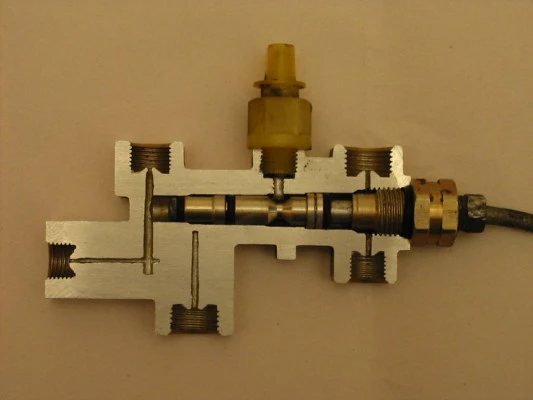
First is the brake light on on the dash? If it is then the piston in the prop valve is not centered causing the switch to be made (See first picture). If it isn't then I suspect you have other problems.
When the brakes were bled the piston may have moved and need to be re-centered but just bleeding the brakes usually doesn't cause the piston to move. Were any lines replaced leading to the prop valve etc? Was the master cylinder replaced/bled? Lots of unknowns.
Generic picture:
Centering tool:

Remove switch and insert tool but you may have to remove a line to get the piston re-centered first.
When the brakes were bled the piston may have moved and need to be re-centered but just bleeding the brakes usually doesn't cause the piston to move. Were any lines replaced leading to the prop valve etc? Was the master cylinder replaced/bled? Lots of unknowns.
Generic picture:
Centering tool:
Remove switch and insert tool but you may have to remove a line to get the piston re-centered first.

Team Owner


Joined: Jan 2006
Posts: 37,637
Likes: 3,116
From: Crossville TN
When bleeding brakes and working with either front or rear caliper, you need to work the brake pedal slowly and smoothly. Why? You are only working with one-half of the braking system and shoving the pedal down fast will cause the shuttle valve in the distribution block to move off-center and block the other half of the brake system from working. In essence, while bleeding the brakes, the dist block 'thinks' you have a big leak in that half of the system because lots of fluid is flowing thru that portion of the system. It shifts that valve so that the "leak" is blocked off....and so is that portion of the system. If you move the pedal slowly, it won't move the shuttle valve off-center and all will be fine.
Now, you need to re-center the shuttle valve. Once the brake system is bled properly and you have firm pedal, you can STOMP! on the pedal in hopes that it will re-center the valve in the dist block. If that works, great! If it doesn't, you will need to re-center the valve in the block--which means that you open the system up to air and you may need to bleed the brakes again.
Slow and easy when bleeding using the brake pedal. Then, that shuttle valve won't turn into a 'can o worms'.
Now, you need to re-center the shuttle valve. Once the brake system is bled properly and you have firm pedal, you can STOMP! on the pedal in hopes that it will re-center the valve in the dist block. If that works, great! If it doesn't, you will need to re-center the valve in the block--which means that you open the system up to air and you may need to bleed the brakes again.
Slow and easy when bleeding using the brake pedal. Then, that shuttle valve won't turn into a 'can o worms'.
Team Owner
Joined: Jun 2001
Posts: 23,367
Likes: 1,061
From: Virginia USA
When bleeding brakes and working with either front or rear caliper, you need to work the brake pedal slowly and smoothly. Why? You are only working with one-half of the braking system and shoving the pedal down fast will cause the shuttle valve in the distribution block to move off-center and block the other half of the brake system from working. In essence, while bleeding the brakes, the dist block 'thinks' you have a big leak in that half of the system because lots of fluid is flowing thru that portion of the system. It shifts that valve so that the "leak" is blocked off....and so is that portion of the system. If you move the pedal slowly, it won't move the shuttle valve off-center and all will be fine.
Now, you need to re-center the shuttle valve. Once the brake system is bled properly and you have firm pedal, you can STOMP! on the pedal in hopes that it will re-center the valve in the dist block. If that works, great! If it doesn't, you will need to re-center the valve in the block--which means that you open the system up to air and you may need to bleed the brakes again.
Slow and easy when bleeding using the brake pedal. Then, that shuttle valve won't turn into a 'can o worms'.
Now, you need to re-center the shuttle valve. Once the brake system is bled properly and you have firm pedal, you can STOMP! on the pedal in hopes that it will re-center the valve in the dist block. If that works, great! If it doesn't, you will need to re-center the valve in the block--which means that you open the system up to air and you may need to bleed the brakes again.
Slow and easy when bleeding using the brake pedal. Then, that shuttle valve won't turn into a 'can o worms'.

I agree but if the dash light is not on then either the piston (shuttle) didn't move or the brake warning switch is not working. I've bled a lot of brakes over my years and I've never had the piston move by just bleeding and I've always done it the old fashion way, no vacuum or pressure bleed. I guess if you do stomp the pedal with the bleeder open it would fool the system into thinking there is a leak and move the piston as that is what it's for as you described.
Good luck.
Le Mans Master
Joined: Aug 2006
Posts: 7,423
Likes: 1,558
From: mount holly NC
2025 c3 ('74-'82) of the Year Finalist - Unmodified
2019 C3 of Year Finalist (appearance mods)
To test the bulb:
#1 Turn the key ON and pull up on the parking brake, the bulb should light up.
Leave the parking brake OFF and try test #2.
#2 With the key ON remove the wire from the valve and ground it, again the bulb should light up.
#1 Turn the key ON and pull up on the parking brake, the bulb should light up.
Leave the parking brake OFF and try test #2.
#2 With the key ON remove the wire from the valve and ground it, again the bulb should light up.
Corvette Stories
The Best of Corvette for Corvette Enthusiasts

Top 10 Most Explosive Corvettes Ever Made: Power-to-Weight Ratio Ranked!
Joe Kucinski
150 hp to 1,250 hp: Every Corvette Generation Compared by the Specs That Matter
Joe Kucinski
8 Coolest Corvette Pace Cars (and Replicas) of All Time
Verdad Gallardo
Top 10 Corvette Engines RANKED by Peak Torque (70+ Years of Muscle!)
Joe Kucinski
Corvette ZR1X Will Be Pacing the Indy 500, And Could Probably Race, Too!
Verdad Gallardo
Top 10 Corvettes Coming to Mecum Indy 2026!
Brett Foote
Top 10 C9 Corvette MUST-HAVES to Fix These C8 Generation Flaws!
Michael S. Palmer
10 Revolutionary 'Corvette Firsts' Most People Don't Know
Joe Kucinski