When you click on links to various merchants on this site and make a purchase, this can result in this site earning a commission. Affiliate programs and affiliations include, but are not limited to, the eBay Partner Network.
Hi, I'm going to pick up a '68 427/435 roadster early this week. The remnants of the tank sheet are good - shows it is a 435hp car; 4.11 gears (ugh :-) ); etc. The reason I'm asking a couple of questions is because I thought I had previously read of the forum that not all '68s had the VIN stamped onto the pad. Can you give a little help on the following for a late '68 427/435, iron head?
* On the pad stamping, it should be: T(4 digits for date of mfg)IR (VIN). Is this correct?
Just doing a little final check. Current owner is a great guy, and I've spoken with the previous owner - that covers the past 30+ years.
Thanks in advance! Paul
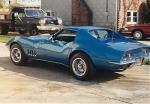
I'm adding a few pics to this original post. The current owner is a forum member - and he's sent around 50 pics. He's had it over 10 years, and also hooked me up with the previous owner. The car isn't cheap, but I believe the deal is reasonable and I believe what the owner(s) have shared with me in several conversations, pictures, etc. It appears to have good bones, we currently have a C3 so I know about bird cage and other rust and it's checked out from pics, there are some issues but the owner has been very forthright about them. Just looking for additional confirmation from those who know a heck of a lot more than I do. Thank you!
Tach is correct for a 435 car. I believe this is the correct shroud for a 435? Owner has the original valve covers
Hi, I'm going to pick up a '68 427/435 roadster early this week. The remnants of the tank sheet are good - shows it is a 435hp car; 4.11 gears (ugh :-) ); etc. The reason I'm asking a couple of questions is because I thought I had previously read of the forum that not all '68s had the VIN stamped onto the pad. Can you give a little help on the following for a late '68 427/435, iron head?
* On the pad stamping, it should be: T(4 digits for date of mfg)IR (VIN). Is this correct?
Just doing a little final check. Current owner is a great guy, and I've spoken with the previous owner - that covers the past 30+ years.
Thanks in advance! Paul
Paul,
We will be skeptical and you should be too. Real ones are EXPENSIVE and rare. Fake ones are EVERYWHERE.
Hi, I'm going to pick up a '68 427/435 roadster early this week. The remnants of the tank sheet are good - shows it is a 435hp car; 4.11 gears (ugh :-) ); etc. The reason I'm asking a couple of questions is because I thought I had previously read of the forum that not all '68s had the VIN stamped onto the pad.
I don't know where you heard that not all '68's had the VIN stamped on the pad but THAT IS FALSE!!! Every car had it. If someone says it didn't that would need some amazing proof backing up that claim. The reason it was done was for warranty application as well as theft. How could GM warranty your car if they could not prove that the engine in it that you just blew up under warranty was the original? Verifcation was done with the vin stamp on the pad.
Extraordinary claims require extraordinary proof. If someone says they have a rare car with no engine stamp on the pad from the factory they need more than there BS story to back up that claim to be believed.
I want to update this post to say all 68 CORVETTES had the stamp on the pad, not necessarily all 68 vehicles. I do not know much about other makes.
Last edited by ed427vette; May 4, 2019 at 10:32 PM.
^^^^ I thought I read it on the forum somewhere, and was checking. I appreciate your, and the other responses. The owner is not claiming that at all, he's never mentioned it - I was probably miss-remembering some stuff I read on the forum. The owner is a long time forum member and I feel very good about the legitimacy of the car.............but it never hurts to do some final checking. I'm adding a couple of pics to the original post to get additional insights - hopefully. :-)
some plants elected to stamp partial VINs on other locations beside the engine pad (such as the rough cast area by the oil filter boss or on the bellhousing flange), most plants for most years did stamp the partial VIN on the engine pad next to the Flint or Tonawanda engine assembly date and ID letters. don't know of this is also true for corvettes in all engine or assembly plants.
some plants elected to stamp partial VINs on other locations beside the engine pad (such as the rough cast area by the oil filter boss or on the bellhousing flange), most plants for most years did stamp the partial VIN on the engine pad next to the Flint or Tonawanda engine assembly date and ID letters. don't know of this is also true for corvettes in all engine or assembly plants.
That is correct. From what I remember in very early 1970 some LS5 engines had the vin stamping by the oil filter. Not many but the earliest cars had that anomally. But in 68, they were all on the pad.
Now, about this 68. Red and tan was not a standard paint combo. Unless this is a very early 68 then the paint is not original as indicated by the back cowl area being red. Does the tank sheet for this car show the color? This car looks a little rough in some areas. I hope you are getting a good deal on it. Do you have a pic of the tank sticker. Do you know how to tell a real one from a fake?
Do your due diligence before purchasing. After reading Davids comment in that sale thread....
Originally Posted by AllVettes4Me
Did you ever sort out your concerns with the stamp on the engine pad? Just like you were concerned for the authenticity of the pad in the past you might want to post a picture of the pad today showing. Just a thought. Did you replace the original valve covers since you purchased the car? I don't remember Bow Tie Chevrolet on the big blocks in 1968. Do you have the original valve covers? All important facts when it comes to getting top dollar for your nice 1968.
Good luck with your sale.
David Howard
AllVettes4Me
some plants elected to stamp partial VINs on other locations beside the engine pad (such as the rough cast area by the oil filter boss or on the bellhousing flange), most plants for most years did stamp the partial VIN on the engine pad next to the Flint or Tonawanda engine assembly date and ID letters. don't know of this is also true for corvettes in all engine or assembly plants.
On some '69 engines that had the alternator moved to the passenger side for '69 (when the long water pump was being implemented), the stamp pad was obscured by the alternator. Struggling with the practice of moving the alternator out of the way, stamping the VIN derivative, then replacing the alternator was deemed too labor intensive. Norwood began stamping VIN derivatives on the rough cast area near the oil filter. Los Angeles also adopted the practice but was inconsistent. Did not affect any cars with short water pumps where alternator was mounted on the drivers side so those Corvettes would not be affected.
Some commercial HD trucks were not subject to the VIN derivative on the pad rules. Seen it myself.




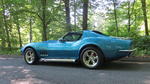






 Engine, etc. identification: '68 427/435