When you click on links to various merchants on this site and make a purchase, this can result in this site earning a commission. Affiliate programs and affiliations include, but are not limited to, the eBay Partner Network.
I'm at the point of cleaning up my front and rear brakes in the process of a complete frame up rebuild. I was originally going to get all new disks but after some reading, it sounds like I may not necessarily have to. However, they all look like this (see pictures below). They're still riveted to the rotors. Lots of surface rust, but the actually braking surfaces are nice and smooth, no ridges. Should I clean them up and use them? Should I paint them (obviously not the actual braking surfaces)? Or should I be thinking about replacing?
Those rotors are from back when they were beefy. I think I would reuse if they will clean-up.
If you know someone who can turn them and remove a few thousandths, that would certainly help. GM dealerships of long-ago had the machinery to do the task.
Now days shops just pitch them in the scrap-iron bin. Then slap on some thin overseas replacement.
Agree with heads up. What I have often done in bedding in a new set of pads is to re-install my old pads with emery cloth glued to them and then carefully and slowly drive around. I guess that depends on where you live but in my case it is a cul-de-sac.
I've done that to remove the glaze from the old set of pads. In your case you will have the runout that the factory deemed satisfactory. And you will get to the backside of the rears as well.
Do not drill out the rivets...they help the rotor to "run true". As other members said...clean them up/bead blast the rust.
You might want to replace the bearings and races if they are discolored-scratched-pitted, , also replace the grease seals.
Thanks all for the help. I was leaning towards keeping them. Hell, if it doesn't turn out well, I can always drill them out and get new ones. Nothing really lost.
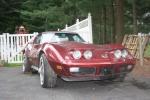
The more I dig into this car, the more I find it was fairly untouched over the years. I bought it in 2011 and it had sat quite a while before that too. Rusty (stored outdoors in New Hampshire), but mostly surface and we're dealing with that. In the same vane as the disks still being original, I believe the calipers aren't sleeved yet either. I could be wrong. Need a better look, but I understand that's fairly rare for its age.
If they are original, measure the thickness. If good, clean them up, replace the bearings and seals. You’ll be potentially opening up a huge can of worms if you go down the replacement path. My advice is don’t go there unless you absolutely have to,
I electrochemically stripped the frame and suspension components on my 69 40 years ago and painted them with polyurethane enamel. Hand painted the inside of each cooling air path on the rotors and they look as good today as they did then and not a speck or rust anywhere.
Just finished up a full bushing replacement effort and it’s got its tuxedo on again.
If they are original, measure the thickness. If good, clean them up, replace the bearings and seals. You’ll be potentially opening up a huge can of worms if you go down the replacement path. My advice is don’t go there unless you absolutely have to ...
Exactly. Check the thickness, and check the runout. Are those your actual rotors? Refresh or replace the bearings, and use a dial indicator to check runout. If it is more than 0.002", you are likely to have problems.
You don't [necessarily] have to get them "turned". It would be easiest to do so....if you can find a shop with a good metal lathe. But, you could also use an orbital sander to get rid of the rust, etc. ont he disc surface. You could also dunk the whole thing in a tub of CLR or other rust remover. When you get down to base material (clean metal), the condition of the surface will tell you if the part needs to be turned or not. If the surface is pretty smooth, with very little grooving/gouging, finer sanding should prep the part with no real issues. If you actually have to remove metal to clean up the part, they NEED to be turned.
[QUOTE=HeadsU.P.;1603944626
Now days shops just pitch them in the scrap-iron bin. Then slap on some thin overseas replacement.[/QUOTE]
That’s because they can charge you r&r labor, plus buy the rotors at wholesale and sell them to you at retail+.
They make more money off you by replacing them. And then they get a few cents for the scrap iron, too.









 Brake Disk Refresh