





74 454 bad engine?

Thread Starter
Heel & Toe

Joined: Mar 2021
Posts: 18
Likes: 2
 74 454 bad engine?
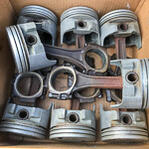
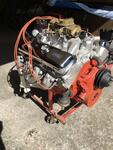
I have a 74 454 numbers matching (270 hp/380 ft/lbs) and it is currently eating oil. I'm hoping there is no damage to the ports. If it turns out that the block is unrepairable, what are some suggestions for a new engine? Do put a 454 back in or a 502? And would I need to change the drive shaft and differential to handle the higher hp and torque?
1967 Pedal Car Champion

Joined: Mar 2020
Posts: 9,137
Likes: 4,247
From: US-PNW
Your oil consumption could be a number of problems:
Do you get gray smoke out the exhaust when starting up, accelerating hard, while just idling?
Have you looked at the lower sides of the block, oil pan, and trans for oil wetness?
You may have worn valve guides and/or worn cylinder walls and/or very leaky gaskets. If it's an original engine to the car you are far better (resale value) rebuilding what you have than changing it out. Having an non-matching number engine can cost you $5k-$10k or more compared to the original engine. Being that there were less than 3,500 454 Corvettes out of 37,500 total produced in '74, you have a relatively rare car. The caveat to rebuilding is to ensure they don't deck the block and remove the assembly line stampings on the engine pad - assuming they weren't removed by a previous rebuild in the last 50 years. A quality, standard performance rebuild will likely cost around $5000 to $7500 depending on machining and any repairs needed.
Do you get gray smoke out the exhaust when starting up, accelerating hard, while just idling?
Have you looked at the lower sides of the block, oil pan, and trans for oil wetness?
You may have worn valve guides and/or worn cylinder walls and/or very leaky gaskets. If it's an original engine to the car you are far better (resale value) rebuilding what you have than changing it out. Having an non-matching number engine can cost you $5k-$10k or more compared to the original engine. Being that there were less than 3,500 454 Corvettes out of 37,500 total produced in '74, you have a relatively rare car. The caveat to rebuilding is to ensure they don't deck the block and remove the assembly line stampings on the engine pad - assuming they weren't removed by a previous rebuild in the last 50 years. A quality, standard performance rebuild will likely cost around $5000 to $7500 depending on machining and any repairs needed.
Thread Starter
Heel & Toe
Joined: Mar 2021
Posts: 18
Likes: 2
I don't have any smoke but the oil pan is a little wet but no oil drips on the floor. I'm thinking it's piston rings not sealing. One day it ran really well, Great acceleration and good power. A few days later I could tell something was wrong cuz it wouldn't acceleration as fast and at idle. Felt like a cylinder or 2 wasn't firing.

Burning Brakes


Joined: Jan 2003
Posts: 961
Likes: 275
From: Frederick MD
I have a 74 454 numbers matching (270 hp/380 ft/lbs) and it is currently eating oil. I'm hoping there is no damage to the ports. If it turns out that the block is unrepairable, what are some suggestions for a new engine? Do put a 454 back in or a 502? And would I need to change the drive shaft and differential to handle the higher hp and torque?
1967 Pedal Car Champion
Joined: Mar 2020
Posts: 9,137
Likes: 4,247
From: US-PNW
I don't have any smoke but the oil pan is a little wet but no oil drips on the floor. I'm thinking it's piston rings not sealing. One day it ran really well, Great acceleration and good power. A few days later I could tell something was wrong cuz it wouldn't acceleration as fast and at idle. Felt like a cylinder or 2 wasn't firing.

Le Mans Master


Joined: May 2002
Posts: 5,086
Likes: 786
From: Lebanon Township New Jersey
Its very unlikely, from what you're describing, that your current problems would require replacing the block. Cylinder honing, or bore and honing (plus new pistons) will correct the oil consumption. At worst, if a cylinder is damaged enough, it can be sleeved for reuse.
Corvette Stories
The Best of Corvette for Corvette Enthusiasts

Top 10 Most Expensive Corvettes Ever Sold on Bring A Trailer
Brett Foote
10 Things Every Corvette Owner Needs (2026 Edition)
Michael S. Palmer
8 Most "Only Corvette Owners Understand" Quirks and Problems
Pouria Savadkouei
10 Reasons the C6 Z06 is Still A Performance Benchmark After 20 Years
Joe Kucinski
How Much Horsepower Every Corvette Engine "LOST" in 1972
Joe Kucinski
Top 10 DOs and DON'Ts for Protecting Your Convertible Top!
Michael S. Palmer
Top 10 Most Explosive Corvettes Ever Made: Power-to-Weight Ratio Ranked!
Joe Kucinski
150 hp to 1,250 hp: Every Corvette Generation Compared by the Specs That Matter
Joe Kucinski
8 Coolest Corvette Pace Cars (and Replicas) of All Time
Verdad Gallardo
Thread Starter
Heel & Toe
Joined: Mar 2021
Posts: 18
Likes: 2

Team Owner

Joined: Feb 2003
Posts: 54,109
Likes: 9,424
From: Sitting in his Nowhere land Hanover Pa
2024 C2 of the Year Finalist - Unmodified
2015 C2 of Year Finalist

Le Mans Master


Joined: Nov 2004
Posts: 5,253
Likes: 768
From: Waterford WI
Ifit is burning the oil, you should see evidence of that with black deposits on your exhaust tips. And if it is burning oil, your loss of power cold be one or more oil-fouled spark plugs.

Burning Brakes


Joined: Jan 2006
Posts: 1,223
Likes: 174
From: Fort Wayne IN
Are you sure it's burning oil and not leaking oil? Just pulling the plugs should let you know what cylinder it's getting into. I doubt the block is toast. A cylinder hone and new rings might be all you need.
Team Owner
Joined: Feb 2003
Posts: 54,109
Likes: 9,424
From: Sitting in his Nowhere land Hanover Pa
2024 C2 of the Year Finalist - Unmodified
2015 C2 of Year Finalist
with that amount of oil, the car should have a smoke screen behind it. and after a few hundred miles there is no way the spark plug should fire
1967 Pedal Car Champion
Joined: Mar 2020
Posts: 9,137
Likes: 4,247
From: US-PNW
Holy Moly! That's not "relatively" high, that's something is "seriously wrong, you gotta be kidding me" high. Are you sure your carpets don't have a pool of oil sitting on top? It's got to be spewing out somewhere because if it were burning, as Nowhere Man said, that should be a smokescreen to hide a battleship! Prior to rebuild, my original '72 454 had very worn valve guides but OK cylinder sealing and would go through one quart every 500-750 miles. It had noticeable oil smoke out the exhaust.
Melting Slicks

Joined: Nov 2006
Posts: 3,411
Likes: 1,821
From: Apple Valley, MN
Your question about your differential will depend a lot on many other factors if you decide to up the ante on power. Driving habits and tire size are a couple of big ones.
Assuming it is in good shape, the stock differential is designed to handle about 400-450 lb-ft. Head north of that and/or start drag racing and/or bolt on more rubber and you begin to open the doors to driveline failure.
You can build the differential to handle a lot more power but you need to educate yourself on how this is done properly. Look at posts from Gary Ramadei (gtr1999) on the details (there are a LOT of details - I spent about 6 months reading/learning how to do it, much of what I learned was from Gary). My build should be good for my needs (500 lb-ft, will be driven carefully) but with a lot of $$ for 30 spline components and/or conversion to 12 bolt) it can go higher.
You will also need to consider the halfshafts and outer axles if you beef up the differential as these were also designed to handle the same power as originally built. Again, you can upgrade these but it will add cost to the project.
Don’t forget the driveshaft too. If you go nuts on the engine, you will want to add muscle to that component as well.
Assuming it is in good shape, the stock differential is designed to handle about 400-450 lb-ft. Head north of that and/or start drag racing and/or bolt on more rubber and you begin to open the doors to driveline failure.
You can build the differential to handle a lot more power but you need to educate yourself on how this is done properly. Look at posts from Gary Ramadei (gtr1999) on the details (there are a LOT of details - I spent about 6 months reading/learning how to do it, much of what I learned was from Gary). My build should be good for my needs (500 lb-ft, will be driven carefully) but with a lot of $$ for 30 spline components and/or conversion to 12 bolt) it can go higher.
You will also need to consider the halfshafts and outer axles if you beef up the differential as these were also designed to handle the same power as originally built. Again, you can upgrade these but it will add cost to the project.
Don’t forget the driveshaft too. If you go nuts on the engine, you will want to add muscle to that component as well.

Race Director

Joined: Jul 2015
Posts: 13,082
Likes: 3,399
From: SW Florida.
most likely valve guides and shot valve seals. bunch of ways to hold valves up to replace seals. lots of ways to hold valves up to change seals without pulling heads. we drive these cars 300 to 3000 miles a year. we really don't need to give a machine shop 10k for an occasional use car-toy. if car has never been apart the timing gear can still still have nylon teeth. 74 it could still have points. there is a lot of cheap easy stuff that can make this guy run sub-optimally that should be looked at before you start thinking rings and bearings and pistons and stuff...

Team Owner
Joined: Jan 2007
Posts: 53,648
Likes: 878
From: Southern Cal Ca
St. Jude Donor '22
The amount of oil loss rules out "burning."
Like said, plugs would foul and exhaust would be a thick cloud of smoke.
Parts that wear and cause oils consumption are valve seals and or rings at the the top of cylinder known as the compression ring.
Basically the area at the top of cylinder wears heavily and is no longer capable of sealing.
This area mandates a rebore and can be as little as .010 or great as .030 over.Both require new pistons.
I also would look for a leak vs worn parts.
good luck
Like said, plugs would foul and exhaust would be a thick cloud of smoke.
Parts that wear and cause oils consumption are valve seals and or rings at the the top of cylinder known as the compression ring.
Basically the area at the top of cylinder wears heavily and is no longer capable of sealing.
This area mandates a rebore and can be as little as .010 or great as .030 over.Both require new pistons.
I also would look for a leak vs worn parts.
good luck

Pro

Joined: Jul 2021
Posts: 719
Likes: 156
before ya spend big $ ... do a complete compression test ... both wet & dry--- record all data ... do a complete leak-down test ... both wet & dry---record all data and reply back here.
There may be several ways to skin this cat without a rebuild ... or not. Show us the full data set.
FWIW +ten over shelf stock pistons for BBC are few & far between. Shelf stock OS for GM V8 usually begins at +twenty over (Exception, AFAIK NPR America stocks +ten for some sbc but not BBC)
There may be several ways to skin this cat without a rebuild ... or not. Show us the full data set.
FWIW +ten over shelf stock pistons for BBC are few & far between. Shelf stock OS for GM V8 usually begins at +twenty over (Exception, AFAIK NPR America stocks +ten for some sbc but not BBC)
Thread Starter
Heel & Toe
Joined: Mar 2021
Posts: 18
Likes: 2
before ya spend big $ ... do a complete compression test ... both wet & dry--- record all data ... do a complete leak-down test ... both wet & dry---record all data and reply back here.
There may be several ways to skin this cat without a rebuild ... or not. Show us the full data set.
FWIW +ten over shelf stock pistons for BBC are few & far between. Shelf stock OS for GM V8 usually begins at +twenty over (Exception, AFAIK NPR America stocks +ten for some sbc but not BBC)
There may be several ways to skin this cat without a rebuild ... or not. Show us the full data set.
FWIW +ten over shelf stock pistons for BBC are few & far between. Shelf stock OS for GM V8 usually begins at +twenty over (Exception, AFAIK NPR America stocks +ten for some sbc but not BBC)
