When you click on links to various merchants on this site and make a purchase, this can result in this site earning a commission. Affiliate programs and affiliations include, but are not limited to, the eBay Partner Network.
I have a couple of quick questions what are the pros and cons of owning a tri-power 427 car and the set up of the tri-power is it reliable what happens if it sits for a long time a couple of months is it something that you can get in and start up and not have a problem or does it need to be tune from time to time
2020 Corvette of the Year Finalist (performance mods)
2019 C3 of Year Winner (performance mods)
2016 C3 of Year Finalist
TEh downsides
If you dont get on the secondaires at all the fuel will sit in those bowls for a while and eventually either gum them up or corrode the bowls and metering plates. Thats the downside of letting them sit for a long time. If you are going to let it sit for 3 months and drive it occasionally, I would use a fuel additive like stabil and get on it on the highway just before storing it to cycle the fuel in the end carb bowls. Other than that just treat it like a 4 barrel with detached secondairies, nothing more mysterious than that in it operation. The pain in the *** is that while tuning it you have to pull the center carb to change jets and the power valve. If you can tune a Holley you can tune this thing. You cant change the outboard carbs jetting because of the metering blocks design but you can swap them to new after market plates if you really need a lot more fuel.
If you buy an old set expect to have to spend a lot of money to restore them. DO NOT send them to Holley, use Allstate carb or another carb restoration service. These old carbs use a crappy low melting point aluminum and they tend to warp with really high engine bay temps. If you want to do all the work yourself it is very doable but is labor intensive getting all the mating surfaces flat and true, including the intake. I really like the looks and the performance is about on par with any vacuum secondary 4 barrel. If you add a mechanical linkage expect a bog if you floor it because there is no secondary accelerator pumps.
As for tuning I would tune the center carb with the outboard carbs linkage disconnected. If it is running too rich and cant be tuned out, the AIM says t adjust the rear carb linkage so it pulls a little air. You will have to do a little research on tune up procedures. My setup will not run correctly with the front and rear carbs plugged with a rag so it does need a little of that leaking air around the butterflies to get the air mixture correct. It will still stall if you turn the idle mixture screws all the way in. Do an internet search and you will find a few good Corvette Tripower tuning articles. There is a guy on Youtube that rebuilds the Mopar Six Pack setups and he explains the function really well and the problems you will see with and old used set
As for needing to tune them occasionally its the same as a barrel. They are all set it and forget it if they stay clean. If a setting changes its probably because something got plugged
pros are definitely the looks. you cant beat the wow factor of a big block with a tri power setup when you pop the hood. my vette sat all winter, i cranked it to fill the carb bowls, pumped the gas and it started like it ran last week.
I would say the con is working on them/tuning. IMO you MUST be able to work on the car yourself. they are very similar to a 4 barrel, but they are different enough that you need to pay attention to your setup. plus having to remove the entire center carb if you want to swap jets is a pain.
As others stated they look great, but can be very temperamental and needs routine adjustments. Having said that, we had a tri-power '69, loved the setup.
Last edited by Corey_68; Apr 26, 2022 at 04:41 PM.
Just like anything nowadays......non-ethanol fuel for storage is highly recommended for any storage longer than 6-8 weeks.
As a previous owner of a 69' 427/400.....it is fun....but you better know carbs or know someone who knows as there is a lot more parts to deal with.
I raced a WS6 Ram Air T/A on I-35 with mine years ago and it was just silly when the end carbs pulled open at a 70MPH roll and I walked away from him with that air horn sound...LOL....good times.
Make sure you follow the procedure for adjusting the closing rods. Do not use mechanical linkage for the secondary carbs. When I do my monthly winter warm-ups, I lightly push on on the secondary throttle levers to increase the rpm and get some fuel flow through them. Convert the distributor to manifold vacuum and set up the distributor and timing per Lars's papers.
I have had three different "tri-power" setups on my 496 big block.
1) Factory setup. Looked great. Ran well.
2) Mopar mechanical secondary Six Pack carbs. All mechanical. Three accelerator pumps. Absolute kick in the pants.
Downside on both setup was:
- Stinky idle with my 496 and big cam
- Hard braking caused serious fuel slosh and engine would want to die.
3) Problems solved with setup #3. Custom 3x2 EFI. Three two barrel throttle bodies. Port EFI controlled by FAST XFI. Idles at 850 rpm and pulls to 6500 rpm. Cost was probably in same ball park as a fully restored carb setup.
How did you get the Mopar carbs to fit with the metering blocks
The Mopar carbs have side hung float bowls. So, bowls are shorter. Needed a 1/2" phenolic spacer so accelerator pumps would clear with 68/69 manifold. Made my own progressive linkage and swapped Corvette choke mechanism over and bent up a longer rod. Was already using braided fuel line. Small notch in air cleaner base. That was it.
I kept my Holley equipped LT1 for 30 years. Raced it often. And rarely if ever touched the carbs, once it got tuned.
The key was driving it at least monthly, excercizing the secondaries, and when it did need for to sit for 3+ months at a time, use stabil.
One time I did not and the gas degenerated so badly I thought it had major engine damage. Burned it up (gently) put in a fresh tank, and all is good again.
With the recent development of the 10% ethanol fuels, careful storage is even more important than before.
And you must source and use alcohol resistant gaskets, and pump diaphragm.
So, I have been fighting tuning issues on my 496 big block tripower setup. I also missed the feeling of the mechanical secondaries kicking in.
So, after a little research I found a set of Mopar 4782/4783 mechanical secondary carbs for the 440 Six Pack. These carbs have accelerator pumps on all three carbs and metering blocks that use regular jets.
To make the carbs work, I had to:
1) Use 1/2 spacers so the front carb would clear the water neck. This would not be a problem with a '67 manifold but I have the lower '68 model. I got 1/2" phenolic spacers from Dashman Fabrications and he matched the Corvette carb gasket so the PVC cavity is sealed and the vacuum fitting at the back fits. I now have 1/4" hood clearance with the stock '75 hood.
2) Swap choke setup from the Corvette center carb to the Mopar carb. They both use divorced chokes but the geometry is a little different. The choke stove would not work with the Mopar linkage but works great now. Just had to fabricate a longer rod due to the spacer.
3) Modify the throttle cable bracket. Stock bracket conflicted with the accel pump on the rear carb. Had a local shop cut and weld the bracket so it bolts to the rear olt of the center carb and the rear bolt of the rear carb. Works great.
4) Fabricated progressive linkage between carbs. Secondary kick in at about 40% main opening.
5) Made up some new AN fuel lines (was using an AN setup with the old carbs also).
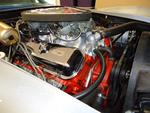
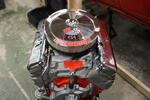
Found a few old pics: Driver's side Passenger's side Better photo of linkage Air cleaner mod (new notch) Modified throttle bracket
2020 Corvette of the Year Finalist (performance mods)
2019 C3 of Year Winner (performance mods)
2016 C3 of Year Finalist
Thanks for the update. I will be looking at some mods in the future for sure. I have progressive linkage for my set up but lacking the front and rear accelerator pumps makes the bog horrendous. I've gone back to the vacuum secondaries for now and I am dealing withe a clogged idle channel on my metering block. I have 2 new ones and will drop one in and see what I get for idle adjustablilty. Its super lean and wont change with the idle mixture screws.
Thanks for the update. I will be looking at some mods in the future for sure. I have progressive linkage for my set up but lacking the front and rear accelerator pumps makes the bog horrendous. I've gone back to the vacuum secondaries for now and I am dealing withe a clogged idle channel on my metering block. I have 2 new ones and will drop one in and see what I get for idle adjustablilty. Its super lean and wont change with the idle mixture screws.
I found my set up on eBay. Sold them there as well. They don’t show up often and go fast. Just checked and just one 4782 center carb available. Probably worth having a search going with alerts.








 Tri power setup pros and cons