When you click on links to various merchants on this site and make a purchase, this can result in this site earning a commission. Affiliate programs and affiliations include, but are not limited to, the eBay Partner Network.
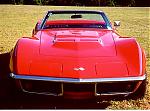
When I disassembled the upper windshield trim when I started the restoration on my '71 Roadster the two chrome upper corner moldings had to be pried off with great difficulty (prybar, large Channellock's, etc) There was a very thick black rubbery adhesive completely filling the entire cavity under the molding on both sides.
It was obviously there in 1976 when I bought the car from the original owner and I have never replaced the windshield or any of the trim parts. After all this time it was still pliable, hadn't hardened and stuck tightly to both the windshield frame and the underside of the molding. Was this normal and part of the manufacturing process and if so, what was the black adhesive so I can fill the cavities when I install the moldings on the new windshield frame?
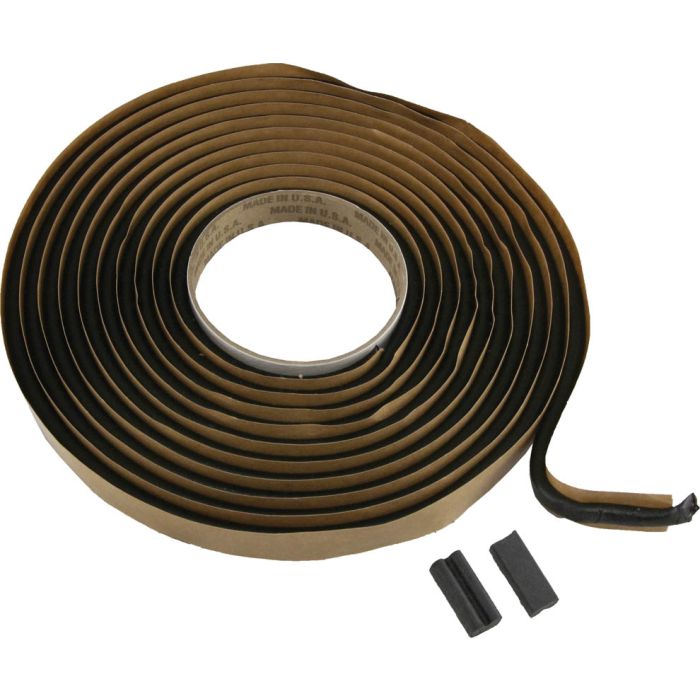
Butyl tape was used to install windshields and the windshield trim on C1's C2's & C3's...
I still prefer it to urethane on these old cars.
New cars use polyurethane that holds like nothing else out there...But you would destroy the windshield and probably rip your birdcage out trying to replace a windshield in the future.
I’ve always used the butyl rope before too but I don’t think the 3M strip caulk was what was in the frame under the molding. It completely filled the cavity which is over an inch deep and wider. It looked like it was applied with a caulking gun.
I’ve always used the butyl rope before too but I don’t think the 3M strip caulk was what was in the frame under the molding. It completely filled the cavity which is over an inch deep and wider. It looked like it was applied with a caulking gun.
Well it could be just about anything if the windshield has been replaced.
I use the tape as a dam on the windshield inside edge of the frame and then apply butyl in a caulk gun outside of that.
So when you look through the windshield you can only see black. After the windshield is installed, I use the caulk gun to go around it and also to seal the stainless trims...
The cars will never see rain again most likely anyway.
Don't need to make them water proof to 30 meters as if it's a submarine...lol
2025 C3 ('68-'73) of the Year Finalist - Unmodified
2024 C3 of the Year Finalist - Unmodified
2023 C3 of the Year Finalist - Unmodified
Originally Posted by n2h2o2
Butyl tape was used to install windshields and the windshield trim on C1's C2's & C3's...
I still prefer it to urethane on these old cars.
New cars use polyurethane that holds like nothing else out there...But you would destroy the windshield and probably rip your birdcage out trying to replace a windshield in the future.
Seems everyone is telling you what they used to install the windshield to the frame.
But the question was, what is used under those upper chrome plated corner sections.
I rebuilt my entire roof and windshield frame about 3 years ago. I was then asking the same question.
And the answer is still 3M strip caulk.
Seems everyone is telling you what they used to install the windshield to the frame.
But the question was, what is used under those upper chrome plated corner sections.
It should be called out in the AIM. In my '72 AIM it's hard to spot which page shows those chrome trim pieces being attached but I think the sealant was #238. The page cross-referencing the numbers to products skips over #238, so the AIM is no help for my copy. Maybe the '71 AIM?
Sounds like someone squirted some windshield sealant in there with a caulking gun. The butyl tape alone couldn't be trusted to seal water so sealant was used also after glass was set in place. Guessing someone got carried away and used an entire tube, then snapped the trim on.
2025 C3 ('68-'73) of the Year Finalist - Unmodified
2024 C3 of the Year Finalist - Unmodified
2023 C3 of the Year Finalist - Unmodified
As my local expert, you might want to reach out to this guy "JOE" @ Fontana's Glass for your questions. He installed my '68 windshield & has been installing them on these cars for a very long time.
Thanks for all the responses. The windshield has never been replaced since I've had the car but I don't know about the original owner. I just like someone emptied an entire tube of caulk/adhesive under the entire chrome molding on both sides. But after 50 years it hadn't hardened. Prior to disassembly the windshield leaked inside the car, but not under the chrome moldings and more to the center. The body mount cavities were also quite clean with little rust so whatever it was, it must have worked.
Thanks for all the responses. The windshield has never been replaced since I've had the car but I don't know about the original owner. I just like someone emptied an entire tube of caulk/adhesive under the entire chrome molding on both sides. But after 50 years it hadn't hardened.
Just FYI, each piece of glass, whether factory or replacement, should carry an etched manufacturer and date code. That will tell you all you need to know about originality. The GM-supplier's maker mark should be LOF (Libby Owens Ford) and a short alpha numeric code for date. Parts counter glass would have also been LOF but would have a date after your car's date.
My '72 is in a similar state regarding the caulking/sealant at the chrome joints. If you read the water testing specs in the AIM, it's a pretty good soaking they had to endure with no leaks. 30 nozzles placed at most a foot or two from the surface, each spraying water at a minimum of 3 gallons per minute for at least 4 minutes. Better to over apply the caulk than send the car back for remedial work.
Thanks for all the responses. The windshield has never been replaced since I've had the car but I don't know about the original owner. I just like someone emptied an entire tube of caulk/adhesive under the entire chrome molding on both sides. But after 50 years it hadn't hardened. Prior to disassembly the windshield leaked inside the car, but not under the chrome moldings and more to the center. The body mount cavities were also quite clean with little rust so whatever it was, it must have worked.
All of these products suggested are butyl.
"3M Strip Caulk" are flat strips of butyl
The windshields were originally set into a round (or oval) butyl bead that was installed on the inside edge of windshield frame.
You can see this in the AIM.
There was also an additional bedding sealant that also appears to be a butyl product. This is NOT shown on the AIM diagram.
However, when you pull out original windshields and trim you see this sealant the OP describes. It is a bedding sealant for the windshield.
It is butyl caulk.
This bedding sealant is important for windshield install because you can look through the windshield and see the bedding and the seal.
This same bedding sealant was used to install and seal the stainless trim.
These are the closest to the original seal and bedding sealant I could find.
Thanks. I've installed windshields and rear windows with the round butyl ribbon but most of what I've seen in threads here is a PSA foam "wall" with 3M adhesive applied on the outer edge with a caulking gun. I've never used that procedure before.
Thanks. I've installed windshields and rear windows with the round butyl ribbon but most of what I've seen in threads here is a PSA foam "wall" with 3M adhesive applied on the outer edge with a caulking gun. I've never used that procedure before.
I believe some like to use the new materials like the foam as a dam to replace the butyl round ribbon and then use a modern urethane windshield ADHESIVE instead of the original butyl bedding SEALANT caulk...
I don't like these NEW materials.
They were made to glue glass to a car and becomes part of the structural integrity of the car.
C3's weren't designed this way.
But the install procedure is the same principle. The round butyl ribbon is applied to the frame and then a caulk bedding is applied to seal the windshield...
The 3M strip caulk is less messy than in a tube, so some might prefer it...
But butyl caulk from a gun is really messy...It gets on everything and sticks to everything...
But, like I said, acetone makes it an easy clean up.
I use a lot of the caulk under the trim and use a rag soaked with acetone to remove the excess and smooth it out nicely.
Good to know. Thanks. I don't have Acetone but I bet Lacquer Thinner works just as well.
I think mineral spirits, kerosene, and WD-40 will also do well (could be mistaken but that's what I remember using with butyl caulking). They won't hurt paint like lac thinner or acetone.
Makes sense. Thanks. Right now I'm not too worried about the paint. It is very custom and was done in the '70's by a guy who worked at Kosmoski's (original Hour of Kolor) I want to replicate the paint job so am leaving it as it (very old and faded) but figure I will have a lot of difficulty finding someone these days who can do it.







 Rubbery Adhesive in windshield frame